
Tulkarem and Qalqiliya, Mon 22.10.07, Morning
Tulkarm checkpoints
Irtah 7:45
At the request of our guest, who is working on a piece about the privatized checkpoints, we began at Irtah, but got there late because of transportation problems.
All the laborers have already gone through, and we observed and conversed with families of inmates who were on their way to visit their relatives. According to the reports of the drivers and the few laborers who were still waiting for their employers, the checkpoint opened today at 4:30 and laborers started to get through at around 5:15, and that's good. But the complaints about long stays in the "rooms" and, thus, the delaying of other laborers and the loss of work time, remain constant.
Uriel interviewed some Palestinians and the Red Cross representative on site, who supervises inmate family visits, and then we went on to Anabta. (Because of shortage in time we skipped Ar-Ras today.)
Anabta 8:45
There's a queue of 22 cars at the entrance to Anabta; it is unclear why that is, because, in effect, there's almost no inspection, and indeed, within ten minutes of our arrival the queue dissolves.
At the exit from Tulkarm there's a queue of around 15 cars. The soldiers take a break between one hand motion and the next, and so a queue is forming. Also, there's an unending stream of cars leaving Tulkarm and that's why there are around 15 cars at all times.
A family is picking olives between the road and the hill where the settlement Einav sits. Another family is picking olives near the checkpoint, and they call us over, and after mutual greetings they ask whether we could help. The families are from the village of Ramin and one brother is from Israel. They arranged with the checkpoint commander to come pick olives on their land, which stretches all the way to the settlement's fence; but when they approached the fence, some settlers came out, and threatened them and drove them away. When they went back to the checkpoint, the checkpoint commander said that he can't spare soldiers from the checkpoint to protect them. I gave them the phone number of the army hotline as a procedural step, but more to the point I consulted with Tami and with her consent established contact between them.
9:10 the taxi problem is solved and the coffee vendor walks around with the coffee pot. We leave for Beit Iba.
'Anabta CP
See all reports for this place-
'Anabta CP
The checkpoint is located south of the village of 'Anabta, at the intersection of Road 60 (leading to Nablus at the entrance to Area A), with Road (57, 557, 5576) facing west towards the Einav settlement and the checkpoint at the exit from the West Bank - Figs checkpoint. Until 2010 we used to watch the intersection and report the long columns created due to a slow inspection of the vehicles in both directions.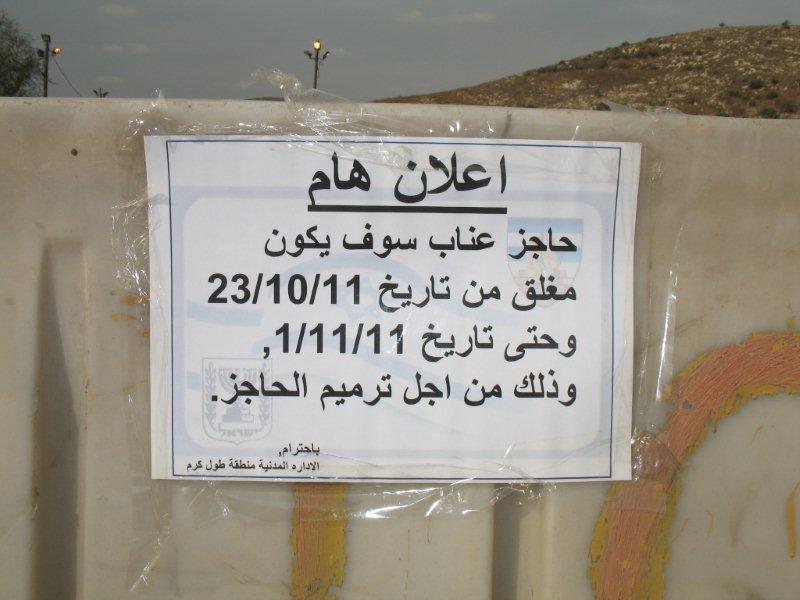 Oct-28-2011Anabta checkpoint 24.10.11
-
Irtah (Sha'ar Efrayim)
See all reports for this place-
The checkpoint is for Palestinians only. It is the main barrier to the passage of workers from the northern West Bank to Israel. Workers with a permit to work in Israel and also for trade (with appropriate permissions), medicine, and visiting prisoners. One can cross the checkpoint only on foot. The checkpoint is located north of Road 557 and south of Tulkarm. Operated by a civil security company, opening hours: between 4:00 and 19:00 on weekdays. As members of Machsom Watch, we began our shifts to this location in 2007. We arrived before it opened at 4 in the morning and report since, on the harsh conditions and the long and crowded queues of workers. The workers who pass by continue their journey by transportation to work throughout Israel. In the first period of its activity, about 3,000 and then 5,000 people passed through this checkpoint every day. Due to the small number of checking points and arbitrary delays for long periods of time in the "rooms", workers feared losing their transportation. Hence workers leave their homes at 2:30 at night to be among the first. Today, 15,000 pass and the transition is faster. Workers are still leaving their homes very early to get past the checkpoint at 7 p.m. In an adjacent compound, there is a terminal for the transfer of goods on a commercial scale, using the back-to-back method.
-
