
Tulkarm area
Tulkarm area, Eyal Passage, Irtah Passage, Jubara upper gate, Ar-Ras, Anabta, Wednesday, January 24, 2007, a.m.Observers: Naty, Inbal R. (reporting)Translation: Galia S.OverallVery difficult conditions at Eyal Passage. Improved flow of traffic at the Tulkarm area.Eyal Passage06:55 – The passage serves workers with permits to work in Israel, merchandise transport and families of prisoners. This report is based on stories we have heard from some fifteen workers and contractors we had talked to at the Eyal parking lot.The workers wait three hours for the inspection at the terminal. Many get there as early as 03:30 in the morning. The terminal opens at 04:00, but well before the opening, there is already a long line of nervous people. This morning some workers have been slightly hurt being crushed against the fence as a result of pushing.Some of the workers sleep in front of the terminal gate. It usually involves those who came from the area of Nablus, who having to wait for the checkpoints on their way to open, may be late in leaving Eyal. The Israeli contractors will find other workers and they will lose a workday.One of the workers who lives in the Jordan Valley has told us that he gets up at 02:30 at night and passes four checkpoints (Juftlik, Hamra, Ein Bidan, Huwwara) before he finally gets to the line at Eyal.To our question how many workers pass at Eyal every day, we get different answers – between 2500 and 5000 or even 7000. In any case, it is a very busy passage, even more than Irtah.What causes the delay in the inspections? Again here we have heard different opinions. Some put the blame on frequent replacement of the soldiers that carry out the inspections who sometimes examine a standard form for fifteen minutes. This claim sounds plausible. The Irtah passage is run by a private company that has permanent workers who have acquired skill in inspections, whereas the Eyal Passage is run by the army that send soldiers in rotation. One can only guess the mood of the soldiers, woken up in the middle of the night, who have no experience in a quick examination of documents of thousands of people and perhaps not too much motivation either. It is possible that at 04:00 in the morning, there are soldiers who stare at the papers.Another reason for the delay is the repeated failures of the new biometric equipment (which records physiological parameters). The equipment reads the back of the hand and not the palm. That of workers is usually wounded.The equipment has been operated experimentally both at Eyal and at Irtah.To judge from unofficial talks with the person in charge of the checks, it is not considered a success story.The last reason for the delay we saw with our own eyes as we were standing at the terminal gate: Only three out of eight inspection posts were manned. An additional remark concerning the biometric equipment: In case of disparity between his print on the computer and the one on the screen of the equipment at the terminal, the worker is sent to the DCO [District Coordination Office of the IDF Civil Administration that handles passage permits].After the DCO confirms his identity, the worker has to pay IS 130.00 for correcting the print on the computer. In our opinion the state of Israel has the right to add another method of checking to the inspections and operate an experimental system. However, it is unreasonable to force the poor Palestinian workers to pay the price of the experiment. This distortion is only due to the fact that the workers have no choice and no power to confront the system.Irtah Passage07:30 – We arrived late. Few workers were waiting at the lot. It seems that this morning the passage functioned well without special incidents. We talked on the phone with the man in charge of the facility on behalf of the Ministry of Defence in order to find out what was going on at the merchandise passage. According to written reports and also to what a Nablus reporter told us, the merchandise passage (back-to-back) [transfer of merchandise between vehicles that can’t cross the checkpoint] at Awarta had closed and all the transportation of goods in the area had been turned to Irtah. We asked Ministry of Defence representative how the Irtah passage was dealing with the additional load of work and why the trucks weren’t sent also to Eyal Passage. The answer was surprising: Until noon today, no truck that had been unloaded before at Awarta arrived at Irtah.The solution of the mystery is probably linked with a report of “Betselem” [The Israeli Information Center for Human Rights in the Occupied Territories] on which Hagar L. relied when she distributed in the net that Israeli drivers refuse to bring merchandise to Irtah because the customs officers and the Ministry of Health representatives that are there check the food.If it is some kind of strike, when and how should the food reach Nablus?Jubara, Upper Gate (what used to be the Agricultural Gate)07:50 – The passage is open 24 hours a day and serves only those who have special authorization to enter Jubara.
Huwwara
See all reports for this place-
The Huwwara checkpoint is an internal checkpoint south of the city of Nablus, at the intersection of Roads 60 and 5077 (between the settlements of Bracha and Itamar). This checkpoint was one of the four permanent checkpoints that closed on Nablus (Beit Furik and Awarta checkpoints to the east and the Beit Iba checkpoint to the west). It was a pedestrian-only barrier. As MachsomWatch volunteers, we watched therre since 2001 two shifts a day - morning and noon, the thousands of Palestinians leaving Nablus and waiting for hours in queues to reach anywhere else in the West Bank, from the other side of the checkpoint the destination could only be reached by public transport. In early June 2009, as part of the easing of Palestinian traffic in the West Bank, the checkpoint was opened to vehicular traffic. The passage was free, with occasional military presence in the guard tower. Also, there were vehicle inspections from time to time. Since the massacre on 7.10.2023, the checkpoint has been closed to Palestinians.
On February 26, 2023, about 400 settlers attacked the town's residents for 5 hours and set fire to property, such as houses and cars. Disturbances occurred in response to a shooting of two Jewish residents of Har Bracha by a Palestinian Terrorist. The soldiers stationed in the town did not prevent the arson and rescued Palestinian families from their homes only after they were set on fire. No one was punished and Finance Minister Smotrich stated that "the State of Israel should wipe out Hawara." Left and center organizations organized solidarity demonstrations and support actions for the residents of Hawara.Hawara continued to be in the headlines in all the months that followed: more pogroms by the settlers, attacks by Palestinians and a massive presence of the army in the town. It amounted to a de facto curfew of commerce and life in the center of the city. On October 5, 2023, MK Zvi established a Sukkah in the center of Hawara and hundreds of settlers backed the army blocked the main road and held prayers in the heart of the town all night and the next day. On Saturday, October 7, 23 The "Swords of Iron" war began with an attack by Hamas on settlements surrounding Gaza in the face of a poor presence of the IDF. Much criticism has been made of the withdrawal of military forces from the area surrounding Gaza and their placement in the West Bank, and in the Hawara and Samaria region in particular, as a shield for the settlers who were taking over and rioting.
On November 12, 2023, the first section of the Hawara bypass road intended for Israeli traffic only was opened. In this way, the settlers can bypass the road that goes through the center of Hawara, which is the main artery for traffic from the Nablus area to Ramallah and the south of the West Bank. For the construction of the road, the Civil Administration expropriated 406 dunams of private land belonging to Palestinians from the nearby villages. The settlers are not satisfied with this at the moment, and demand to also travel through Hawara itself in order to demonstrate presence and control.(updated November 2023)
.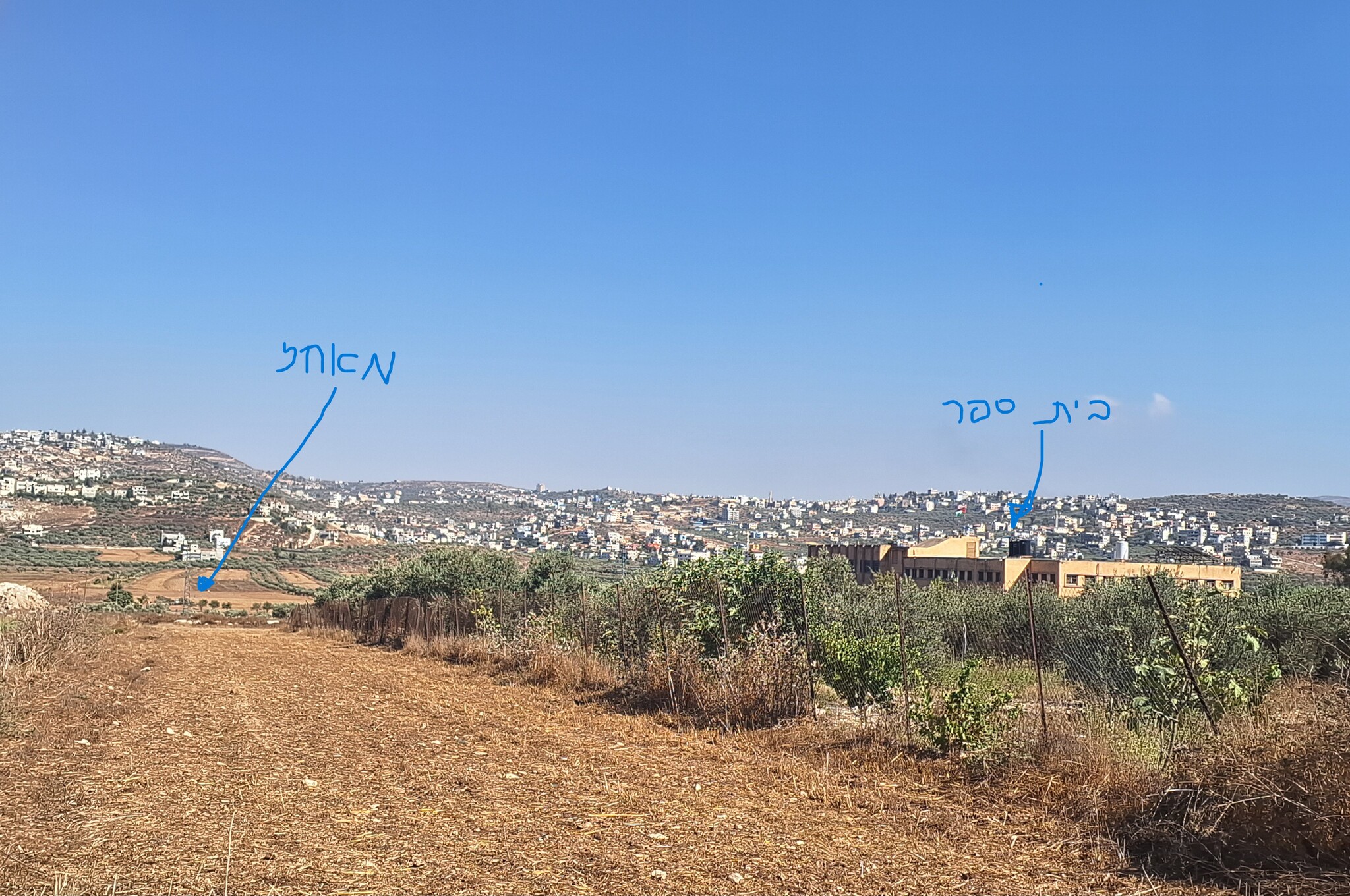 Ronit Dahan-RamatiAug-24-2026Huwara: The school on the outskirts of town and an outpost hidden among the trees
-
Jordan Valley
See all reports for this place-
Jordan Valley The Jordan Valley is the eastern strip of the West Bank. Its area consists of almost a third of the West Bank area. About 10,000 settlers live there, about 65,000 Palestinian residents in the villages and towns. In addition, about 15,000 are scattered in small shepherd communities. These communities are living in severe distress because of two types of harassment: the military declaring some of their living areas, as fire zones, evicting them for long hours from their residence to the scorching heat of the summer and the bitter cold of the winter. The other type is abuse by rioters who cling to the grazing areas of the shepherd communities, and the declared fire areas (without being deported). The many groundwaters in the Jordan Valley belong to Mekorot and are not available to Palestinians living in the Jordan Valley. The Palestinians bring water to their needs in high-cost followers.Rachel AfekOct-8-2026Jordan Valley. Widening of Road 505
-
