
Umm al-Kheir: Final demolition orders for many buildings
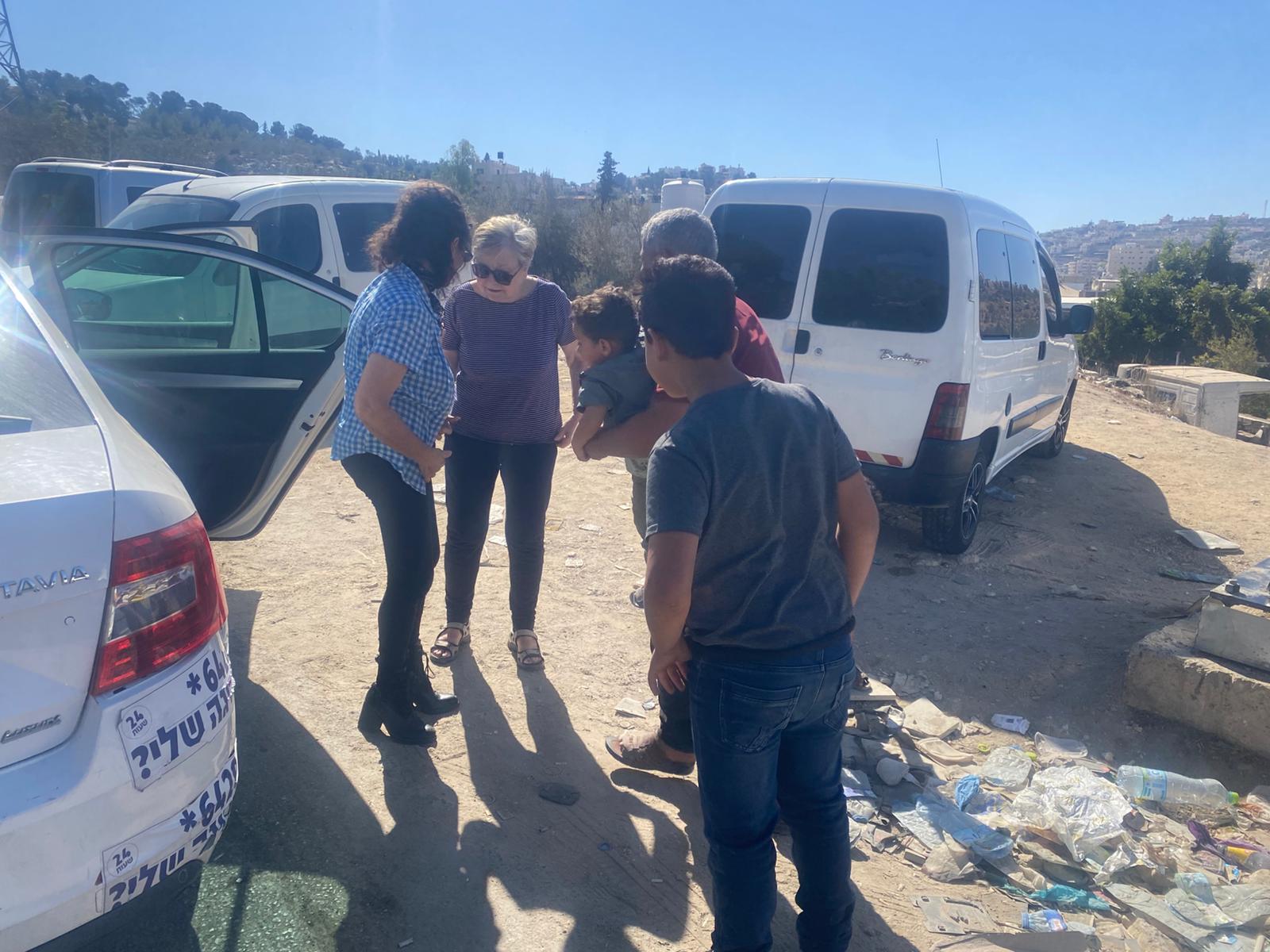
This time we’re driving through Tarqumiyah (known as the Lachish Checkpoint) to meet N., near the village of Idna, as we’ve done several times since October 7th.
N. used to work in Israel, and like tens of thousands of Palestinians who have not been working since then, he has no means of basic livelihood — without financial assistance, they won’t survive.
N., my friend, assists him, and we add contributions — clothes, shoes, household items, bedding, and toys.
He’s a good man, always embarrassed by the need to receive help. He’s a person who gives endlessly. Our meetings with him are brief because of the heavy presence of the army and police everywhere. Entering the villages is, of course, out of the question — everything is blocked.
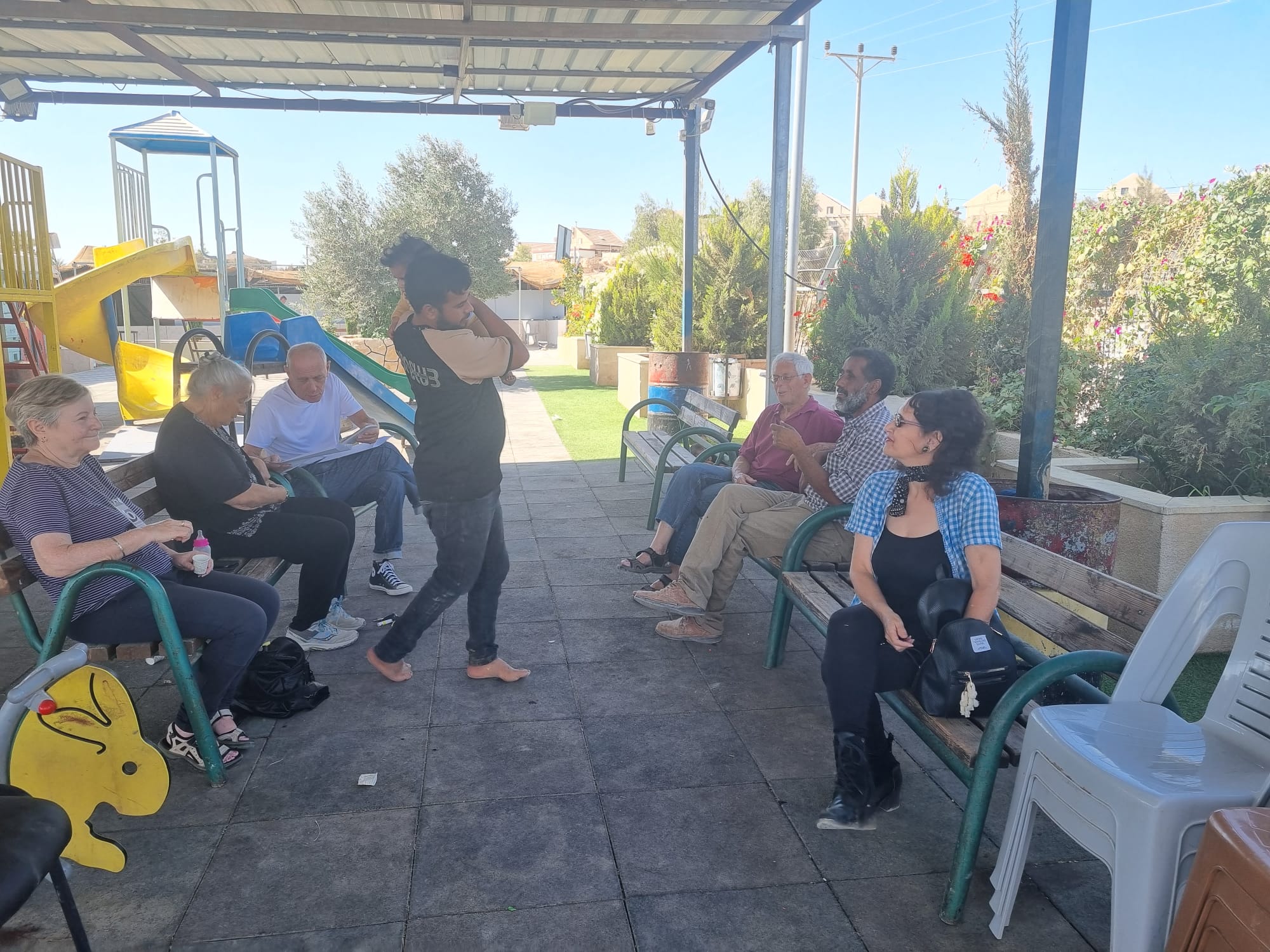
From there, we continued to Nabil’s grocery store, where we bought food supplies for the people of Umm al-Kheir, as we usually do.
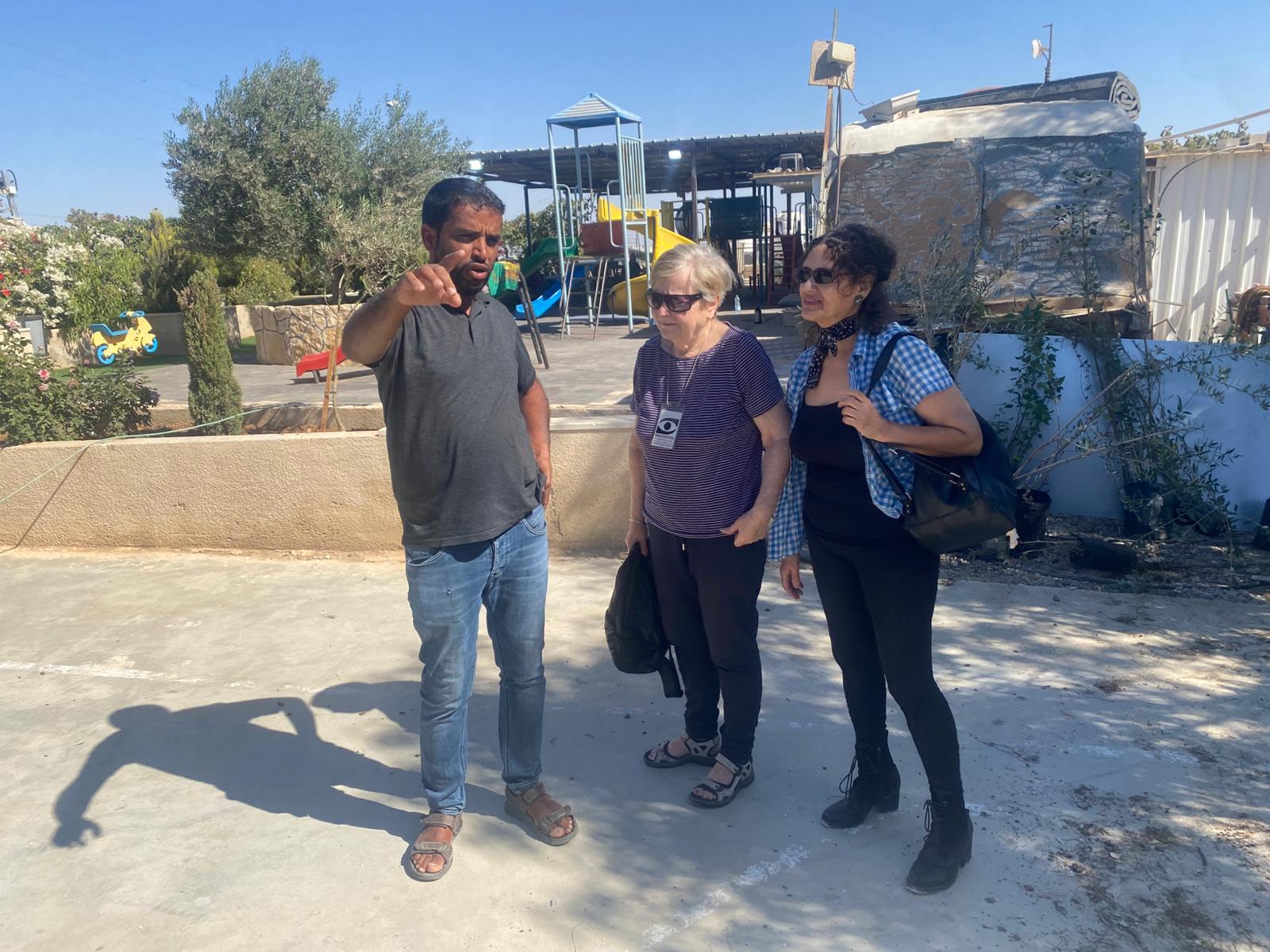
In Umm al-Kheir, we were greeted by Khalil al-Hathalin, who speaks English and gives N. and me an overview of the worsening situation.
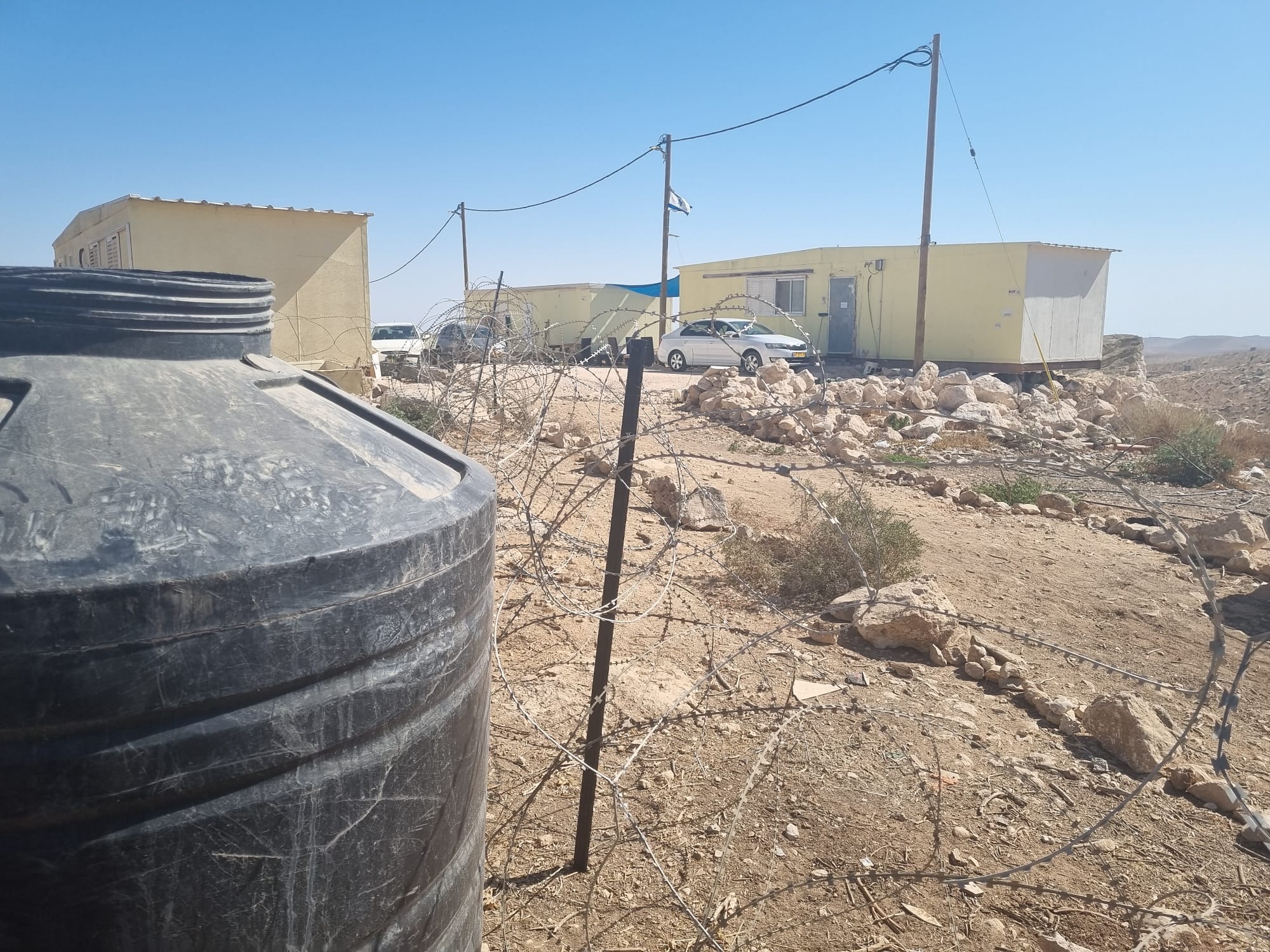
He leads us to see the outpost next to their community center — the same outpost for which the excellent attorney Michael Sfard managed to obtain a court order to stop the construction.
Unfortunately, there is no law and order in the occupied territories and no enforcement. You can see photos of cars next to every caravan. The settlers act as they please.
Let me remind you — this is the area that was cleared with heavy machinery owned by Yinon Levy, the murderer who cold-bloodedly killed Odeh al-Hathalin, a man of peace, in July of this year.
Khalil tells us about the relentless violence from nearby settlers, whose sole goal is to expel the residents of Umm al-Kheir and complete their takeover of the entire area. It should be noted that, thanks to government policy — led by Smotrich and Ben Gvir — this is indeed happening.
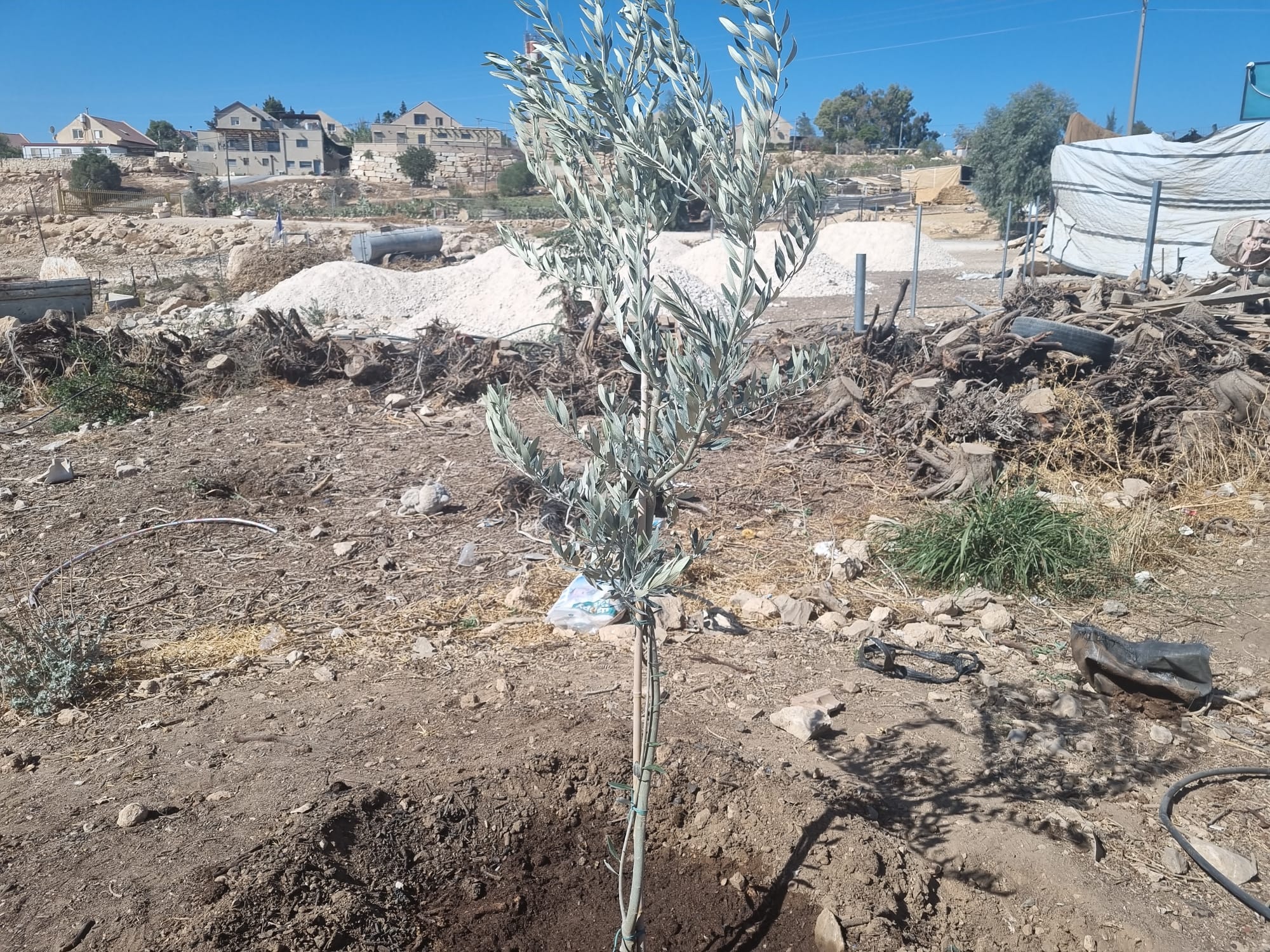
Despite everything, they planted an olive tree (see photo), and more saplings are waiting nearby to be planted. There is hope.
A bit later, Erela from the Villages Group arrived with two of her friends — activists who have worked and fought long and hard for the people of Masafer Yatta.
We got back into the car, burdened with heaviness and pain over what is happening — and what will happen.
The situation deteriorates day by day, and as proof, the day after our visit, the residents of Umm al-Kheir received demolition orders.
Attached are details from a message that was shared on social networks.
You can’t really call this life.
#ThisIsTheOccupation
Michael Sfard’s post: https://www.facebook.com/share/p/1BR3KikwzN/
Haaretz article about court order to halt building the settlers’ outpost
A video posted by Tareq al-Hathalin about the issuance of demolition orders
https://www.facebook.com/share/v/1BwDXAWhSo/
Notice posted by residents of Umm al-Kheir:
Please share widely with any/all relevant contacts in media, government, diplomacy, NGOs, etc: Occupation Forces and the Civil Administration Raid Umm al-Khair in Masafer Yatta, Delivering Dozens of Final Demolition Orders*
Masafer Yatta – Israeli occupation forces, accompanied by personnel from the Civil Administration, raided Khirbet Umm al-Khair, east of Yatta, on Tuesday morning and handed residents a series of final demolition orders, in what locals fear is a prelude to a large-scale demolition campaign in the coming days.
Residents reported that the orders targeted several homes and community facilities, as follows:
• Umm al-Khair Community Center – Final demolition order.
• Greenhouse, approximately 500 square meters, owned by Khalil Mohammad al-Hathaleen – Final demolition order.
• Yasser Eid al-Hathaleen – Residential house, final demolition order.
• Sara Eid al-Hathaleen – Residential house, final demolition order.
• Khalil Shuaib al-Hathaleen – Residential house, final demolition order.
• Kheirallah Suleiman al-Hathaleen – Residential house, final demolition order.
• Hussam Salem Eid al-Hathaleen – Residential house, final demolition order.
• Bilal Salem Eid al-Hathaleen – Residential house, final demolition order.
• Zayed Suleiman al-Hathaleen – Residential house, stop-work order.
• Mousa Suleiman al-Hathaleen – Residential house, final demolition order.
• Eid Suleiman al-Hathaleen – Residential house, final demolition order.
• Maliha Hamad al-Hathaleen – Residential house, final demolition order.
• Omar Suleiman al-Hathaleen – Residential house, final demolition order.
• Khadra Suleiman al-Hathaleen – Bathroom facility, final demolition order.
Khirbet Umm al-Khair is one of the most repeatedly targeted Bedouin communities in Masafer Yatta, having endured more than 20 demolition operations since 2007, during which over 100 residential, agricultural, and public structures were destroyed — the most recent occurring in February 2025.
Today, the community once again faces the looming threat of demolition and forced displacement under the policies of the Israeli occupation, placing the residents’ very existe
Location Description
Mesafer Yatta
See all reports for this place-
This is happening in Fire Area 918 in the South Hebron Hills
On the eve of Remembrance Day (the day before Israel Independence Day), 4th May, 2022, the Israeli High Court decided on the transfer and expulsion of residents from 8 Palestinian communities in the area of Masafar Yata in the South Hebron Hills. Residents of the villages have been living under the threat of demolition, evacuation and expropriation since the IDF issued evacuation orders in 1999 based on the 1980s proclamation of their area of residence as a firing zone for IDF drills. None of the nearby settlements were included in this zone. The Masafer Yata Palestinian villages retain a special lifestyle and ancient agricultural culture. They also posess a clear historical documentation that testifies to a Palestinian settlement in this area, generations before the establishment of Israel, long ago in the caves and at later times outside them.
Evacuating residents from the area means destroying these historic villages and leaving entire families (about 2,000 people, children, adults, and the elderly) homeless. This is contrary to international law.
In June 2022, a firing drill started, and life became harder.
-
South Hebron Hills
See all reports for this place-
South Hebron Hills
South Hebron Hills is a large area in the West Bank's southern part.
Yatta is a major city in this area: right in the border zone between the fertile region of Hebron and its surroundings and the desert of the Hebron Hills. Yatta has about 64,000 inhabitants.
The surrounding villages are called Masafer Yatta (Yatta's daughter villages). Their inhabitants subsist on livestock and agriculture. Agriculture is possible only in small plots, especially near streams. Most of the area consists of rocky terraces.Since the beginning of the 1980s, many settlements have been established on the agricultural land cultivated by the Palestinians in the South Hebron Hills region: Carmel, Maon, Susia, Masadot Yehuda, Othniel, and more. Since the settlements were established and Palestinians cultivation areas have been reduced; the residents of the South Hebron Hills have been suffering from harassment by the settlers. Attempts to evict and demolish houses have continued, along with withholding water and electricity. The military and police usually refrain from intervening in violent incidents between settlers and Palestinians do not enforce the law when it comes to the investigation of extensive violent Jewish settlers. The harassment in the South Hebron Hills includes attacking and attempting to burn residential tents, harassing dogs, harming herds, and preventing access to pastures.
There are several checkpoints in the South Hebron Hills, on Routes 317 and 60. In most of them, no military presence is apparent, but rather an array of pillboxes monitor the villages. Roadblocks are frequently set up according to the settlers and the army's needs. These are located at the Zif Junction, the Dura-al Fawwar crossing, and the Sheep Junction at the southern entrance to Hebron.
Updated April 2022
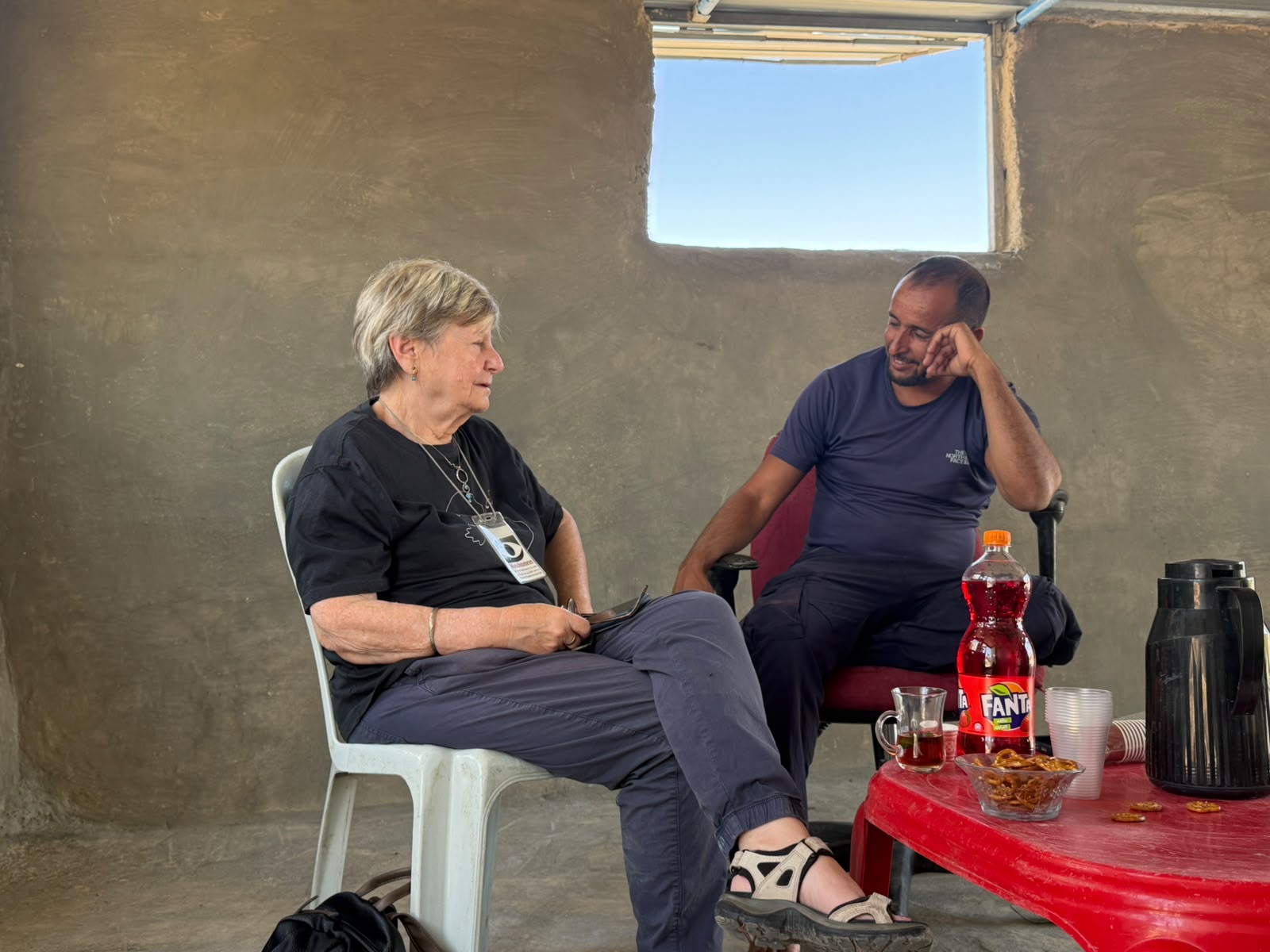 Muhammad D.Oct-10-2026Smadar with Najeh in Umm Qusa
-
Tarqumiya CP
See all reports for this place-
The Tarqumiya Checkpoint is one of the largest and busiest checkpoints where people and goods cross into Israel. It is located on the Separation Barrier close to the Green Line, on Road 35 (connecting Beer Sheva and Hebron). It is run by the Israel Defense Ministry’s Crossings Administration with civilian secuirty companies running the day to day operations. The checkpoint is indeed open to vehicles in both directions 24/7, but Palestinians are prevented from crossing in vehicles, except in special cases. MachsomWatch activists visit the checkpoint as it opens at 3:45 am, in order to observe the daily passage of nearly 10,000 Palestinian workers. The workers arrive from throughout the Southern West Bank. Our activists report on the tremendous overcrowding at this checkpoint; they have observed young men climbing and scrambling on the fences and roofs of the ‘access cages’. This is how the work day begins for those who ‘build the land of Israel’. updated November 2019
-
Umm al-Khair
See all reports for this place-
Umm al-Kheir
A Palestinian village in the southern Hebron governorate, populated by five families. The Palestinian residents settled there decades ago, after Israel expelled them from the Arad desert and purchased the land from the residents of the Palestinian village of Yatta. The village suffers from the violence of nearby Carmel settlers, from water shortage and is subject to frequent demolition of buildings by the Civil Administration.
-
