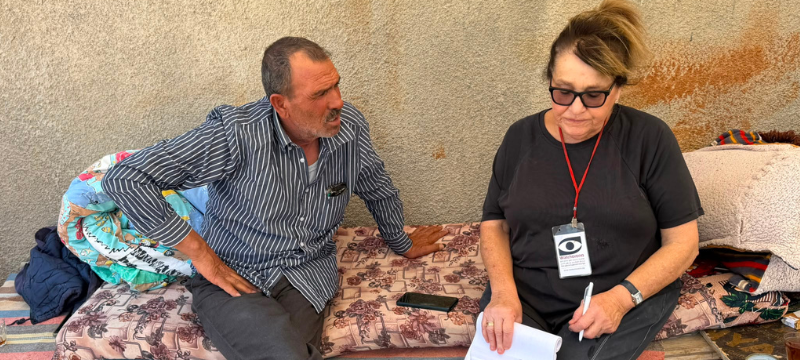
Umm al-Khair - Invisible cruelty far from sight
Unimaginable cruelty out of sight
We went to Umm al-Khair to visit our dear friends, the Hadalin family, after five difficult and violent days of encounters with settlers from Carmel’s Barkai neighborhood and people from Shorashim Farm.
We brought what they needed for the community center, a donation from a vegetable shop in Lakiya, and, as always, donations of clothing and equipment collected by Smadar.
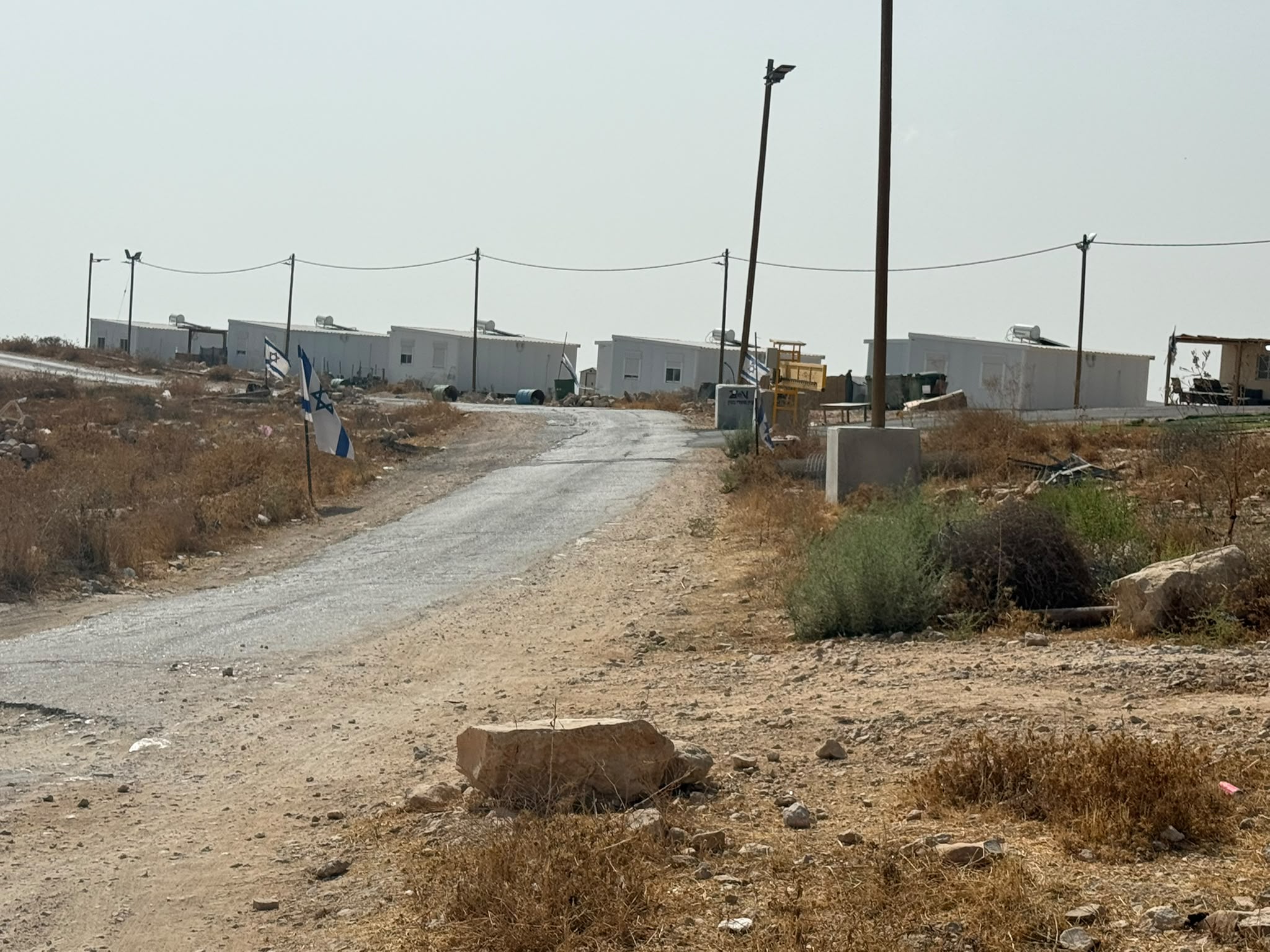
The entrances to the communities along Highway 60 are closed. At Hebron’s southern entrance, at Sheep Junction, there is a conspicuous military presence. Along the entire highway, new Israeli flags fly in dense, aggressive and visually jarring rows.
We arrived at Umm al-Khair’s well-kept community center. E׳ and his companions welcomed us with sad, tired eyes. On Wednesday, settlers from the Barkai neighborhood, who crowd up against them and try to choke them out and drive them away, came and lit a bonfire at midnight beside the window of S׳’s daughter’s room. The fire and smoke forced her to close the window, making it difficult to breathe, and the area was immediately declared a closed military zone. “They are allowed to burn and suffocate us,” says S׳.
At five in the morning, the settlers arrived with an opaque blue plastic sheet and covered the window. They banged on the 18-year-old young woman’s window. “You’re not allowed to look at us,” they said. “You’re not allowed to film.” Later, they came and took his wife away “politely,” he says with a smile, because a policewoman accompanied them and led her away quietly.
Only when they brought her to the police vehicle did they handcuff and blindfold her, then take her to the base in Susiya. Why? Perhaps because she had dared to shout at them to leave. At the base, they kept her seated on a chair for five hours, handcuffed and blindfolded.
She sat there in fear, also because she could hear dogs barking and approaching around her. No one spoke to her or questioned her. No one offered her a glass of water or a chance to use the toilet. After five hours, toward evening, they released her outside the base in a deserted field. From there, she called her husband to come and take her home.
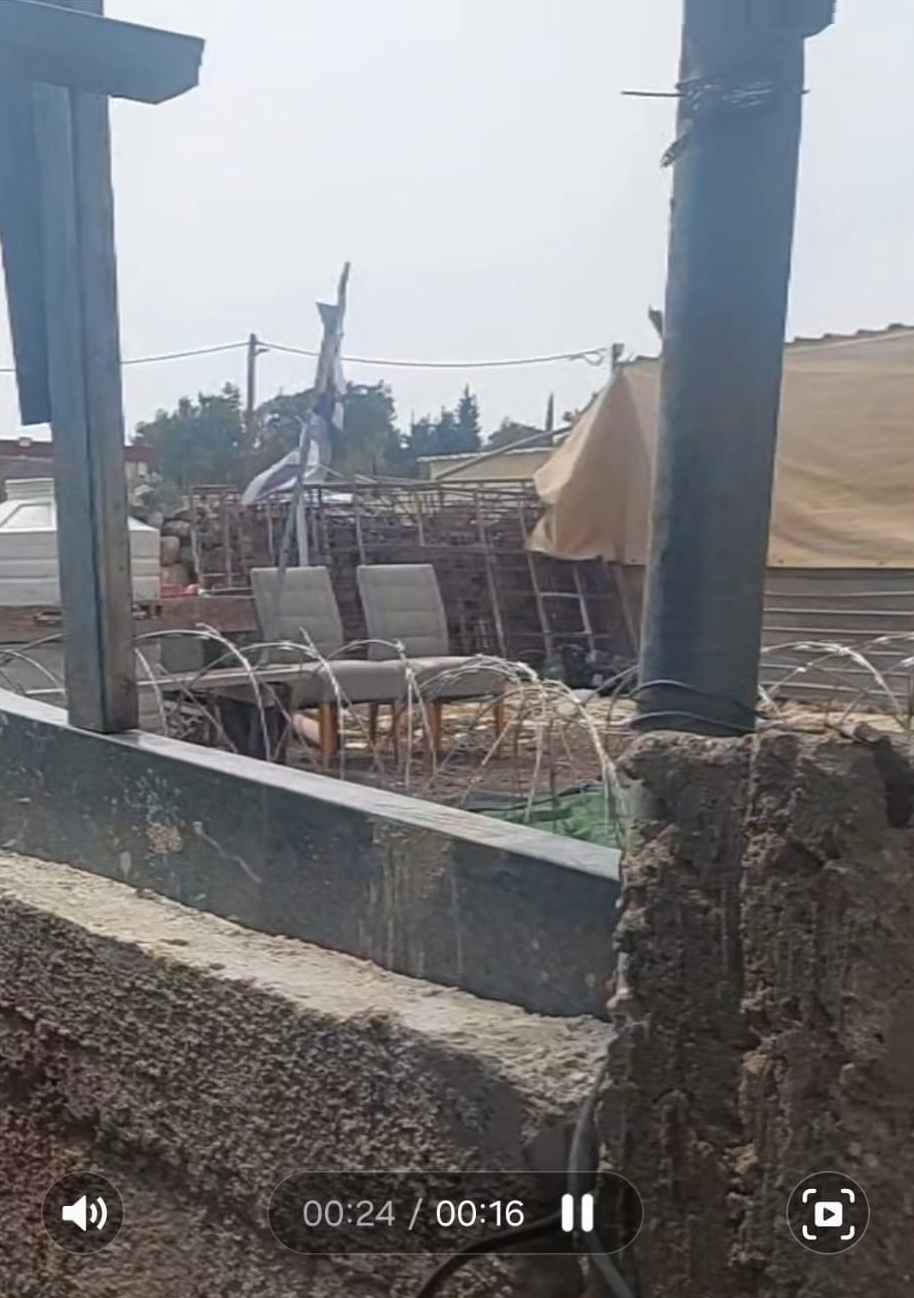
As a reminder, the residents of Umm al-Khair are barred from approaching the sheep pen adjoining their homes, the toilet structure and the swing. This is a closed military zone! To feed the sheep confined in the pen, they must ask the neighboring settlers for permission and coordinate with them.
Unimaginable cruelty out of sight.
Shimon Atiya from Shorashim Farm, his youths and the shepherd Matan brought their flock onto the Palestinian shepherds’ piles of straw, breaking them apart and ruining them. Atiya does this mainly to make his sheep mingle with the Palestinians’ sheep, so that when he moves them, the flocks will be inextricably mixed. “We guarded the sheep,” says A׳. “We kept them from moving for two hours so this wouldn’t happen. Eventually, they left.”
But half an hour later, they returned, claiming that one of their sheep was missing…
That was sufficient reason to summon the army and police and search every home. Four jeeps and a Savana van arrived; 30 soldiers and 12 Border Police officers came to look for a sheep.
Of course, they did not find the sheep, but E׳ heard Atia say on the phone: “It may have got lost on the road when we were bringing the flock back.”
“But for two hours they drove us mad, treated us like thieves,” says the gentle E׳, deeply hurt.
Having found nothing, they declared the entire village a closed military zone from Thursday until Sunday afternoon.
“Do you understand?” he says to me. “We are all terrorists, and they, the attackers, are the poor victims. It’s all a performance. They wear us down, but they won’t succeed. We won’t leave.”
This is the routine everywhere in this no-man’s-land.
On the way back, already far from the village, we again saw a settler shepherd with his flock in an olive grove belonging to the Jabareen family from Shaab al-Butum. The sheep were devouring the olive trees’ foliage and whatever fruit remained.
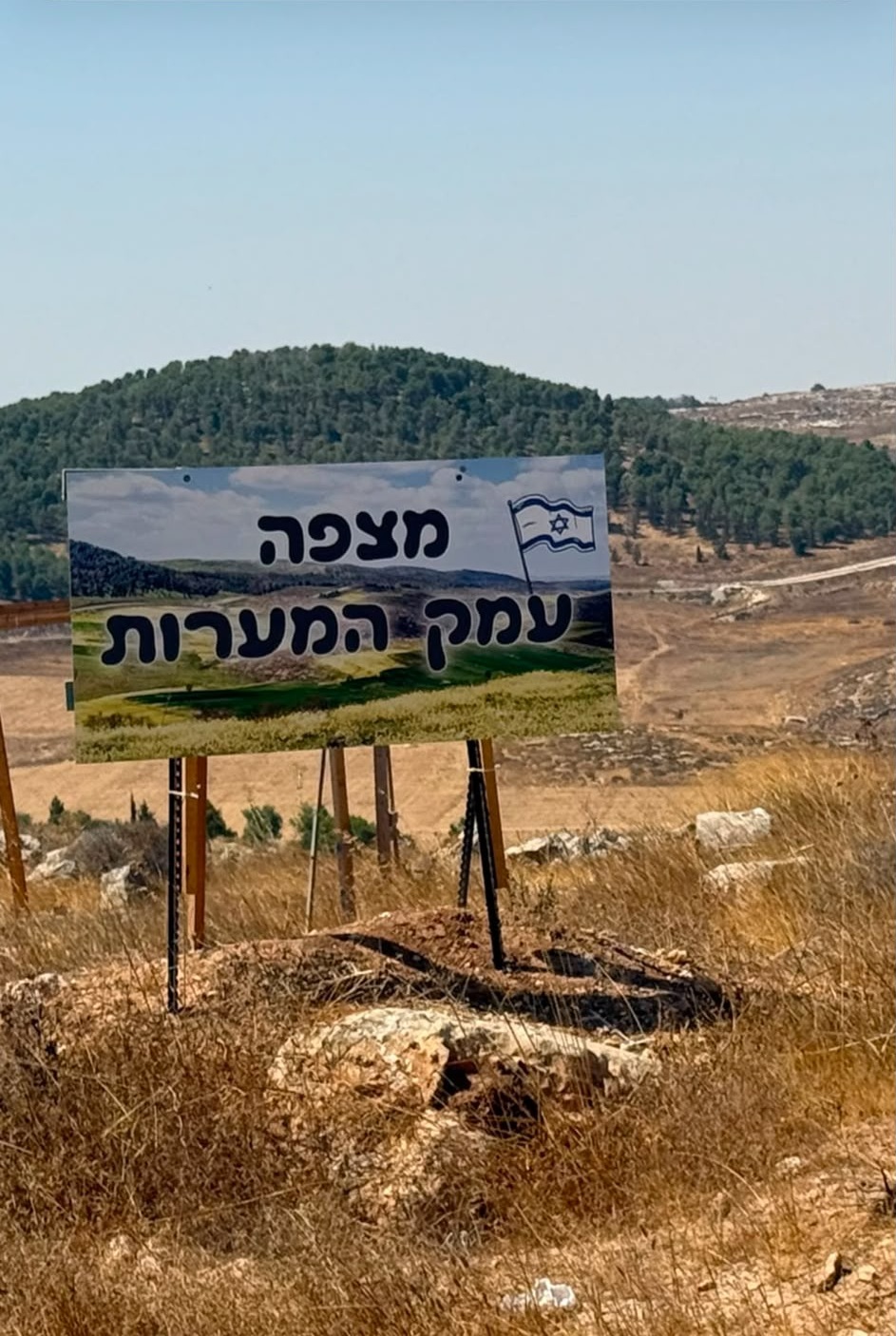
Farther along the road, a sad reminder of the devastation suffered by the family of our late friend Abu Safi: on the left lies Wadi Radim, once his home. Now a large sign stands beside the road: “Valley of the Caves Lookout.” That is what the settlers now call this place.
Location Description
Hakvasim (sheep) Junction
See all reports for this place-
One of the roadblocks (earthworks, rocks, concrete blocks or iron gates) that prevent transit of vehicles to Route 60 in the southern West Bank and block the southern entrance to Hebron. A manned pillbox supervises the place.
-
Hebron
See all reports for this place-
According to Wye Plantation Accords (1997), Hebron is divided in two: H1 is under Palestinian Authority control, H2 is under Israeli control. In Hebron there are 170,000 Palestinian citizens, 60,000 of them in H2. Between the two areas are permanent checkpoints, manned at all hours, preventing Palestinian movement between them and controlling passage of permit holders such as teachers and schoolchildren. Some 800 Jews live in Avraham Avinu Quarter and Tel Rumeida, on Givat HaAvot and in the wholesale market.
Checkpoints observed in H2:
- Bet Hameriva CP- manned with a pillbox
- Kapisha quarter CP (the northern side of Zion axis) - manned with a pillbox
- The 160 turn CP (the southern side of Zion axis) - manned with a pillbox
- Avraham Avinu quarter - watch station
- The pharmacy CP - checking inside a caravan with a magnometer
- Tarpat (1929) CP - checking inside a caravan with a magnometer
- Tel Rumeida CP - guarding station
- Beit Hadassah CP - guarding station
Three checkpoints around the Tomb of the Patriarchs
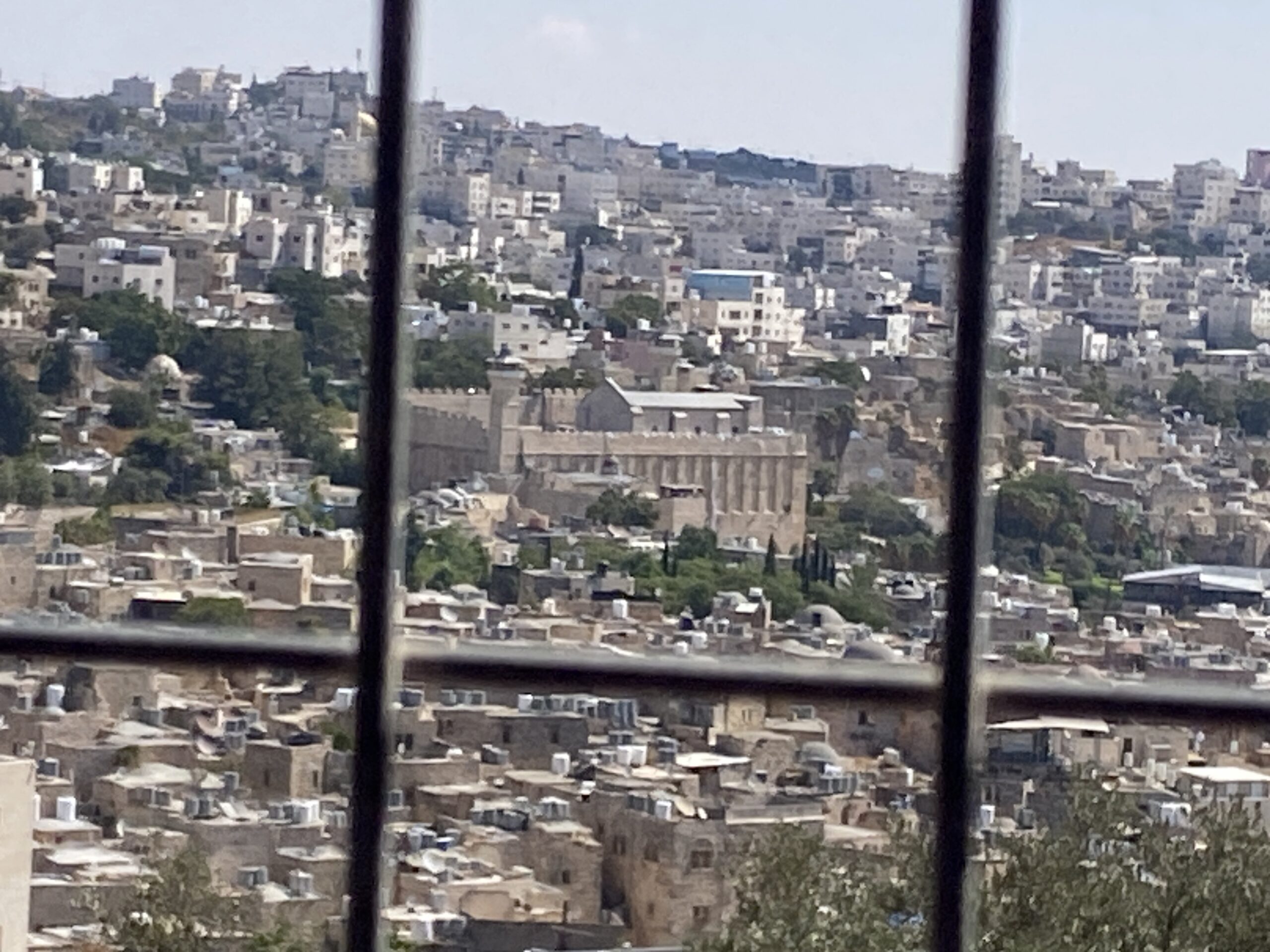 Yael ZoranSep-24-2026Hebron and the Cave of the Patriarchs from Beit Hashalom
-
South Hebron Hills
See all reports for this place-
South Hebron Hills
South Hebron Hills is a large area in the West Bank's southern part.
Yatta is a major city in this area: right in the border zone between the fertile region of Hebron and its surroundings and the desert of the Hebron Hills. Yatta has about 64,000 inhabitants.
The surrounding villages are called Masafer Yatta (Yatta's daughter villages). Their inhabitants subsist on livestock and agriculture. Agriculture is possible only in small plots, especially near streams. Most of the area consists of rocky terraces.Since the beginning of the 1980s, many settlements have been established on the agricultural land cultivated by the Palestinians in the South Hebron Hills region: Carmel, Maon, Susia, Masadot Yehuda, Othniel, and more. Since the settlements were established and Palestinians cultivation areas have been reduced; the residents of the South Hebron Hills have been suffering from harassment by the settlers. Attempts to evict and demolish houses have continued, along with withholding water and electricity. The military and police usually refrain from intervening in violent incidents between settlers and Palestinians do not enforce the law when it comes to the investigation of extensive violent Jewish settlers. The harassment in the South Hebron Hills includes attacking and attempting to burn residential tents, harassing dogs, harming herds, and preventing access to pastures.
There are several checkpoints in the South Hebron Hills, on Routes 317 and 60. In most of them, no military presence is apparent, but rather an array of pillboxes monitor the villages. Roadblocks are frequently set up according to the settlers and the army's needs. These are located at the Zif Junction, the Dura-al Fawwar crossing, and the Sheep Junction at the southern entrance to Hebron.
Updated April 2022
Michal TsadikOct-12-2026Umm al-Khair - Concertina wire and fences
-
Umm al-Khair
See all reports for this place-
Umm al-Kheir
A Palestinian village in the southern Hebron governorate, populated by five families. The Palestinian residents settled there decades ago, after Israel expelled them from the Arad desert and purchased the land from the residents of the Palestinian village of Yatta. The village suffers from the violence of nearby Carmel settlers, from water shortage and is subject to frequent demolition of buildings by the Civil Administration.
-