
Yesterday, after the attack at Yehuda Junction, the army arrived in Hebron and evacuated 200 families who were transferred to schools and community centers
Saturday. The settlers are working — and how they are working!
Following the attack near Hebron yesterday, October 23, 2026, in which two soldiers were killed, we debated whether to carry out our shift or postpone it.
Reports from various locations and the news indicated that checkpoints had been set up everywhere and that there was an increased presence of soldiers and police.
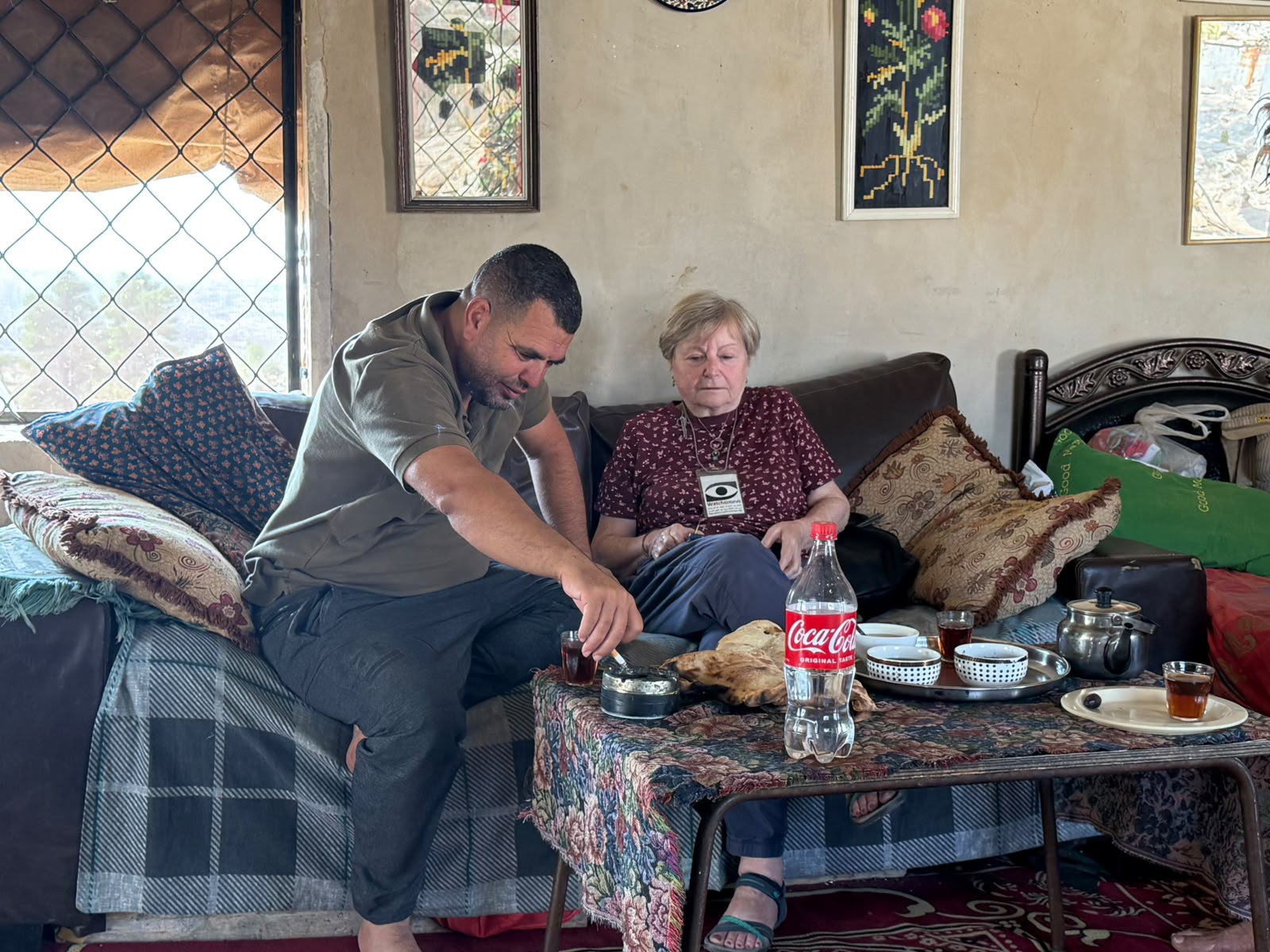
After making several phone calls and receiving up-to-date information, we decided to travel to Susiya to visit Azzam and Wadha.
Checkpoint survey:
- Near Samu’: a dirt road is open; the yellow barrier at the entrance is closed.
- Near Simiya: passage around the closed yellow gate is open.
- Northern Abda: open.
- Dura: closed.
- Fawwar: closed.
- Zif: closed.
We bought food at Nabil’s grocery store for the family in Susiya.
We continued along Road 317 toward Susiya. Near the turnoff leading up to the Avigayil settlement, we encountered a Ranger (an off-road vehicle) carrying two young settlers whose faces were covered with masks. They were standing in the vehicle as it sped toward us.
It all happened so quickly that there was no chance to take a photograph. Terrifying. I have no other word for it.
Later, when we met Nasser Nawaj’ah, he told us that this was a familiar sight, characteristic of what is happening in the South Hebron Hills.
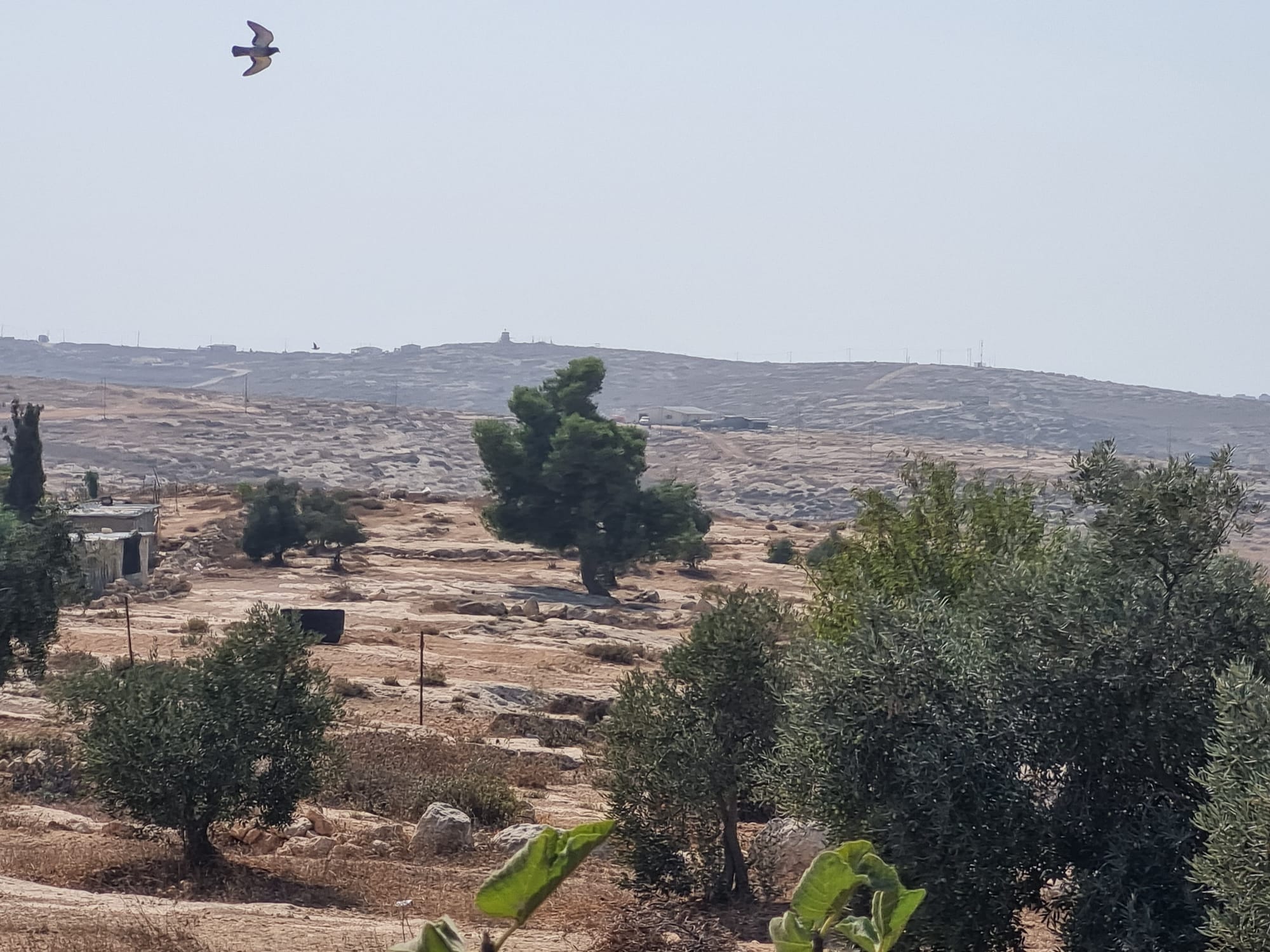
I asked Azzam to show me once again the outposts scattered not far from their home and explain who was living in them.
Nasser Nawaj’ah, B’Tselem’s representative in the South Hebron Hills, told us about a serious incident that had occurred near Yatta an hour earlier.
Yousef, his wife, and their child had been harvesting olives in a grove in the Shakara neighborhood, west of the Susiya archaeological site. Settlers arrived in a Ranger and attacked them with clubs. A Palestinian Red Crescent ambulance took them to Yatta.
Yousef suffered fractures to his skull and nose and was hospitalized for treatment. His wife and son sustained less serious injuries.
Yesterday, following the attack at the Yehuda Junction in Hebron, the army arrived and evacuated 200 families, who were transferred to schools and community centers. The army used loudspeakers to order residents to leave their homes.
There is extensive documentation of this on social media.
Three weeks ago, following requests by lawyers, the brigade commander granted the Palestinian District Coordination Office permission for the olive harvest, with dates allocated to individual families. In Susiya, for example, the date was November 3.
Following the attack, the DCO canceled all the permits.
Activists providing protective presence are needed in all the villages of Masafer Yatta, and the demand for them continues to grow.
We handed over the food and donations we had brought.
I left with a heavy heart.
#ThisIsTheOccupation
Location Description
Dura Al-Fawwar Junction
See all reports for this place-
Junction on Route 60: west - the town of El Dura, east - the Al Fawwar refugee camp. There is a manned pillbox at the junction. From time to time the army sets up flying checkpoints at the entrance to El Fawwar and Al Dura. Al-Fawwar is a large refugee camp (7,000 inhabitants in 2007) established in 1949 to accommodate Palestinian refugees from Be'er Sheva and Beit Jubrin and environs. There are many incidents of stone-throwing. In the vicinity of the pillbox there are excellent agricultural areas, Farmers set up stalls adjacent to the plots close to the road. In recent months the civil administration has set up dirt embankments thereby blocking access to the stalls, and making it impossible for the farmers to sell their vegetables. Updated April 2021, Michal T.
-
Mesafer Yatta
See all reports for this place-
This is happening in Fire Area 918 in the South Hebron Hills
On the eve of Remembrance Day (the day before Israel Independence Day), 4th May, 2022, the Israeli High Court decided on the transfer and expulsion of residents from 8 Palestinian communities in the area of Masafar Yata in the South Hebron Hills. Residents of the villages have been living under the threat of demolition, evacuation and expropriation since the IDF issued evacuation orders in 1999 based on the 1980s proclamation of their area of residence as a firing zone for IDF drills. None of the nearby settlements were included in this zone. The Masafer Yata Palestinian villages retain a special lifestyle and ancient agricultural culture. They also posess a clear historical documentation that testifies to a Palestinian settlement in this area, generations before the establishment of Israel, long ago in the caves and at later times outside them.
Evacuating residents from the area means destroying these historic villages and leaving entire families (about 2,000 people, children, adults, and the elderly) homeless. This is contrary to international law.
In June 2022, a firing drill started, and life became harder.
-
South Hebron Hills
See all reports for this place-
South Hebron Hills
South Hebron Hills is a large area in the West Bank's southern part.
Yatta is a major city in this area: right in the border zone between the fertile region of Hebron and its surroundings and the desert of the Hebron Hills. Yatta has about 64,000 inhabitants.
The surrounding villages are called Masafer Yatta (Yatta's daughter villages). Their inhabitants subsist on livestock and agriculture. Agriculture is possible only in small plots, especially near streams. Most of the area consists of rocky terraces.Since the beginning of the 1980s, many settlements have been established on the agricultural land cultivated by the Palestinians in the South Hebron Hills region: Carmel, Maon, Susia, Masadot Yehuda, Othniel, and more. Since the settlements were established and Palestinians cultivation areas have been reduced; the residents of the South Hebron Hills have been suffering from harassment by the settlers. Attempts to evict and demolish houses have continued, along with withholding water and electricity. The military and police usually refrain from intervening in violent incidents between settlers and Palestinians do not enforce the law when it comes to the investigation of extensive violent Jewish settlers. The harassment in the South Hebron Hills includes attacking and attempting to burn residential tents, harassing dogs, harming herds, and preventing access to pastures.
There are several checkpoints in the South Hebron Hills, on Routes 317 and 60. In most of them, no military presence is apparent, but rather an array of pillboxes monitor the villages. Roadblocks are frequently set up according to the settlers and the army's needs. These are located at the Zif Junction, the Dura-al Fawwar crossing, and the Sheep Junction at the southern entrance to Hebron.
Updated April 2022
Muhammad D.Oct-24-2026Smadar with Nasr Nawaja'a, in Susiya
-
Susiya
See all reports for this place-
Susiya The Palestinian area lies between the settlement of Susya and a military base. The residents began to settle in areas outside the villages in the 1830s and lived in caves, tents and sukkot. To this day they maintain a traditional lifestyle and their livelihood is based on agriculture and herding. Until the 1948 war, the farmers cultivated areas that extended to the Arad area. As a result of the war, a significant portion of their land left on the Israeli side was lost. After the 1967 war and the Israeli occupation, military camps were established in the area, fire zones and nature reserves were declared, and the land area was further reduced. The Jewish settlement in Susya began in 1979. Since then, there has been a stubborn struggle to remove the remains of Palestinian residents who refuse to leave their place of birth and move to nearby town Yatta. With the development of a tourist site in Khirbet Susya in the late 1980s (an ancient synagogue), dozens of families living in caves in its vicinity were deported. In the second half of the 1990s, a new form of settlement developed in the area - shepherds' farms of individual settlers. This phenomenon increased the tension between the settlers and the original, Palestinian residents, and led to repeated harassment of the residents of the farms towards the Palestinians. At the same time, demolition of buildings and crop destruction by security forces continued, as well as water and electricity prevention. In the Palestinian Susya, as in a large part of the villages of the southern Hebron Mountains, there is no running water, but the water pipe that supplies water to the Susya Jewish settlement passes through it. Palestinians have to buy expensive water that comes in tankers. Solar electricity is provided by a collector system, installed with donation funds. But the frequent demolitions in the villages do not spare water cisterns or the solar panels and power poles designed to transfer solar electricity between the villages. Updated April 2021, Anat T.
-
Zif Junction
See all reports for this place-
Zif Junction located on the crossroads that directs towards Road 356 to Yata. Yata is the district city of the southern Hebron Mountains. Usually, this junction is open to traffic. The nearby pillbox is unmanned. But the army and police are present occasionally, sometimes setting up a checkpoint and sometimes detaining residents from the big city. Often, the Israeli policemen inspect vehicles and distribute driving reports to Palestinian vehicles. s
-
