
A visit to Sheikh Sa'id in Rarkiz
Route 60/317: Little traffic. The greenery from after the rains has already vanished, and even the numerous Israeli flags along the roads look weary. On the other hand, an outpost/farm peeks out from every hilltop—sometimes just a tattered tent and a watchtower, and sometimes a few prefabricated houses…
In A-Tuwani, it is clinic day—many people, mostly women, are waiting outside. There is an ambulance waiting for something and a military vehicle patrolling (possibly settlers, who frequently drive around in advanced military vehicles).
We continue to the tiny village of Rakiz (6–7 families) to visit Sheikh Sa’id. We brought clothes, equipment, and basic food supplies. As is known, the Sheikh was shot in the leg a little over a year ago by a settler (possibly the security coordinator) from the Avigayil settlement. Despite being severely injured, the Sheikh was arrested on charges of attempting to harm settlers on their own land! His 15-year-old son was also arrested. The Sheikh was taken to Soroka Hospital where he underwent surgery; his leg was amputated, and he was shackled by all three remaining limbs (shackling Palestinian patients and wounded individuals in Israeli hospitals is a routine procedure applicable to any medical condition they have). The Sheikh recounted that he was treated with indifference and hostility, and after 4 days, they transferred him—an amputee—to At-Tuwani, not in an ambulance, but in a “Posta” (an IPS vehicle used for transferring detainees/prisoners from jail to court, etc.). The Posta consists of narrow cells where every passenger is shackled by their hands and feet. Those inside sit on a steep incline, so that every movement of the vehicle jolts the passengers and tosses them back and forth. The prisoners/detainees describe this as torture. From At-Tuwani, the Sheikh arrived by ambulance at a hospital in Hebron and stayed there for another 4 days. Today he walks with a prosthesis but without a cane.
However, this is not the end of the story: the son (a minor) who was arrested was released on a 5,000 NIS bail following video evidence filmed during the attack, which shows that the Palestinians were defending themselves on their land and did not attack the settlers. Subsequently, and over the past year, the Sheikh was attacked by settlers who came to the village, threw stun grenades, and shouted insults. In March 2026, the Sheikh was attacked by soldiers in uniform who beat him, gashed his head open, and he required stitches. Because of his medical condition, they did not arrest him.
We said goodbye to the man and his two lovely, veiled wives. The village is blocked from the south side, and the access road through At-Tuwani is horrifyingly winding and steep!
On the way back, opposite As-Samu (Asael) and far from the road, we saw another beginning of a developing settlement with a large herd of cows around it. We couldn’t stop to take photos because the road suddenly became congested.
Location Description
Mesafer Yatta
See all reports for this place-
This is happening in Fire Area 918 in the South Hebron Hills
On the eve of Remembrance Day (the day before Israel Independence Day), 4th May, 2022, the Israeli High Court decided on the transfer and expulsion of residents from 8 Palestinian communities in the area of Masafar Yata in the South Hebron Hills. Residents of the villages have been living under the threat of demolition, evacuation and expropriation since the IDF issued evacuation orders in 1999 based on the 1980s proclamation of their area of residence as a firing zone for IDF drills. None of the nearby settlements were included in this zone. The Masafer Yata Palestinian villages retain a special lifestyle and ancient agricultural culture. They also posess a clear historical documentation that testifies to a Palestinian settlement in this area, generations before the establishment of Israel, long ago in the caves and at later times outside them.
Evacuating residents from the area means destroying these historic villages and leaving entire families (about 2,000 people, children, adults, and the elderly) homeless. This is contrary to international law.
In June 2022, a firing drill started, and life became harder.
-
South Hebron Hills
See all reports for this place-
South Hebron Hills
South Hebron Hills is a large area in the West Bank's southern part.
Yatta is a major city in this area: right in the border zone between the fertile region of Hebron and its surroundings and the desert of the Hebron Hills. Yatta has about 64,000 inhabitants.
The surrounding villages are called Masafer Yatta (Yatta's daughter villages). Their inhabitants subsist on livestock and agriculture. Agriculture is possible only in small plots, especially near streams. Most of the area consists of rocky terraces.Since the beginning of the 1980s, many settlements have been established on the agricultural land cultivated by the Palestinians in the South Hebron Hills region: Carmel, Maon, Susia, Masadot Yehuda, Othniel, and more. Since the settlements were established and Palestinians cultivation areas have been reduced; the residents of the South Hebron Hills have been suffering from harassment by the settlers. Attempts to evict and demolish houses have continued, along with withholding water and electricity. The military and police usually refrain from intervening in violent incidents between settlers and Palestinians do not enforce the law when it comes to the investigation of extensive violent Jewish settlers. The harassment in the South Hebron Hills includes attacking and attempting to burn residential tents, harassing dogs, harming herds, and preventing access to pastures.
There are several checkpoints in the South Hebron Hills, on Routes 317 and 60. In most of them, no military presence is apparent, but rather an array of pillboxes monitor the villages. Roadblocks are frequently set up according to the settlers and the army's needs. These are located at the Zif Junction, the Dura-al Fawwar crossing, and the Sheep Junction at the southern entrance to Hebron.
Updated April 2022
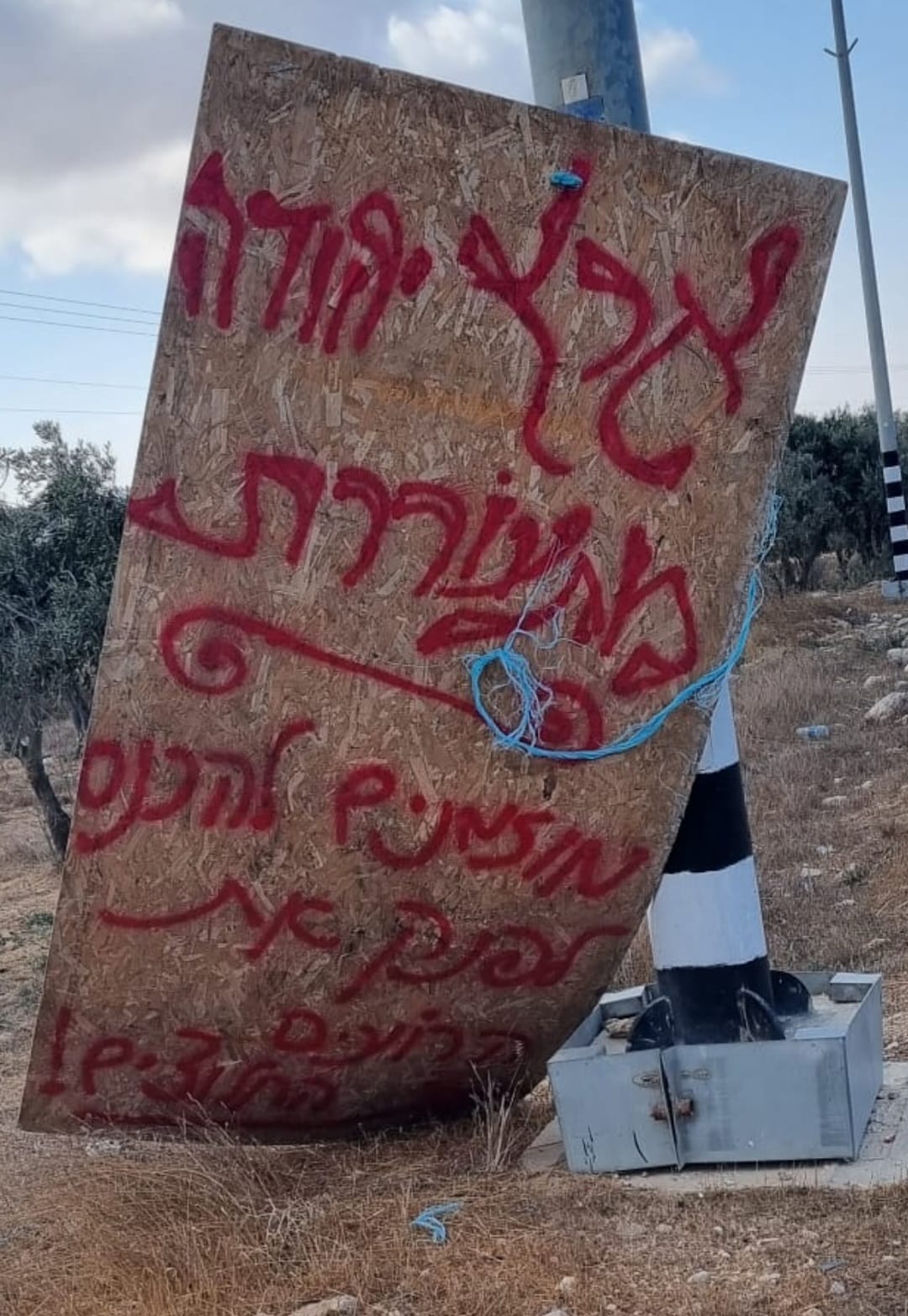 Smadar BeckerOct-17-2026A sign placed by those who call themselves the Pioneer Shepherds, at the outpost adjacent to Qawawis
-
