
Qalandiya
For a change, we went out to Qalandiya this time on Sunday, and the difference turned out to be substantial, as will be clarified below.
As previously reported, you now have to make a detour through Atarot to reach the parking lot near the checkpoint. Parking – as expected -is full. On the back road there was another blockage that shortens the curb where you can park, and on one side was a bus that took 4-5 parking spaces. Our MW friends were already forced to park on the Palestinian side about two weeks ago. Luckily we found parking at the edge, but from now on we will have to arrive by taxi.


When we arrived from the direction of Atarot along the wall, the traffic in front of us was lively, which indicates that most of those who pass the checkpoint by car, or who come to pick up workers, are now traveling from here. Those wishing to travel west should cross the checkpoint on the westernmost lane and travel through a lane that is actually designated for public transportation. There are also shuttles and vehicles that come to pick up workers, also through the public transportation lane. The parking area is very crowded with vehicles and people. The nearby cafe is bustling. When we arrive, around 6, it is still quite dark and in front of us, a whole pedestrian bridge is revealed decorated with lights for Christmas. We do not remember seeing Christmas decorations here before, it was more towards Bethlehem but was nice looking.

The checkpoint itself was quite calm. People came all the time, but there were no queues and everything flowed. This is despite the fact that the middle entrance was closed and only two entrances were entered. We headed east and met our friend Abu Ramzi, the pretzel seller. He stood there with his cart and sold it to anyone who was interested. He now brings a chair with him and sits from time to time, because it is already difficult for him to stand all the time. He is here around 4:30 every day, except Saturday, and earns a maximum of 100 NIS per day (usually less). He must work to support himself and his wife, as well as his house and children who live with them. Demanding. Recently he said they broke the TV at home. He does not buy otherwise, because he is trying to save money for cataract surgery with his other eye.
Near Abu Ramzi, there is a stall that sells many foods. Fried falafel, chips and cauliflower on the spot, chickpeas and salads prepared in boxes, pitas and also bags with vegetables (tomato, cucumber, onion and hot pepper in each). On both sides there are kiosks in transit cars, the old one closer to the checkpoint, and the one recently erected in the square on the ruins of the fruit and vegetable stand destroyed by city inspectors.
We noticed that the square is quite empty and in general the traffic of vehicles towards the checkpoint is very sparse. This is an unusual situation for us. There is usually a long traffic jam here and the beeps of cars can be heard from all sides. We returned to the pedestrian checkpoint, which continued to flow from both directions (from Qalandiya through the cut fence and east through the regular entrance). New: There is a stall selling masks and neck-warmers, but there is no seller. Instead, there is a speaker that says “Put a shekel and take a mask” (5 shekels-bread-neck). And there are really people who buy because at the checkpoint they must wear a mask.

We noticed that the square is quite empty and in general the traffic of vehicles towards the checkpoint is very sparse. This is an unusual situation for us. There is usually a long traffic jam here and the beeps of cars can be heard from all sides. We returned to the pedestrian checkpoint, which continued to flow from both directions (from Qalandiya through the cut fence and east through the regular entrance). New: There is a stall selling masks and neck-warmers, but there is no seller. Instead, there is a speaker that says “Put a shekel and take a mask” (5 shekels-bread-neck). And there are really people who buy, because at the checkpoint they must wear a mask. Here, too, the sparse traffic stands out. The traffic on the route towards the checkpoint is separated from that on the route coming from the checkpoint (from the direction of Jerusalem) by tundas. The vendors place their goods on the tundas. Coffee and more. .). Now because there is not much traffic and no traffic jams do not buy. The peddler explains to us that it is because Sunday is the day. Later the traffic pressure will start before the checkpoint. He explains that the busiest morning of the week is Monday. Explained that schools and some workplaces do not work on Sunday so on this day the traffic is sparse. For us, it was a very rare sight. We returned to the pedestrian checkpoint where more and more people continued to pass without delays, even though the middle entrance was still closed. Some people have contacted us who said that even though they have permits and are vaccinated with a third vaccine, they have not been allowed to pass for some time. They display the printed green character, with the code bar that is supposed to work all over the world, but at the Qalandiya checkpoint, they do not know how to scan it. They had already gone to the DCO, and went to Beit El, and called the number they had given them, and returned to the Palestinian Irtibat (where they were told that their names had been transferred to Israel as vaccinated) and still did not move today. If they fail to get a solution to a problem they will turn to Sylvia tomorrow, and we hope you can help.
Shortly after seven we got in and passed pretty quickly. There were already soldiers in the positions in front of the middle entrance, but they still did not act for some reason. A monitor is playing a game of cards on one of the computers. Later, as we waited in line to check our IDs, people started coming out of these positions as well. Our presence at the scene provoked a backlash from the female soldier and the security guard turned to us. We explained who we were and proved him wrong for claiming we should not be there. He claims that he only wants to protect us: you did not hear about what happened in Ramallah a few days ago (referring to young Chabad youths who accidentally entered Ramallah with their vehicle and were rescued by Palestinian police). But again we explained that the other side of the checkpoint is not in Ramallah but in the area under the responsibility of the Jerusalem Municipality and we do not feel danger there …
From the bridge, we photographed the sparse traffic from the direction of Qalandiya and the road where there was once a square in the direction of Jerusalem.


On the way back to the car we saw that the digger, digging probably the sinking pit, had progressed west since the last time we were here.
Qalandiya Checkpoint / Atarot Pass (Jerusalem)
See all reports for this place-
Click here to watch a video from Qalandiya checkpoint up to mid 2019 Three kilometers south of Ramallah, in the heart of Palestinian population. Integrates into "Jerusalem Envelope" as part of Wall that separates between northern suburbs that were annexed to Jerusalem in 1967: Kafr Aqab, Semiramis and Qalandiya, and the villages of Ar-Ram and Bir Nabala, also north of Jerusalem, and the city itself. Some residents of Kafr Aqab, Semiramis and Qalandiya have Jerusalem ID cards. A terminal operated by Israel Police has functioned since early 2006. As of August 2006, northbound pedestrians are not checked. Southbound Palestinians must carry Jerusalem IDs; holders of Palestinian Authority IDs cannot pass without special permits. Vehicular traffic from Ramallah to other West Bank areas runs to the north of Qalandiya. In February 2019, the new facility of the checkpoint was inaugurated aiming to make it like a "border crossing". The bars and barbed wire fences were replaced with walls of perforated metal panels. The check is now performed at multiple stations for face recognition and the transfer of an e-card. The rate of passage has improved and its density has generally decreased, but lack of manpower and malfunctions cause periods of stress. The development and paving of the roads has not yet been completed, the traffic of cars and pedestrians is dangerous, and t the entire vicinity of the checkpoint is filthy. In 2020 a huge pedestrian bridge was built over the vehicle crossing with severe mobility restrictions (steep stairs, long and winding route). The pedestrian access from public transport to the checkpoint from the north (Ramallah direction) is unclear, and there have been cases of people, especially people with disabilities, who accidentally reached the vehicle crossing and were shot by the soldiers at the checkpoint. In the summer of 2021, work began on a new, sunken entrance road from Qalandiya that will lead directly to Road 443 towards Jerusalem and Tel Aviv. At the same time, the runways of the old Atarot airport were demolished and infrastructure was prepared for a large bus terminal. (updated October 2021)
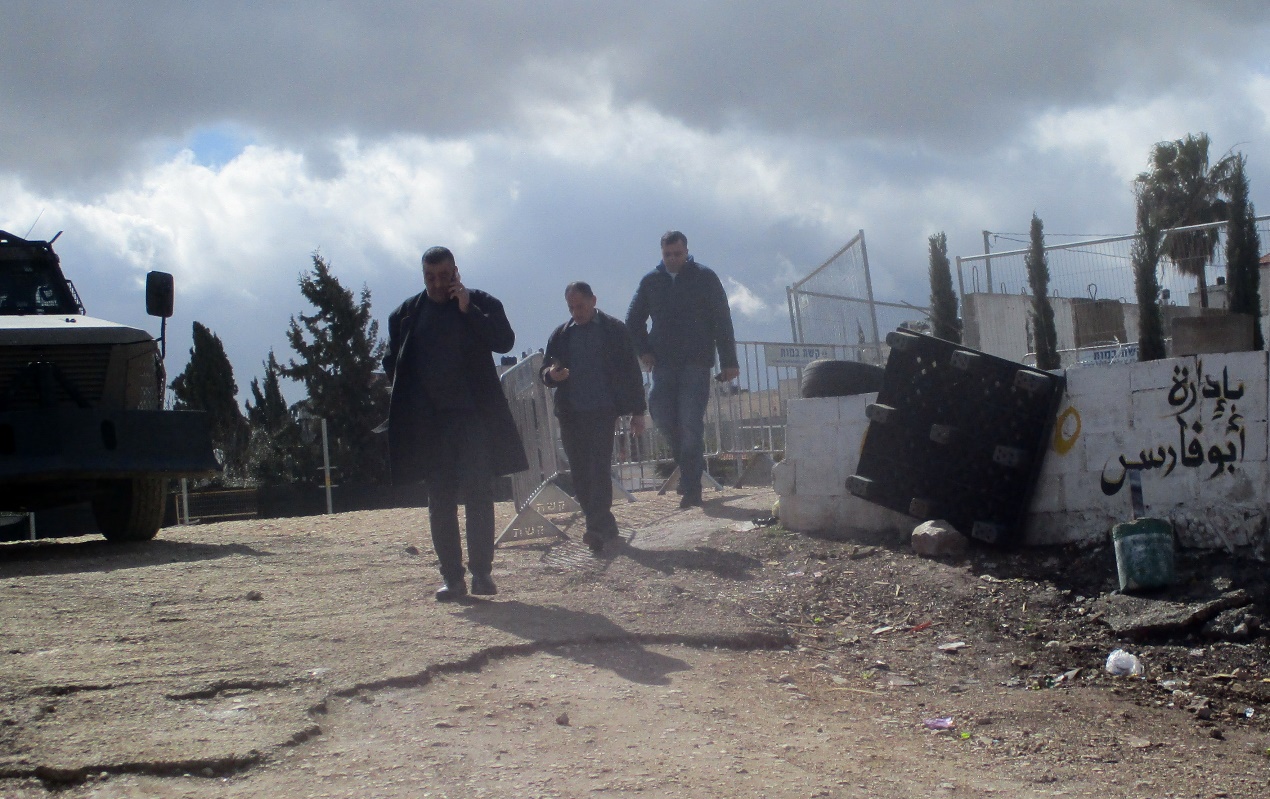 Tamar FleishmanFeb-27-2026Qalandiya: On the way to prayer
-