
In the Palestinian Jordan Valley SURVIVAL is a life-death game, not a prize-carrying reality program
We go out in the dark and come back home in the dark… a long, full day
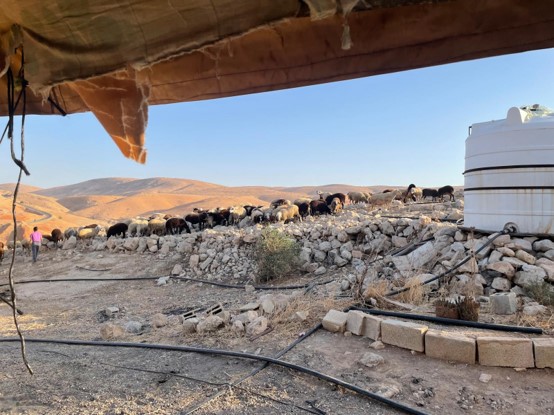
We began our morning with coffee at M.’s, on the hill overlooking the falling-apart Hamra Checkpoint, that has moved to En Shibli. M. is always full of new ideas and performances. Beside the strawberry greenhouse there is now a new tomato greenhouse. In the field a special crop for his special sheep (mixed Marino) is now growing. The sheep wander near the house, looking for something to snack. The family members are each busy with their tasks but gladly ready for us. M. talks about his life beside the Israelis with whom he was and still is in contact (from the Hamra colony) and about his Palestinian neighbors of Furush Beit Dajan. Both sides can be at times with him and at others – against him. His little son, H., takes us to see the well adjacent to the home, that supplies water to their large tank and at times even to the colonist neighbors when it is missing there. No one like them. Now he is building a new room that will serve to make cheese. In God’s eye, as they say.
From there we continued to Samra, our beloved place. We had tea with H. and A. who showed us a sophisticated camera that can photograph 360 degrees. Only the SIM is missing. Then we spent another moment with A. And then we were summoned to Humsa for Protective Presence.
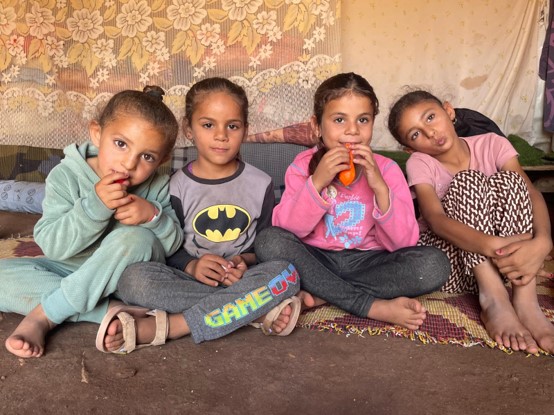
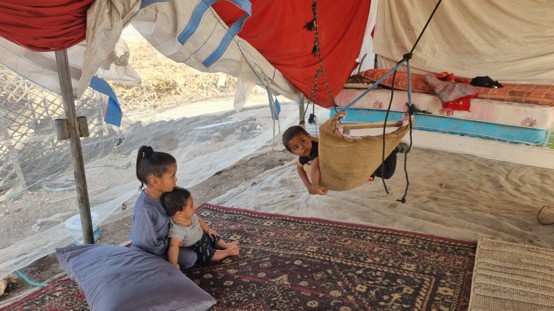
Humsa. Q.’s family is situated apart from the other residents, more exposed to colonist attacks. There are about five families nearby, a father and his sons. They are of the Abu Kabash clan who came from Samu’a after the 1967 war. Here the horrific rape and stealing of the flock took place. We sat in the tent with friendly H. and family members kept coming to meet us. The sweet girls kept us busy making statuettes of sheep or Celine Diwan… We blew up balloons and finished with a delicious lunch. They have a tomato dish that is so easy to make and most delicious with the flatbread, baked that very morning, swimming inside. A real treat. H. tells us about the women’s weekly work. Each in her turn is responsible for cooking for the entire community. Each family receives a tray with its food, to its own tent.
- – whose photo was publicized the world-over after he openly told what had been done to him – sits with us and his wife and three cute daughters. He is smiling, relaxed. Only wants there to be one of us to watch over them and protect then when necessary.
Since their flock was stolen, they were promised help in purchasing a new one. In the meantime, they have only 30 goats. The flock, supposed to arrive from Israel, was blocked at the border and has not arrived. So far, the promise to pass a sum of money to buy a new Palestinian flock has not been fulfilled either.
We must leave for another mission for which we’ve come, leaving them there with the promise that someone else would come. And find out there is no one to replace us. There are too few volunteers today. Where is everyone when they are needed?
We met Mahdi at En Al Beda and drove to visit a family that had escaped the pogrom in Mita in February 2026. We had met them there with other families who escaped elsewhere. They escaped the night their place was burnt and arrived at Sukut near En Al Beda. Together with other refugee they built their own residence. M. works intermittently. The night of October 10th, as the parents were not at home, their home was incinerated as a result of an electricity mishap. The two tiny children, ages 5 and 3, who were at their neighbors’, and passed on home at night, woke up to a fire and neighbors hauled them out. They sat and looked at us with great big eyes. Only a burnt metal frame survived. Everything else was burnt. In other words, their meager belongings were all gone. With the colorful balloons they blew up, Bosmat managed to make them laugh eventually.
In the meantime, they were given a cover and mattresses and a ventilator, and food every day. The mother’s every other word is “thank God”. We gave them everything we had in the car. Truth be told, I hadn’t known this was the situation when I was invited to come. I didn’t understand the invitation, although he sent me a photo of a burnt tent. One’s eyes now see only fires and fences and razing and destruction. Next time we shall fill the car in a more satisfying manner. They need everything anew. A fridge, a washing machine, a cooking stove, clothes, eating utensils – everything.
The mother said this was the first time they have laughed since that happened.
We went by Farisiya to see about the students, met A. and the nice children. We hurried to another meeting and decided this was enough for a single day…
Location Description
Humsah
See all reports for this place-
Humsah
A shepherd community in the Jordan Valley. It is located in a remote place in Area C. There are no convenient ways to reach it. Its inhabitants make a living from their flocks. Like other shepherd communities, they live without basic infrastructure. This shepherd community is exposed to settler harassment and demolition of property by the military through civil administration orders.
Rachel AfekOct-22-2026Jordan Valley, Hamra – Livestock searching for food
-
Khirbet Samrah
See all reports for this placeחמרה
See all reports for this place
