
‘Anabta, Habla, Irtah (Sha’ar Efrayim), Jubara (Kafriat), Sun 9.1.11, Afternoon
Summary
Today, the first shift of the New Year, we were in the OPT to uphold and continue our MachsomWatch tradition, to monitor and report on-the-ground realities but mindful, too, that we uphold the practice of opposition and dissent in a “democratic” state. The vilification of NGOs as legitimate critics who refuse to dehumanize “the other,” who refuse to be set apart from other countries, other allies and diasporas of Jews, as well as Arabs, will get us nowhere. As a key component of civil society, MachsomWatch will continue to respect and protect human rights, reporting hard ground truths and acting on behalf of a more reality based, just and principled Israel.
12:30 Jubara
On the far side of the checkpoint, the yellow arm of the barrier is open, and that’s the barrier that makes of Jubara, once again, after so many years a “junction” where one can cross into Tulkarm (with permit or whatever) or continue on the apartheid road. Along that road, we are surprised to see that the fencing on either side, near Shufa, is coming down. Yes this needs to be repeated: although the metal posts are still up on the sides of the road, the wire fencing is no longer there. On the other hand, the wet, slippery slope up to the village remains as it has for years, and there’s no other way in or out of the village.
Anabta
Traffic moves in either direction through the checkpoint without stopping, but there are three soldiers who stand behind a concrete protective “shield.” No soldiers visible up in the military lookout tower.
The fields and valleys around here begin to show specks of bright green, giving the countryside a fresh sparkling look. Springtime and hope usually go together, but reality soon breaks into this reverie:
Route 55
At the junction of Route 55 with the road to Immanuel and Ariel, near Fonduk, a jeep has stopped a Taneeb bus, parked by the jeep. A young man, looking crestfallen, is surrounded by three Border Police, his hands behind his back, meaning that he’s obviously manacled.
Gate 109 (Efraim)
A black settler pickup truck shows its annoyance at our presence by hooting and swerving by our flag bedecked car.
13:45 Habla
We’re early, or so we think, for Gate 1393 to be opened, but we’re wrong. Two Hummers stand by the side of the Separating Barrier, a group of five soldiers stands in the middle of the Barrier dirt path, there’s mud everywhere, and the gate(s) is open. Nobody around: why should there be? Soldiers don’t usually open early, and the usual time for the gate to open is still fifteen minutes away (14:00-15:00).
Grudgingly, the soldiers tell us, “Read the notice.” They nod to the Zim container “waiting room” for those who want to cross here. Stuck on one side is a piece of paper telling of opening times, in Arabic, although the numbers are not in Arabic but appear as follows:
7:00-9:00
13:00-14:00
16:45-18:30
When we ask when this change took place, we are met with stony silence, and these are reservists. One stands on side of the gate, gun at the ready, another stands at the other side of the gate, behind concrete protective “shield,” also with gun at the ready. But there are no Palestinians to train them on….
13:50 — a truck arrives on the far side of the Barrier, the driver dismounts goes to the concrete checking booth, leaving his truck engine running, and a woman’s raised voice is heard from inside (unseen military policewoman, we assume). On our side of the Separation Barrier, a young man arrives, papers in hand, calling out to the soldier that he needs to give these, to do with his plant nursery, to somebody on the other side. The soldier won’t let him advance but takes the papers and walks over to the other side. The farce of all this….
On to this “mise en scene,” the Matak arrives in his white jeep. T., the captain, leaps out and immediately starts talking animatedly to one of the soldiers standing in the middle of the Barrier.
13:55 — a Palestinian car comes by, a man gets out, shakes hands with T., gets back into his car and drives back in the direction of Habla. Just now, a huge truck, laden with white, Jerusalem stone boulders, wrapped in bright blue cling wrap, inches its way past us to one of the nurseries near Route 55.
A Palestinian man arrives and looks for the sign telling him of changes of gate opening hours. Of course there’s nothing, hasn’t been for years, on the yellow metal sign on the gate itself. Who would think of looking on the side wall of the Zim container “waiting room”?
T. comes over cheerfully, extends his hand to us and talks of the change, which has been in effect only since this morning. Why? For the convenience of the school children, whose hours fit in better with this new arrangement, at least at this time of day. There will be problems for a day or two, he tells us, “but Palestinians can go to gate 109 if they come here and the gate is not open. I’ll make certain that works for them.”
He indicates that he intends to tell all the plant nursery owners, and we wonder, aloud, why he isn’t in charge of all agricultural gates: “I have plenty enough,” he laments, and we, in turn, lament that he didn’t manage to tell Palestinian before this change took place.
14:05 — one of the soldiers comes up to T., who realizes that it’s past 14:00. The soldiers are anxious to close, the Matak drives off, and the soldiers make haste to do so too.
14:10 — a woman and a young man arrive, shout at the departing soldiers who merely shout back: “Look at the notice” and speed off into the distance. We now call the Matak who indicates that he will return. But, meanwhile, we take the two Palestinians to Gate 109 where the Matak’s jeep is standing, and T., the driver, is on the phone, but nods to us that all is well, or will be well.
14:30 — back at the nursery at Habla, one of the nursery workers pedals past on his bicycle, ready to cross the Separation Barrier. O., the owner, calls out to him in time to prevent H. going in vain to a gate that will remain closed until the occupying army decides to open it once more. Over hot, sweet fresh herb tea, our Palestinian friends let us in on the fact that, in Palestine, they have heard about what has ensued with MachsomWatch and its fellow NGOs in the past week. And we are glad to be there, in the warm sunshine of the Seam Zone — for the rain is over and gone – for now.
'Anabta CP
See all reports for this place-
'Anabta CP
The checkpoint is located south of the village of 'Anabta, at the intersection of Road 60 (leading to Nablus at the entrance to Area A), with Road (57, 557, 5576) facing west towards the Einav settlement and the checkpoint at the exit from the West Bank - Figs checkpoint. Until 2010 we used to watch the intersection and report the long columns created due to a slow inspection of the vehicles in both directions.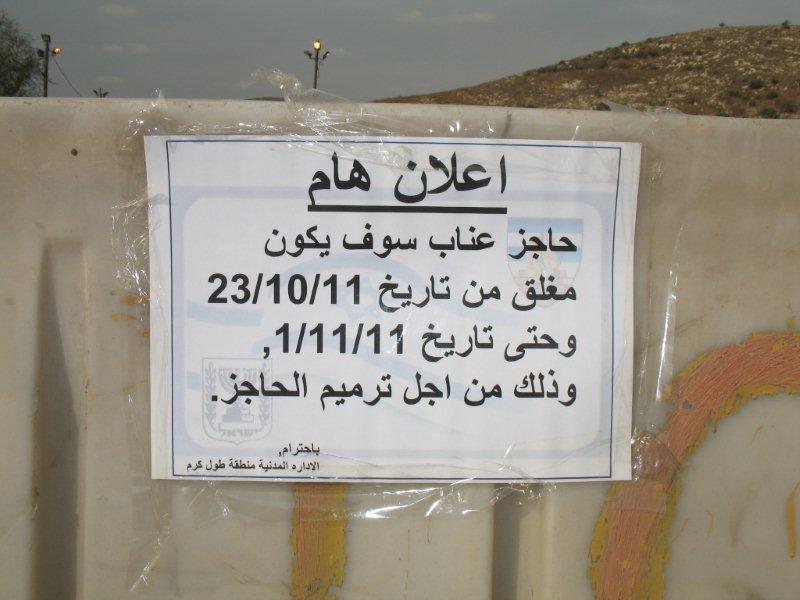 Oct-28-2011Anabta checkpoint 24.10.11
-
Habla
See all reports for this place-
Habla CP (1393)
The Habla checkpoint (1393) was established on the lands of the residents of Qalqilya, on the short road that
connected it for centuries to the nearby town of Habla. The separation barrier intersects this road twice and cut off the residents of Qalqilya from their lands in the seam zone.(between the fence and the green line).
There is a passage under Road 55 that connects Qalqilya to the sabotage This agricultural barrier is used by the farmers and nursery owners established along Road 55 from the Green Line and on both sides of the kurkar road leading to the checkpoint.
This agricultural checkpoint serves the residents of Arab a-Ramadin al-Janoubi (detached from the West Bank), who pass through it to the West Bank and back to their homes. The opening hours (3 times a day) of this agricultural checkpoint are longer than usual, about an hour (recently shortened to 45 minutes), and are coordinated with the transportation hours of a-Ramadin children studying in the occupied in the West Bank.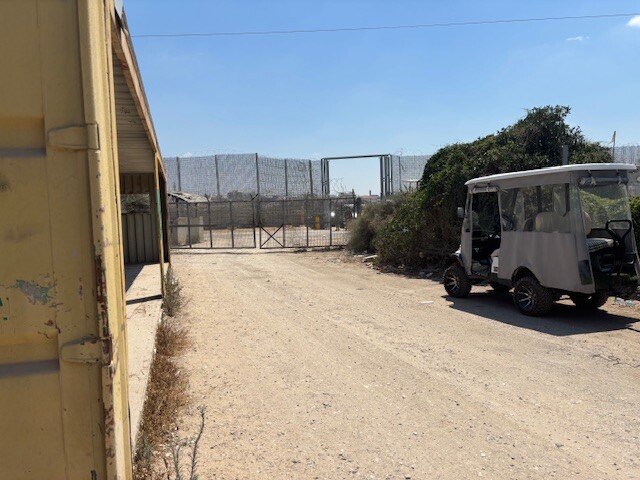 Nina SebaAug-18-2025Habla: The gate is in the process of closing
-
Irtah (Sha'ar Efrayim)
See all reports for this place-
The checkpoint is for Palestinians only. It is the main barrier to the passage of workers from the northern West Bank to Israel. Workers with a permit to work in Israel and also for trade (with appropriate permissions), medicine, and visiting prisoners. One can cross the checkpoint only on foot. The checkpoint is located north of Road 557 and south of Tulkarm. Operated by a civil security company, opening hours: between 4:00 and 19:00 on weekdays. As members of Machsom Watch, we began our shifts to this location in 2007. We arrived before it opened at 4 in the morning and report since, on the harsh conditions and the long and crowded queues of workers. The workers who pass by continue their journey by transportation to work throughout Israel. In the first period of its activity, about 3,000 and then 5,000 people passed through this checkpoint every day. Due to the small number of checking points and arbitrary delays for long periods of time in the "rooms", workers feared losing their transportation. Hence workers leave their homes at 2:30 at night to be among the first. Today, 15,000 pass and the transition is faster. Workers are still leaving their homes very early to get past the checkpoint at 7 p.m. In an adjacent compound, there is a terminal for the transfer of goods on a commercial scale, using the back-to-back method.
-
Jubara (Kafriat)
See all reports for this place-
The Jabra checkpoint was on Road 557, south of Tulkarm, on the side of the Figs Pass, which is located within the Palestinian Authority (a few kilometers east of the Green Line), and serves as an entry barrier from the territories to Israel. The checkpoint to the village of Jubara, which until 2013 was in the seam area, blocked and surrounded by a fence, was intended for the passage of the family members of the house next to the checkpoint, and also for the MachsomWatch volunteers (with special permission only), on their way to checkpoint 753. on the other side of the village. The soldiers supervising the "fig crossing" also supervised the crossing at this checkpoint, in our shifts we often waited a long time until the key was found and the gate opened. The checkpoint was abolished and became part of the separation fence that was moved west following the High Court.
-