
Habla
Checkpoint 1447 between ‘Azzun ‘Atma and ‘Izbet Salman, Checkpoint 1393, Habla
We went through the checkpoints relatively quickly. It’s very hot, the soldiers in full, heavy kit forced to engage in what is essentially a policing activity also appear to be suffering. Each side knows exactly what its role is and how to behave. And yet the mere existence of the routine that denies a person freedom of movement demonstrates for all to see the essence of the occupation’s daily injustice: some are allowed through, some are denied, and those who are permitted are subject to a predetermined schedule which doesn’t necessarily meet their needs, and the location of the gates lengthens the journey of some by many unnecessary kilometers.
12:20 We drove along the new fence near ‘Azzun ‘Atma, toward Elkana, and on the security road saw 14 people who had been caught by the army for being present in Israel without a permit. They walked in a line, tied together. People we spoke to later told us they had no choice, there’s no work on the West Bank and that’s the only way left to them to bring food to their families – to sneak through the fence.
12:45 Checkpoint 1447 between ‘Azzun ‘Atma and ‘Izbet Salman
Some farmers are already waiting under a canopy in the shade. We spoke with them: complaints about the fence, they want peace, to live in a single country, today they’re living in a jail. And the same question, again and again, why, why, why aren’t they allowed to move freely? One (who looks to be about 40) says he’s never been to the sea or to Jerusalem, why isn’t he allowed? Complaints by residents of ‘Azzun ‘Atma about this gate which is near ‘Izbet Salman but far from them. The gate in the wall which had been open until recently was better for people from ‘Azzun ‘Atma but not for those from ‘Izbet Salman. They ask both gates be opened because they’re very far from their fields, kilometers away.
Gradually more people arrive from both sides. They wait, we continue talking. “If I do only what’s permitted, I’ll die, there’s no alternative, I must violate the army’s orders,” says one man and drives his car back to the field. Some told us the soldiers don’t allow them to sit in the shade, but we ourselves didn’t witness that and everyone sat in the shade until the gate opened.
13:00 The gate opened.
People cross quickly. A small truck coming from the West Bank with fruit isn’t allowed through. Its passengers went through on foot with their belongings.
13:15 The checkpoint closed, everyone went through.
13:35 Checkpoint 1393, Habla
About 15 people from Habla and 8 from the other side wait for the gate to open.
It opens fifteen minutes late; the soldiers operating it were earlier at ‘Izbet Salman. The first people came through at 13:35.
Many people come through on foot and in various types of transport: horses, horse carts, cars, trucks with seedlings.
14:10 The soldiers begin to close the checkpoint about five minutes before the scheduled time.
On the other (Habla) side of the gate stands a young man who was apparently not allowed through. The MP commander yells at him, but he continues to stand by the gate, stubbornly or not understanding. The checkpoint closes.
Habla
See all reports for this place-
Habla CP (1393)
The Habla checkpoint (1393) was established on the lands of the residents of Qalqilya, on the short road that
connected it for centuries to the nearby town of Habla. The separation barrier intersects this road twice and cut off the residents of Qalqilya from their lands in the seam zone.(between the fence and the green line).
There is a passage under Road 55 that connects Qalqilya to the sabotage This agricultural barrier is used by the farmers and nursery owners established along Road 55 from the Green Line and on both sides of the kurkar road leading to the checkpoint.
This agricultural checkpoint serves the residents of Arab a-Ramadin al-Janoubi (detached from the West Bank), who pass through it to the West Bank and back to their homes. The opening hours (3 times a day) of this agricultural checkpoint are longer than usual, about an hour (recently shortened to 45 minutes), and are coordinated with the transportation hours of a-Ramadin children studying in the occupied in the West Bank.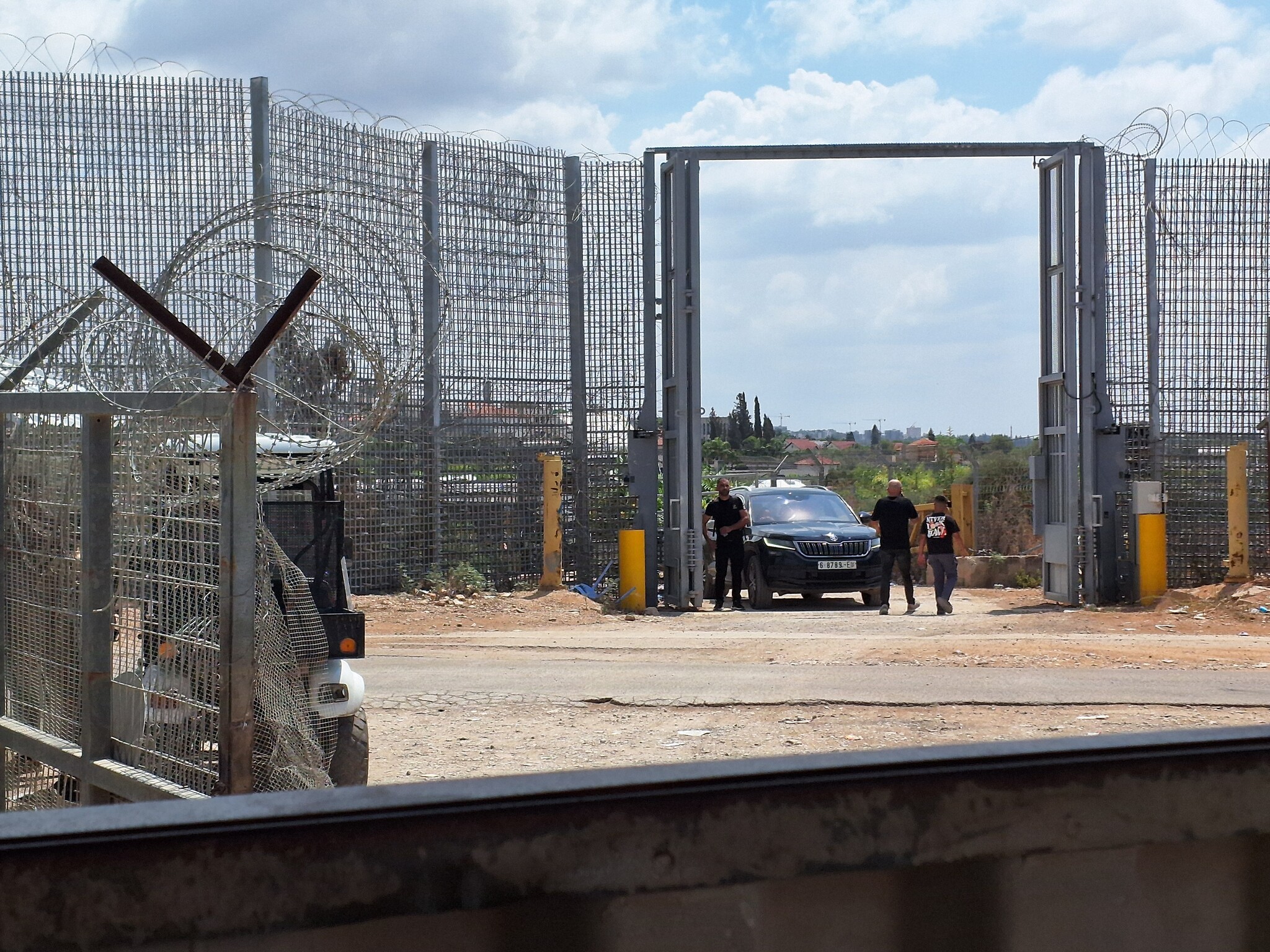 Ronit Dahan-RamatiAug-31-2026Habla. The gate is open
-
