
Qalandiya
We were present at the CP from 5:00 to 7:00
Points which should be mentioned:
1. Sparsity of workers: The regular groups of workers did not arrive in busses, and the attendance was sparse. Until 6:00 there were hardly any queues in the enclosures. After 6:00 o'clock, even when the girl soldier in the aquarium only seldom allowed the flow of people, there were hardly any too long queues in the enclosures, as they would have formed in an ordinary situation.
2. The Pilot for the transfer of workers in busses: We were told that today was the last day of the pilot for the transfer of workers in the direction of Atarot in busses (the information we got from the DCO officer was about 200 workers in all – which still does not explain the sparse attendance at the CP). We do not know what the results of the pilot will be and what the policy will be from now on.
3. The functioning at the tracks: When we entered the CP we stood and observed for 10 minutes the girl soldiers who let workers pass on track no. 1. During these 10 minutes the girl soldier responsible for the screening, was asleep. The second one continuously let each time three workers pass and stopped for a break of a minute or two in order to watch pictures on her cellular telephone. When they understood that we watch them they returned to some more activity.
4. The functioning of the DCO: At 6:00 o'clock women and elderly people began gathering near the humanitarian gate. Very quickly they went back to the regular queues, when they realized that there was nobody present who could open the gate for them, and it was also impossible to communicate with the only factor around – the girl soldier in the aquarium (even the policeman hadn't arrived yet).At 6:10 we contacted DCO Calandia. At first they disconnected the phone. At the second conversation a soldier answered and said he didn't care. To the third call another soldier answered and explained politely that "20 minutes ago a DCO officer left here and should arrive". At 6:30 P., the officer known to us as a fine person arrived, and said that he was busy with the busses to Atarot and that was the reason he arrived only now (in any case during the last months the gate was never opened at the appointed time, 6:00 in the morning.
5. The attitude towards the people waiting in the queue: Most of the time the Palestinians have naturally no possibility to communicate with uniformed personnel. Until 6:00 the only person around was the girl soldier in the aquarium, who does not come out to the square. But even when the rest of the functionaries arrived –a policeman and a policewoman, two civil security officers and a DCO officer – it is difficult to approach them, even when they come out to the square outside the aquarium. They are busy with coffee, cigarette and a lively conversation amongst themselves, which sometimes even delays the flow of queues in the enclosures.
Today we came up against another exceptional event – a Palestinian young man who was already waiting inside the track, shouted in Arabic at the policemen who stood outside the aquarium. The policewoman, well known to us, screamed back at him aggressively. She didn't try to find out what he wanted. He returned silent and submissively to the track. There is turned out that his sister who is very ill and is on her was to the hospital, is detained. We saw her, she was going to fall, didn't understand what the soldier wanted from her. In the end she just passed.
Summary
Most of the problems mentioned here – the sleeping girl soldiers, the inadequate functioning of the DCO, the inefficiency of officials at the aquarium – could be solved by means of a demand from the responsible functionaries for a higher standard of work. In order to achieve this, the army and the police, or a government office, should receive accounts from those functionaries.In the meantime each deparment is responsible for itself, without anybody having any interest in solving the neglect and the malfunctioning at the CP.
Qalandiya Checkpoint / Atarot Pass (Jerusalem)
See all reports for this place-
Click here to watch a video from Qalandiya checkpoint up to mid 2019 Three kilometers south of Ramallah, in the heart of Palestinian population. Integrates into "Jerusalem Envelope" as part of Wall that separates between northern suburbs that were annexed to Jerusalem in 1967: Kafr Aqab, Semiramis and Qalandiya, and the villages of Ar-Ram and Bir Nabala, also north of Jerusalem, and the city itself. Some residents of Kafr Aqab, Semiramis and Qalandiya have Jerusalem ID cards. A terminal operated by Israel Police has functioned since early 2006. As of August 2006, northbound pedestrians are not checked. Southbound Palestinians must carry Jerusalem IDs; holders of Palestinian Authority IDs cannot pass without special permits. Vehicular traffic from Ramallah to other West Bank areas runs to the north of Qalandiya. In February 2019, the new facility of the checkpoint was inaugurated aiming to make it like a "border crossing". The bars and barbed wire fences were replaced with walls of perforated metal panels. The check is now performed at multiple stations for face recognition and the transfer of an e-card. The rate of passage has improved and its density has generally decreased, but lack of manpower and malfunctions cause periods of stress. The development and paving of the roads has not yet been completed, the traffic of cars and pedestrians is dangerous, and t the entire vicinity of the checkpoint is filthy. In 2020 a huge pedestrian bridge was built over the vehicle crossing with severe mobility restrictions (steep stairs, long and winding route). The pedestrian access from public transport to the checkpoint from the north (Ramallah direction) is unclear, and there have been cases of people, especially people with disabilities, who accidentally reached the vehicle crossing and were shot by the soldiers at the checkpoint. In the summer of 2021, work began on a new, sunken entrance road from Qalandiya that will lead directly to Road 443 towards Jerusalem and Tel Aviv. At the same time, the runways of the old Atarot airport were demolished and infrastructure was prepared for a large bus terminal. (updated October 2021)
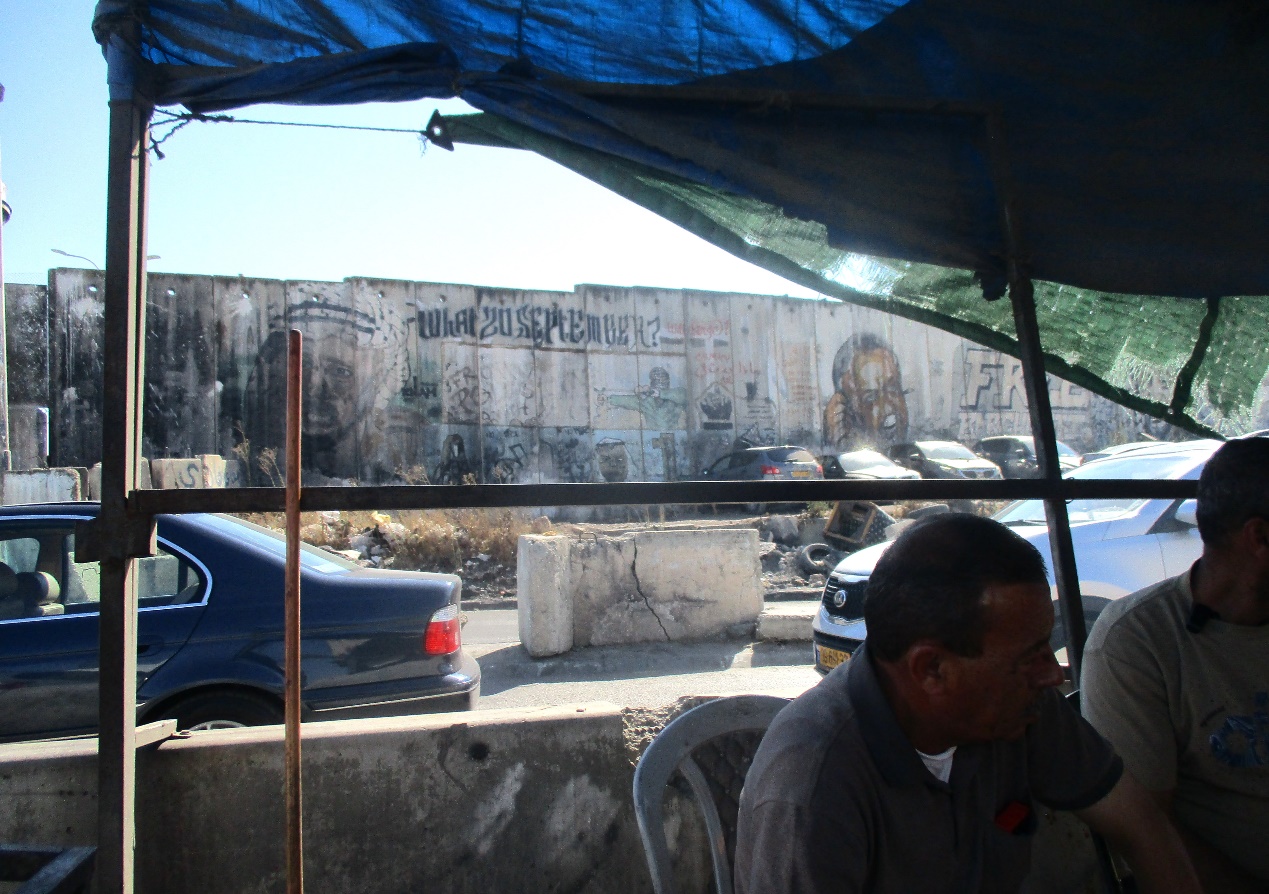 Tamar FleishmanJul-21-2026Qalandiya. Conversation in the shadow of the wall
-
