
Hebron and South Hebron
Hebron, Sunday 5.6.05, AMObservers: Ye’ela L., Paula R. (Reporting)We set out at 6:50 and returned at 11:30.In general: By the sides of the apartheid route 60 many pedestrians: Mainly, Palestinian workers and children in their neat school uniforms. Almost no Palestinian vehicle was on the road.In Hebron, Palestinian residents – old and young – welcomed us on the street or waved friendly from behind the barred windows. We saw the sights of occupation and heard tales of harassment. Some of the soldiers were curious and willing to talk to us, polite and even sympathetic and some were clearly hostile. Somewhere before the Sansana CP, the Border Police detained 8 Palestenians, who had not the necessary authorizations. Near the DCO a military hummer stopped a Palestinian truck. As soon as we stepped out, the hummer left. The truck driver said: “They were afraid of you”. He told that they stopped him when he wanted to get to his plot of land. On our return, Near Beit-Hagay, the soldiers of brigade Lavie and their commander were lecturing two drivers and inspected thoroughly a van and a taxi that stood on a narrow path of a steep slope. The van driver came to rescue the taxi, which was on its way to Beni-Naim and got stuck. “You disobeyed the law. You are not allowed to cross here. I do not care how you manage.” Finally, in a breathtaking operation the vehicles came down. “Now you drive up again. You are not allowed to be on this road. It is forbidden”. After long pleading, the commander took their authorizations again and told them to follow him on the road. We followed them to ensure that they would get back their papers.HebronThe guard, by the entrance to Kiryat Arba let us, unwillingly, in. We stopped at the Gutnik Center and from there we went on foot into the once thriving market streets, and now eerily empty. Apartheid roads in the heart of Hebron. The Palestinians, by the junction of Salah a Din and Nassr a Din streets are not allowed to walk on the road. Instead, they have to move in a narrow path along the houses. The path is formed by plastic bars. The PB have detained 3 Palestinian boys: “Arbitrary checking”. After over 20 minutes of detention, on our reminding, they were freed. An old man came over to us to talk. S’, the officer in command, spoke very respectfully with him (and with us). When the old man parted, he sought how to enter the barred path (it would not occur to him just to walk on the road to his nearby home). S’ opened for him the bar. A man wanted to be sure that the PB would permit him to drive a horse with a cart to the place were he builds a house. He got a day before permission. They did not know anything about it. After some phones, he is allowed to drive the horse. He explains to us: “Sometimes they let and sometimes they forbid. The cart is heavy.” He tells us further: “I am a ceramician. The head of the Israeli Ceramics Association has invited me to participate in a fair in Tel-Aviv. I got a special permit for one day. But in the morning soldiers stood outside my house and detained me. When I was allowed to go, it was already too late for me.” Occupation.One meets soldiers in their posts every few meters. Literally. Some of them are quite eager to talk and curious to hear what brings us to Hebron. To Ye’ela’s question, one soldier sees his main duty in Hebron as a shield to protect Palestinians from the settlers. “Sometimes they [the settlers] are friendly and invite us to drink and eat with them. Sometimes they gather in bands and we have to secure the welfare of the residents”. Yes, he sees our mission very favorable. O’, on the other hand, is convinced that his duty in Hebron is to protect the right of the Jews to settle wherever they wish in Eretz Israel. He does not like the cautions of the nearby settlers not to listen to us, as if his convictions are not firm enough. We too were seen as a security threat on some occasions. When we went to the neighborhood of Abraham (by the Machpela Cave), a settler in an American accent, quite aggressively and with a hinted threat, told us to leave: “This is a closed neighborhood!”Again, when we came to the CP that separates eerie Hebron from the lively Hebron of zone A, and we asked to get a glimpse of the life from the other side, a soldier in ziziths forbade us, and took our Ids, and called his superiors to ask if he could detain us, for causing unrest. Unfortunately, he could not. But still he managed to send a message on our way up to Tel-Romeida. A soldier barred our way, pronouncing the area a closed military zone. He would not show us the edict. (Of course it was illegal, as S’, the PB commander explained to us afterwards. Only an edict, signed by the brigade commander himself is valid). So, two women stirred some unrest in the “harmony” of Occupier-Occupied.We met TIPH volunteers patrolling, A Swedish and an Italian. They hope that by their being there they help somewhat to ease the oppression.
Hebron
See all reports for this place-
According to Wye Plantation Accords (1997), Hebron is divided in two: H1 is under Palestinian Authority control, H2 is under Israeli control. In Hebron there are 170,000 Palestinian citizens, 60,000 of them in H2. Between the two areas are permanent checkpoints, manned at all hours, preventing Palestinian movement between them and controlling passage of permit holders such as teachers and schoolchildren. Some 800 Jews live in Avraham Avinu Quarter and Tel Rumeida, on Givat HaAvot and in the wholesale market.
Checkpoints observed in H2:
- Bet Hameriva CP- manned with a pillbox
- Kapisha quarter CP (the northern side of Zion axis) - manned with a pillbox
- The 160 turn CP (the southern side of Zion axis) - manned with a pillbox
- Avraham Avinu quarter - watch station
- The pharmacy CP - checking inside a caravan with a magnometer
- Tarpat (1929) CP - checking inside a caravan with a magnometer
- Tel Rumeida CP - guarding station
- Beit Hadassah CP - guarding station
Three checkpoints around the Tomb of the Patriarchs
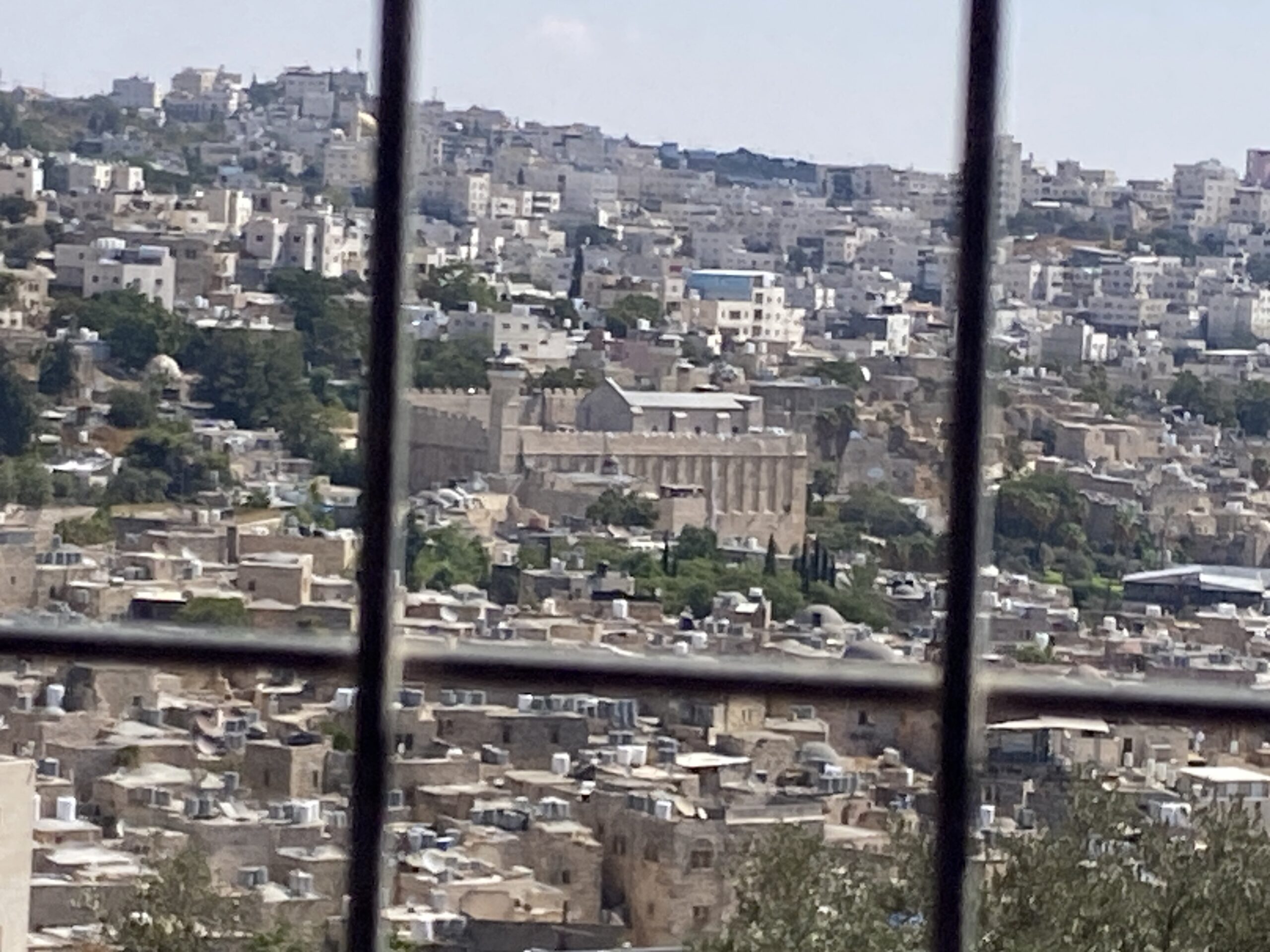 Yael ZoranSep-24-2026Hebron and the Cave of the Patriarchs from Beit Hashalom
-
