
Beit Ummar, Al Aroub, Etzion DCL and Nashash
Bethlehem. Tuesday PM, 8.8.2006 Observers: Ruth O. and Ilana D. (reporting) From 3:00 till 6:00 PMBeit Ummar, Al Aroub, Etzion DCL and NashashWe delivered medication from Yvonne to Muhammad and again wondered who would buy all the wonderfully exhibited plums along the roadside. In Beit Ummar were two detainees. We parked across the street to observe proceedings without talking to the soldiers. A truck was stopped and the driver had to unload all the empty cardboard vegetable cartons. It was clear to us (and also to the soldiers who lifted them as if to test their weight) that no bombs would be transported in the direction of Hebron. The only purpose was harassment. The father of the owner of the grocery store observed that people are usually held up and told to stand in the sun. Now at least they could sit down in the shade. The passengers of a cab had to get off to have their papers checked. The driver was told to proceed. The man said that students with low budgets would have to pay for yet another cab drive. He himself is well settled. He works for the UN and can freely travel in Israel although he is not in possession of a blue Id. He is married to an Israeli from the North. Like every summer they had been with the children to visit his wife’s family, but fled after two days. He had brought her entire extended family with him and had rented rooms for them in the refugee camp. He pointed to an approaching car with yellows license plates and said: “Another Israeli’. The woman spoke a beautiful Hebrew and asked whether she could join us. When we returned an hour later all detainees had been released.The waiting area in the Ezyon DCL was empty. A person who suffers from Rheumatoid Arthritis and has to go to the hospital in Jerusalem three times a week had been given an extension of his permit (which usually was for an entire month) for only a week. He told us he would meet us next week when he would have to spend another day waiting at the DCL. A few foreign citizens (Canadian and Swedish but born here) came with doctor’s attestations to try and get a permit to leave from Ben Gurion Airport. They come annually to visit their families and had also entered via Israel. The trip via the Allenby Bridge is too hazardous for them in the heat and in addition they would have to change their tickets in order to return home from Amman. They were given receipts for the documents they had deposited and told to return in a week which is after they’re due to depart. Dalia Bassa told them to call the DCL on Thursday re the outcome of their requests and if they were refused they should call her. Their return flights are respectively on Monday and Tuesday-morning.At the Ezyon junction we met a group of four young people who were detained for no reason. Since their cab has also left after they were taken off, we offered a ride to El Nashash to two of them who were on their way to Ramalla. On the way we learned that both of them are science students, one at the polytechnic school in Hebron, the other at El-Kuds. After they realized we are not defending all deeds of the army or the government, they told us that once they end their studies they will leave for another country. We claimed that when a Palestinian state will be established people like them will be needed. To that they answered: “Our government does nothing to bring about the building of a state, nor does it help us in any way”In Nashash our old friends approached us. They told us that Bethlehem is full of ‘refugees’ from Northern Israel who take the place of the tourists who have all left. A vendor of toy-dogs was angry at the world and told us that ‘everybody lies’. He was held up at the checkpoint of Sheikh Sa’ad and forced to sign that he entered Israel illegally despite the fact that he had not been past the CP. Since at Nashash there are only poor people she thought he might have more luck with the rich ones beyond Sheikh Saad and be able to bring some food to his children. His Hebrew is excellent, he worked for 25 years as the chef of the Sova Restaurant. A driver had forgotten to pay his 250 Sh. fine in time and we will try and pay it for him. The vendor saw that we were trying to help people and changed his attitude.Again we were told of cruel soldiers in Wadi Nar – “They must be Bedouin, Jews do not behave like that” – the queues stretch for miles when we are not in the vicinity apparently. And yet again we were told of Military Police blocking off the entrance to the Nashash by means of yellow cabs and leaving with their keys. Once they were caught by a high-ranking officer and told that this is illegal, but they continue with this practice. The complainant was told to write down the number of the jeep. He was afraid of revenge and was told that we would not inform on him. On the Southern side of the tunnel the blue police was giving tickets to a great number of drivers. Since the road is very narrow because of the huge construction works a long line of cars formed reaching all the way to Gilo where an accident had taken place at the intersection increasing the number of cars till the line reached Hebron Road.
Beit Ummar
See all reports for this place-
Beit Ummar
The Gush Etzion-Hebron road - which is the main axis of the southern Hebron Mountains - passes through the boundaries of the village. Many incidents of stone throwing occurred on this section of road. There is a checkpoint at the entrance to the village.
In March 2006, a 25-dunam land seizure order was issued around the settlement for the purpose of establishing a "special security area" (SHBM) and a warning fence around the nearby settlement, Carmei Tzur. In April 2019, 401 dunams of the land of the villages of Beit Omer and Halhul were expropriated for the purpose of paving a road that bypasses the house of Omer to the east. Demonstrations are held by the villagers against the seizure of land with the participation of Palestinian, Israeli and international activists.
-
Hebron
See all reports for this place-
According to Wye Plantation Accords (1997), Hebron is divided in two: H1 is under Palestinian Authority control, H2 is under Israeli control. In Hebron there are 170,000 Palestinian citizens, 60,000 of them in H2. Between the two areas are permanent checkpoints, manned at all hours, preventing Palestinian movement between them and controlling passage of permit holders such as teachers and schoolchildren. Some 800 Jews live in Avraham Avinu Quarter and Tel Rumeida, on Givat HaAvot and in the wholesale market.
Checkpoints observed in H2:
- Bet Hameriva CP- manned with a pillbox
- Kapisha quarter CP (the northern side of Zion axis) - manned with a pillbox
- The 160 turn CP (the southern side of Zion axis) - manned with a pillbox
- Avraham Avinu quarter - watch station
- The pharmacy CP - checking inside a caravan with a magnometer
- Tarpat (1929) CP - checking inside a caravan with a magnometer
- Tel Rumeida CP - guarding station
- Beit Hadassah CP - guarding station
Three checkpoints around the Tomb of the Patriarchs
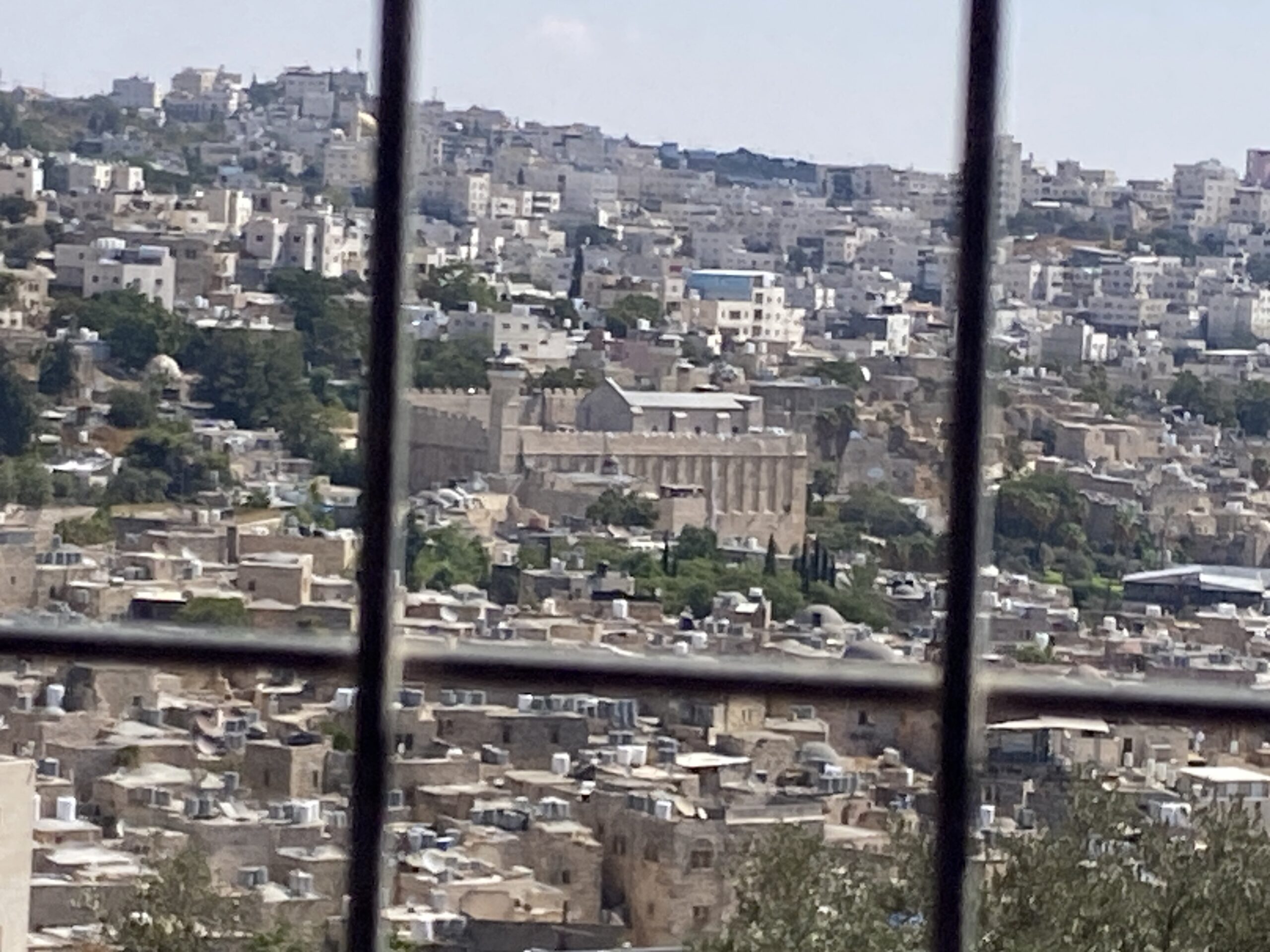 Yael ZoranSep-24-2026Hebron and the Cave of the Patriarchs from Beit Hashalom
-
