
HEBRON AND SOUTHERN HEBRON HILLS
HEBRON AND SOUTHERN HEBRON HILLS, 3.5.07 reporting: Mira B & Ofra B 08:30-12:00Road 60 – Machsom Meitar (Sansana) no lineIllegal outpost Eshtamoa – we saw troop movement on the site. The construction of the permanent building has advanced a lot; now it’s on its final construction stages – closing the roofDaharia : a trailor full of sacks standing; back-to-back transfer of the sacksNear Karame, a Palestinian cab stands on the side of the road. A donkey with water jugs, ridden by a young boy, crosses the road.Dura – open. Sparse movement of people. A “sufa” jeep stands near the observation post Mt. Manoach – in front of Hebron DCO a crane loads betonades. (and we thought that all along the road there are betonades – we were apparently wrong) Sheep Crossing – openThere are a few new piles just after the checkpoint preventing vehicles from crossingBnei Naim – in front of the settlement entrance there is a police checkpointHebronNear the disputed house we met an acquaintance. He told us about a case in which a complaint against a child was submitted; he called the boy (about 8-10 years of age) and after a few minutes his father came, too. Both of them told us the following story::A few days ago Shady (the boy) was playing the ball with some friends. During their game a settler boy passed by (the son of Anat Cohen – the same woman who last nearly ran over a Palestinian child with her car, the same woman who participated in the brutal assault of Mira and Michal using a fire hose). The ball hit the settler boy. The boy filled a complaint to the police and the policemen came to arrest Shady. His father objected at first, but when the policemen threaten to come at night to arrest him, he joined them together with his son to the police station in Kiriat Arba. At the police station Shady was investigated by a policeman named Yossi (who apparently was not a children investigator). The father (Naser Jaber – 0522363965) asked the policeman to check the cameras dispersed all over the area, but the policeman threaten to throw the father out of the police station. During that time the policeman said once toward Naser that if that was his boy – he would have dismissed the complaint, but as being involved the son of Anat Cohen – he has no choice. At the end of the inquiry the father was summoned to the court on 18/6. In addition, he gave a 1000 NIS deposit.Pointless to say that no complaint submitted by us to Hebron police station against the settlers was treated so efficiently. Beit RumeidaA police jeep with two policemen inside stands at the junction. They never heard of MachsomWatch. A group of six people of the Red Cross are waiting for entrance permits to Tel Rumeida. An older person approaches the soldier telling him something about a water pipe problem caused because of the army construction work in the area. We want to join Muhamad Hamed Abu-Ayshy to his house to see what exactly happened. The soldiers refuse to allow us to enter the neighborhood. We demand to see the edict and explain him that if there isn’t any – he has no official authorization to stop us from going there. There starts a discussion. The soldiers lye telling us there exists an edict but it’s not there… It is very clear that they have no idea what they are talking about. As in every military government the soldier is convinced that because he holds a gun he is right and he is not going to let us pass. He does not care much about the orders and the rules. He ignores our request to talk to his commander or to bring here the closed military area edict. The policemen standing there interfere and ask to see our documents. Mira, with diplomacy and maintaining self-control, explains the policeman that she is an Israeli citizen and that he must protect her rights offended by the soldier in that situation. It does not seem that the policeman really understands the problem and he does not know the laws and he asks to see the documents. We give him our ID cards. He runs them at his station and in the meantime there arrives a lieutenant. He starts talking to us, but stops immediately and runs a long conversation on his mobile phone. After a few minutes he stops and asks us with contempt and hostility what’s the matter. We ask again to arrive at Tel Rumeida. He speaks on the mobile phone again and a few minutes later, dragging time, he allows us to enter into the neighborhood. Using a patronizing military diction, in his kindness, he even promises us an escort by his soldiers (what kindness).We climb the hill looking for Muhamad and the Red Cross group who have already entered in one of the houses. One of the soldiers standing at the top of the hill tries to point us where they entered. He asks his friends to show us where they went, but they refuse claiming that we are not nice. We find the house and enter inside. Th Red Cross people are not interested in learning about the case in our presence (it’s somewhat absurd, but they are mentioning the need for secrecy and independence of their organization and the desire of not being identified with anybody – settlers, army or even not MachsomWatch). We talk to Muhamad who tells us about the family history. It seems that he enjoys presenting his theory and ideas about cooperation between Arabs and Jews. We did not understand, nor did we see what exactly happened to the pipe and it’s important to come back Sunday to see what happened.The phone number at their house is: 022229313 (it’s a house called cage, in which was filmed the settler calling sharmuta, cursing).For the following shifts:- it’s important to enter the house again with a translator, to hear what happened and to report in detail- – – it’s important to continue to enter the neighborhood so that the soldiers get used to that and also that the settlers see us more.- – The disputed house – we stop when we see a pipe that looks new (it’s not clear whether it’s a pipe of electricity or water, but it arrives from Kiriat Arba). Four soldiers sit under the “shadowing sheet” erected near the disputed house (a new little army settlement). There is one on the roof of the house, too, and it looks like the soldiers are here to stay (as the settlers). We take pictures here. A BP soldier comes out and asks for our documents. He is insecure. It’s clear he doesn’t know he is allowed to do this and that he does not know the rules. We ask why should we present our documents and he mumbles something about pictures and such. His mobile phone rings and we continue walking without showing any documents. – – It’s a pity they that the soldiers aren’t taught about what they are allowed and forbidden to do. I think that would calm them a bit and strengthen their self confidence.- – Road 356 – till the junction we count nine barriers (it’s not clear whether new or old).- – Tzomet Ziv- Open- – Road 317 – we count nine barriers seeming to be new or old- – At Carmel we see signs of new construction work near the road
Hebron
See all reports for this place-
According to Wye Plantation Accords (1997), Hebron is divided in two: H1 is under Palestinian Authority control, H2 is under Israeli control. In Hebron there are 170,000 Palestinian citizens, 60,000 of them in H2. Between the two areas are permanent checkpoints, manned at all hours, preventing Palestinian movement between them and controlling passage of permit holders such as teachers and schoolchildren. Some 800 Jews live in Avraham Avinu Quarter and Tel Rumeida, on Givat HaAvot and in the wholesale market.
Checkpoints observed in H2:
- Bet Hameriva CP- manned with a pillbox
- Kapisha quarter CP (the northern side of Zion axis) - manned with a pillbox
- The 160 turn CP (the southern side of Zion axis) - manned with a pillbox
- Avraham Avinu quarter - watch station
- The pharmacy CP - checking inside a caravan with a magnometer
- Tarpat (1929) CP - checking inside a caravan with a magnometer
- Tel Rumeida CP - guarding station
- Beit Hadassah CP - guarding station
Three checkpoints around the Tomb of the Patriarchs
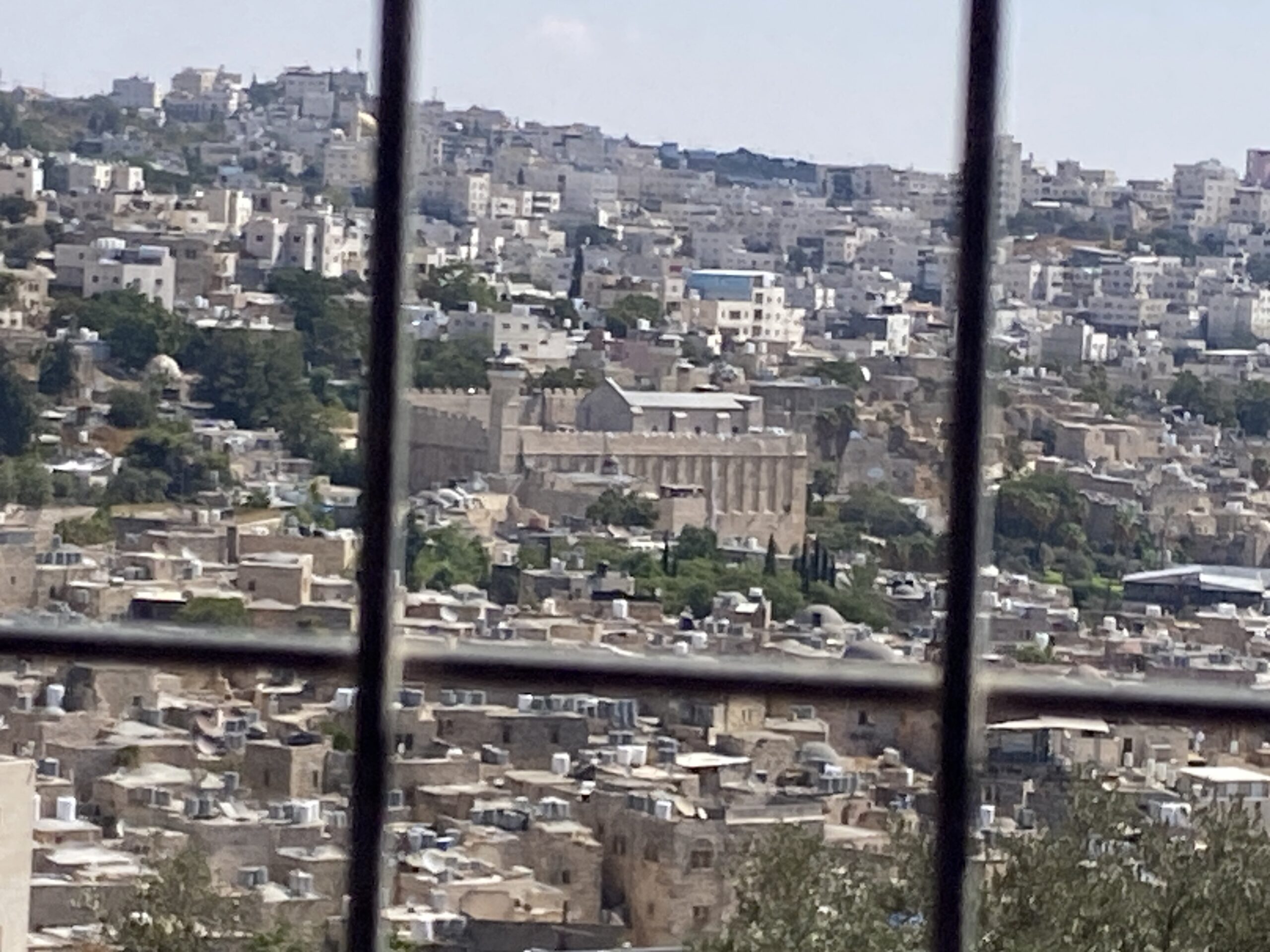 Yael ZoranSep-24-2026Hebron and the Cave of the Patriarchs from Beit Hashalom
-
