
Qalandiya
The procession got under way with the slogan “Hunger – Yes, Oppression – No!”
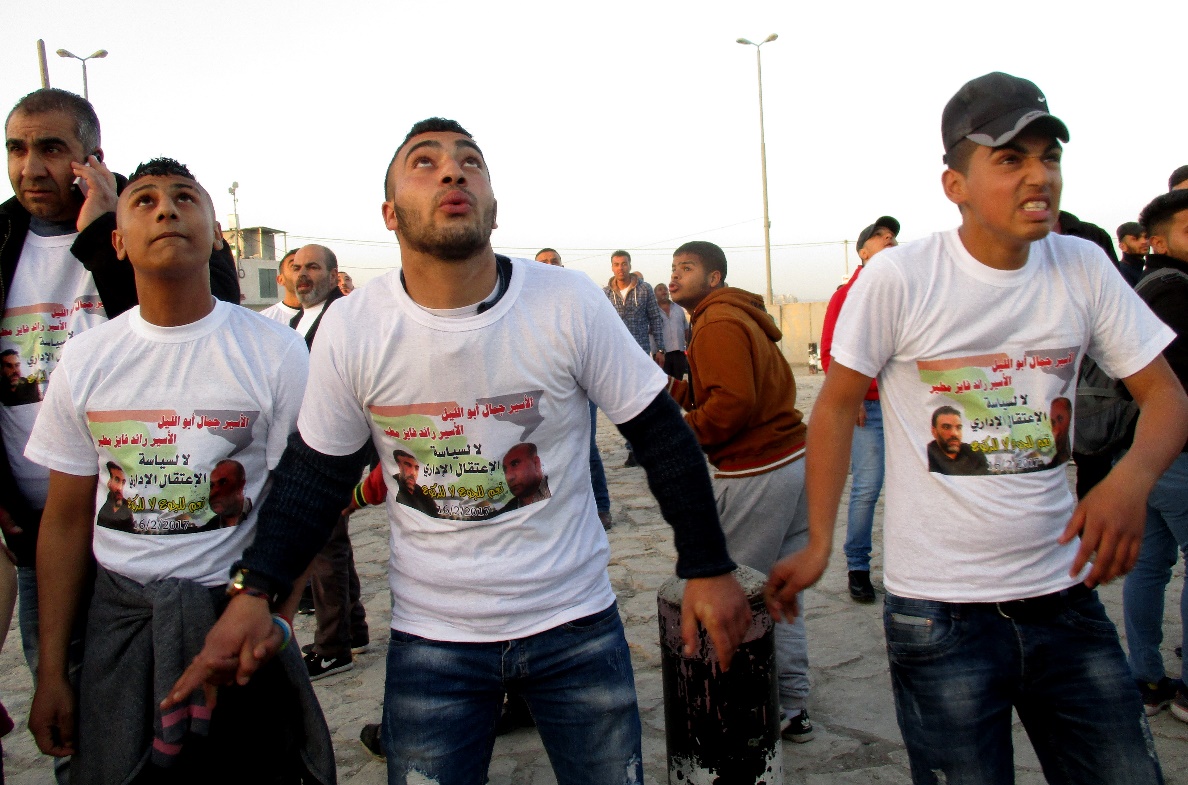
This is the second that passes from the moment one hears the whistle of the gas grenades fired directly at the demonstrators and those at the margins of the demonstration, and the moment they hit the ground, turning the air into a thick, smarting smoke screen that caught us all in a choking noose.
The human chain was disbanded, we no longer saw each other, and dozens of people who had come, shouting loudly, to the checkpoint to demand the release of administrative detainees Raed Faiz Mutir and Jamal Abu Lil, Qalandiya refugee camp leaders hunger-striking in protest of their false arrest – were dispersed.
Those who have no basic human rights do not have the right to shout in protest either.
-Thanks to Vivy Sury for helping find sources of Maan News Agency.
Ahmad’s father has a brain tumor. His Jenin doctors sent him on to the Muqassad Hospital in East Jerusalem. He is supposed to undergo a risk-test which would determine whether to be operated in Muqassad or at Jerusalem’s (Israeli) Hadassah Hospital.
The back-to-back transfer procedure was already under way, the patient had already changed stretchers, a soldier had already photographed the two green IDs (Ahmad’s and his father’s), money for the ambulance services had already changed hands, and even the large black bag containing Ahmad and his father’s belongings had already been opened and inspected. But then, one small step away from their being here – at the checkpoint – and there – on their way to the hospital – everything stopped. “You cannot proceed, you have no permit” said the security official to Ahmad.

Ahmad froze. This is not happening. He had made sure ahead of time that all the required permits were in order. What happened? The father froze, too. Without Ahmad he is lost. But he was already lying in the ambulance on its way to Jerusalem.
A series of phone calls followed.
“We’re looking into it” the voice said at the health hotline. “Perhaps in a little while”.
Ahmad, hoping the confirmation would arrive and he would be able to proceed to join his father by bus, continued to wait. The Jenin medical team was waiting too, and the security official, taking pity on Ahmad and trying to encourage him, said “Perhaps, they’ll allow it… Maybe in half an hour… maybe tomorrow…”
When that half hour passed, and more time passed, Ahmad only had “perhaps tomorrow” left, and with that he headed back to Jenin.
So perhaps tomorrow – but then, maybe not.
**
Transporting a wheelchair from Jerusalem to Palestine is no simple matter, even dangerous.
Two fellows arriving at the checkpoint entry with a wheelchair found themselves stuck.
Even folded, the wheelchair was wider than the space between the metal arms of the turnstile. True, there’s a special gate for carts/wheelchairs etc., but it is locked. No one to open it, no key.
I entered and managed to get the attention of a soldier. “Let them pass through the vehicle lane”, he yelled through the tempered glass window. “It’s dangerous, gunfire!” I yelled back, but he was no longer listening, no longer there.
I couldn’t go back. It’s one way. SO the guys and I decided I’d get to them behind the vehicle lane fence.
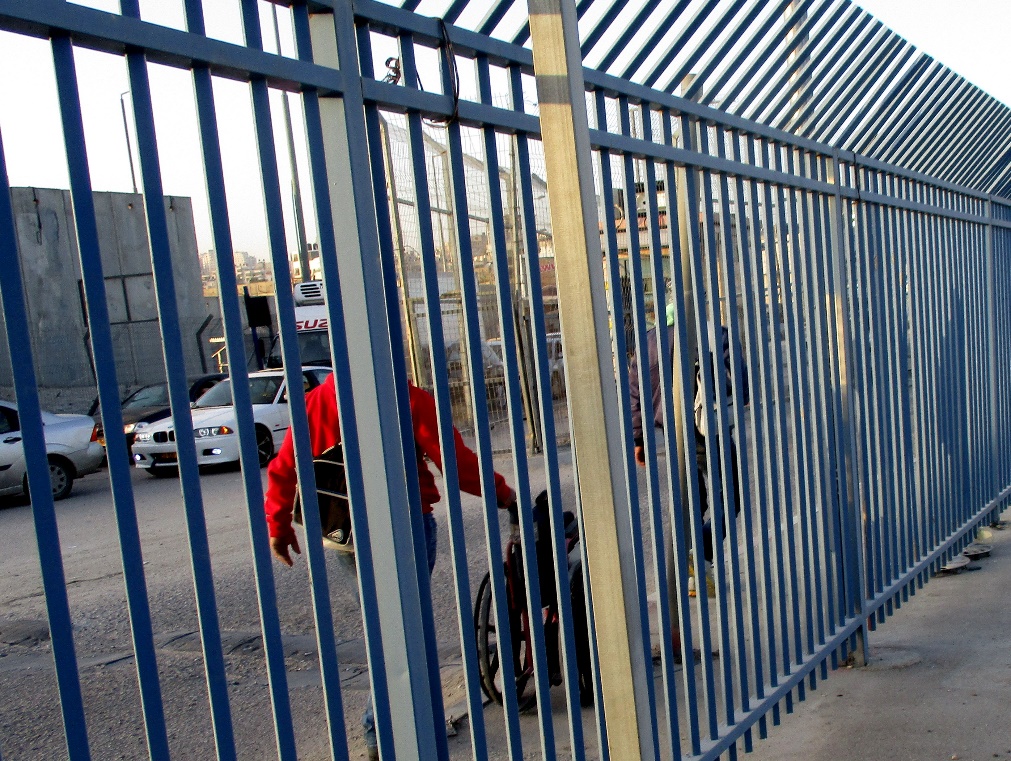
I hurried, close to the blue fence, the one no Palestinian dares approach because “It’s forbidden!”, and beyond it lies a killing field. Everyone knows that whoever walks in the vehicle lane might be shot. Between the metal rods I yelled to the police and security officials that it’s okay, that the soldier said, that… the guys and the wheelchair proceeded towards me, passed me by and got out of the checkpoint compound safely.
I don’t know, perhaps the soldier phoned and informed the policemen, perhaps my yelling did the job, I just know that only when the fellows and the chair passed the danger zone did I notice my pounding heart, and only then could I breathe in relief.
Qalandiya Checkpoint / Atarot Pass (Jerusalem)
See all reports for this place-
Click here to watch a video from Qalandiya checkpoint up to mid 2019 Three kilometers south of Ramallah, in the heart of Palestinian population. Integrates into "Jerusalem Envelope" as part of Wall that separates between northern suburbs that were annexed to Jerusalem in 1967: Kafr Aqab, Semiramis and Qalandiya, and the villages of Ar-Ram and Bir Nabala, also north of Jerusalem, and the city itself. Some residents of Kafr Aqab, Semiramis and Qalandiya have Jerusalem ID cards. A terminal operated by Israel Police has functioned since early 2006. As of August 2006, northbound pedestrians are not checked. Southbound Palestinians must carry Jerusalem IDs; holders of Palestinian Authority IDs cannot pass without special permits. Vehicular traffic from Ramallah to other West Bank areas runs to the north of Qalandiya. In February 2019, the new facility of the checkpoint was inaugurated aiming to make it like a "border crossing". The bars and barbed wire fences were replaced with walls of perforated metal panels. The check is now performed at multiple stations for face recognition and the transfer of an e-card. The rate of passage has improved and its density has generally decreased, but lack of manpower and malfunctions cause periods of stress. The development and paving of the roads has not yet been completed, the traffic of cars and pedestrians is dangerous, and t the entire vicinity of the checkpoint is filthy. In 2020 a huge pedestrian bridge was built over the vehicle crossing with severe mobility restrictions (steep stairs, long and winding route). The pedestrian access from public transport to the checkpoint from the north (Ramallah direction) is unclear, and there have been cases of people, especially people with disabilities, who accidentally reached the vehicle crossing and were shot by the soldiers at the checkpoint. In the summer of 2021, work began on a new, sunken entrance road from Qalandiya that will lead directly to Road 443 towards Jerusalem and Tel Aviv. At the same time, the runways of the old Atarot airport were demolished and infrastructure was prepared for a large bus terminal. (updated October 2021)
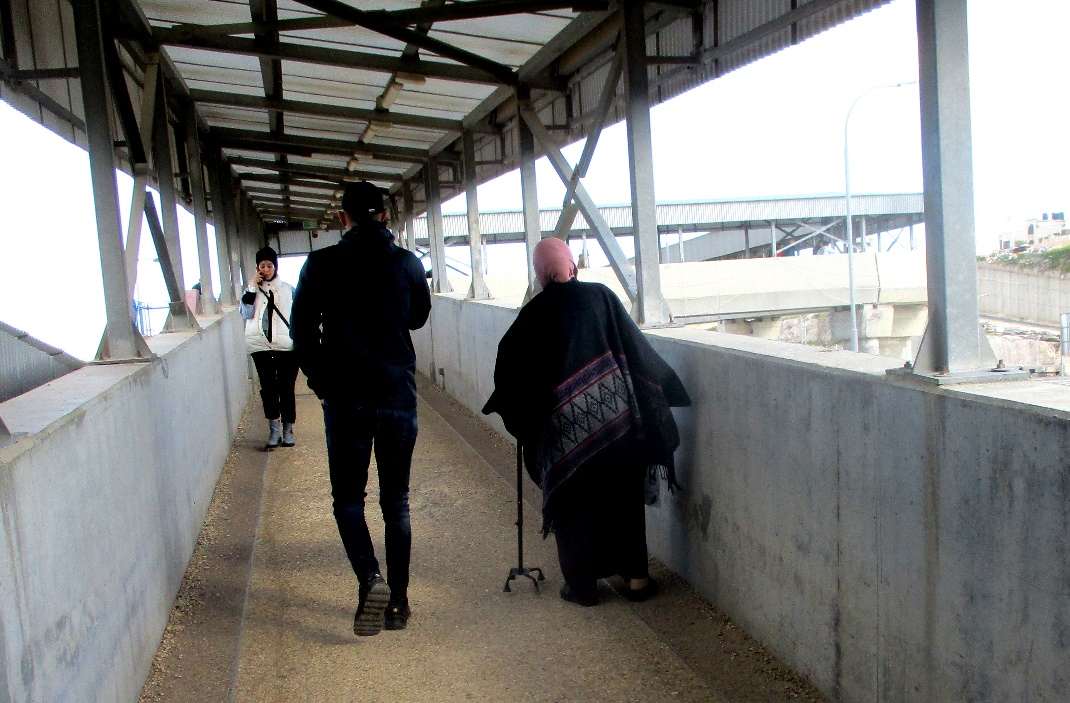 Tamar FleishmanJun-28-2026Qalandiya. The bridge leading from Jerusalem to the Qalandiya checkpoint
-