
Jordan Valley: Where should we escape to? Where is it less dangerous?
Families visited, protective presence, erection of an equipment storehouse, and a bit about colonists
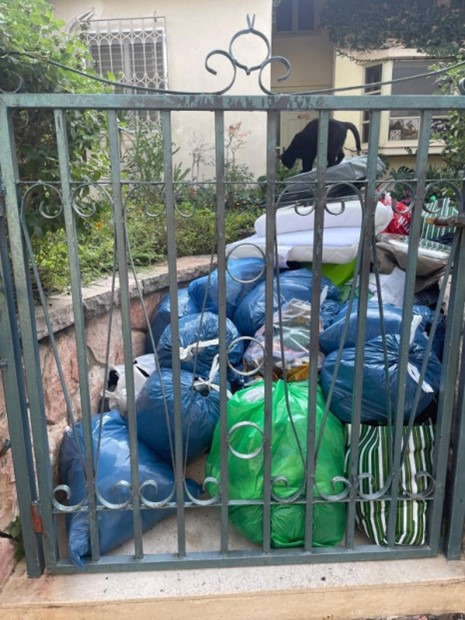
Two days before we went to the Palestinian Jordan Valley, Bosmat helped me packing all the clothes I accumulated since last summer. A room full of sweaters and trousers, was all loaded on Yuval’s transit. In addition to the car filled to bursting was a hanger filled with more packages. We took down everything in of the villages and opened a storehouse that would enable all shepherds in the area to come and take what they need.
These days are very hard. Palestinians – adults and children – discuss with us the question where they should escape to. Where would they be in less danger.
“Did you hear what happened in Hadidiya?”
“No”.
“A colonist came and began erecting an outpost”.
“Really?”
“Right in front of S.’s house”.
We took part in a condolence visit to a family whose son died suddenly from a heart attack. A 35-year-old. Then we saw a group of young colonists congregating in the colony whose last house overlooks us. The family went into fight mode, and the father imagined the discussion taking place above us. What should we do, the colonists wonder. Go to the spring or down to the family? Divide into groups: some will do this, and some the other.
We stood and waited. Most of the group went down to the stolen spring near us, and some remained. Finally, the group came back up from the spring and the show dispersed.
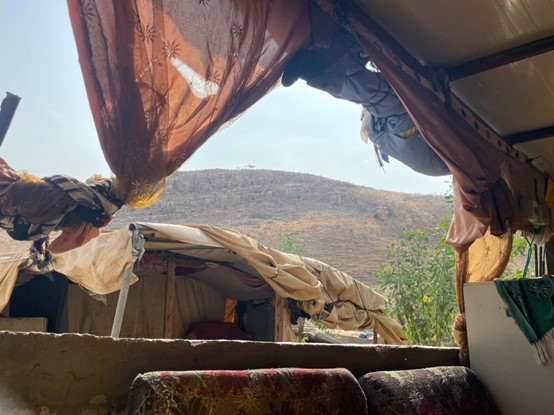
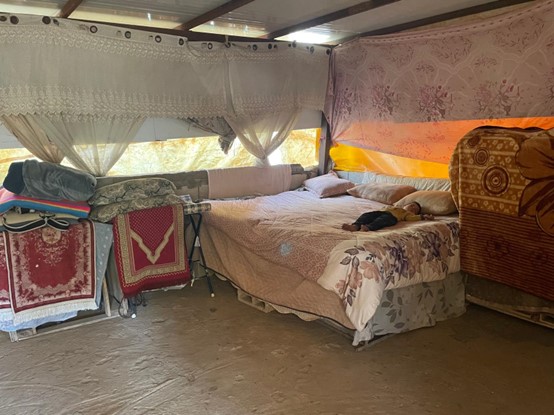
After accompanying the cattle flocks of the two families to the spring, we were invited to share tea with the small known community. We were surprised by the beauty and cleanliness of their residence. “The Stan would arrive or not”, they continue what they are doing. One of them, a tough, energetic young woman, taught us their new nickname for the colonists: in Arabic a colonist is mustautan. She took off the extra letters, and stan remained, good enough. Going down to the spring, she saw the stan from a kilometer away. We saw nothing.
We brought them packages and clothes, too, and they wanted food as well and a doctor to cure their illnesses, and they want to live.
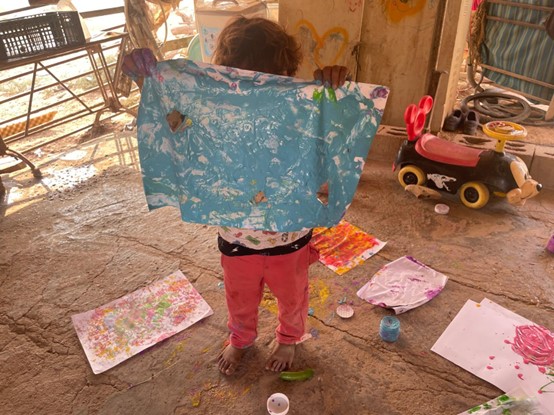
Elsewhere we drew whoever of the children wanted finger paints. We took two guys to En Beda to cut corn for the sheep to eat.
The race for sheep feed has many faces. In this dry time of late summer they eat everything. From almond shells to remains of organic waste and other unrecognized materials unknown to anyone.
There is no cash around. Good change hands in exchange. Feed in exchange for lambs. But the lambs are tiny and carry no price. One must wait for two months so they grow and take on some weight.
Everyone imagines the rare rain, that begins here as this is being written. Hopefully it will rain there too, fill the ravines for a moment. I read that it has. Thank goodness.
At Izdarechet meeting place we met a new guy and all concluded that there is no need of clothes, only food for humans and animals. It is an old conclusion but actual nonetheless. There is a flock that has not received any food for there simply wasn’t any! Whatever that means for whoever understands.
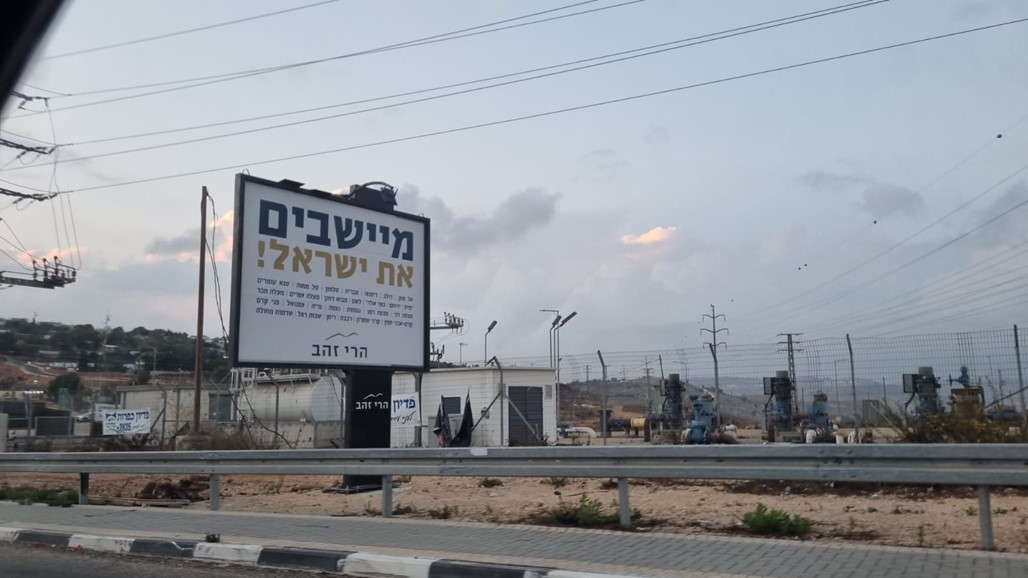
Road 4 from Shaar Shomron until it splits to either the Jordan Valley or Jerusalem was filled with Israeli flags on both sides. A flag every 5 meters. Terrible sight. Not photogenic. The camera didn’t want all these flags. For perhaps 30 kilometers in the west bank, all flags. At the end of the road, from which one literally falls into the Palestinian Jordan Valley, soldiers and colonists met. The feeling was that something is taking place that we are not privy to. Perhaps a celebration of annexation without being formally announced?
Location Description
Jordan Valley
See all reports for this place-
Jordan Valley The Jordan Valley is the eastern strip of the West Bank. Its area consists of almost a third of the West Bank area. About 10,000 settlers live there, about 65,000 Palestinian residents in the villages and towns. In addition, about 15,000 are scattered in small shepherd communities. These communities are living in severe distress because of two types of harassment: the military declaring some of their living areas, as fire zones, evicting them for long hours from their residence to the scorching heat of the summer and the bitter cold of the winter. The other type is abuse by rioters who cling to the grazing areas of the shepherd communities, and the declared fire areas (without being deported). The many groundwaters in the Jordan Valley belong to Mekorot and are not available to Palestinians living in the Jordan Valley. The Palestinians bring water to their needs in high-cost followers.
 Bosmat HetzroniSep-24-2026Khalet Makhul – An unnecessary cleanup operation...
-
