
חבלה, מעבר אליהו, יום ג’ 5.10.10, בוקר
.
06:45 Habla gate
The checkpoint opened at 06:30.
Reserve soldiers on site, including two officers when we arrived. They let people cross in groups of five directly from the gate on the Palestinian side, but they stand in the middle of the crossing, not next to the gate. From time to time they scold people, telling them not to come through the gate until they’re called. It’s not crowded and people cross quickly. The guard booths at the Israeli gate are unmanned.
06:53 Two buses arrive with the schoolchildren. They wait until the five people being inspected come through – three minutes. The luggage compartments in the hold of the bus are inspected quickly and superficially, and the buses drive on.
The people coming through say the gate remains open even until 08:30.
07:30 Eliyahu crossing
Ten vehicles waiting.
08:10 Jayyous
We sat with M. next to the grocery store. He returned to his village after spending years in Saudi Arabia. T., who speaks Hebrew, also came over. We first discussed the acute water shortage. The villagers have no water for a few days every month. It’s been that way for four years. The village has about seven wells that are inaccessible on the other side of the separation barrier, and not everyone has a well in his courtyard. In addition, in the wadi between Jayyous and Azzun, at the site of a planned sewage treatment plant, the army prepared a helicopter landing zone. The plan to lay a water line (the infrastructure for pipes already exists) with foreign funding is delayed because of bureaucratic and other obstacles caused by Israel, despite a Supreme Court decision. A third man who arrived brought updated information from the municipality – according to the mayor, Israel has already agreed. Now they have actually to implement the promised foreign funding.
M. reported that the grove owned by his family has dried up because of where it’s located and because he can’t work and irrigate it.
All of them complained about the continuing night raids by the army. The most recent occurred two days ago. A shop was also broken into.
The conversation concluded with a discussion of the content of school texts used by both sides.
We left our card, and the phone number of “Yesh Din.”
The people with whom we talked and drank coffee made very clear to us they feel they’re living in a jail, unable to control even the most trivial aspects of their lives.
09:50 We continued to Kafr Sur and then to Isla and Izbat al Tabib. We met N., an instructor from the Ministry of Agriculture, who told us that community olive presses had been established (we also saw them). He complained that settlers were harassing the farmers from Jit who came to harvest olives, and that despite the permits he has and his work with the Israeli ministry, he has to wait unnecessarily for a long time at the checkpoints into Israel and back, mainly because he’s young (under 31).
We returned via the Eliyahu gate and Nebi Elias.
Eliyahu CP (109) / Crossing
See all reports for this place-
Eliyahu CP (109) / Crossing This checkpoint, also known as the Fruit Crossing, is one of the main checkpoints between Israel and the West Bank. It is located on Route 55 between Alfei Menashe and the turn to Qalqilya and Zufin, more than 4 km east of the Green Line, in the separation fence, which separates Qalqilya from its lands to the south, thus leaving Alfei Menashe West of the fence - the Seam Zone. This checkpoint, a few kilometers across the Green Line, is intended for "Israeli settlement in the West Bank and the population of the Seam Zone." It is managed by a civil company. Palestinians with a special permit for their lands in the seam area are also allowed to pass through it, on foot, and sometimes by car.
-
Habla
See all reports for this place-
Habla CP (1393)
The Habla checkpoint (1393) was established on the lands of the residents of Qalqilya, on the short road that
connected it for centuries to the nearby town of Habla. The separation barrier intersects this road twice and cut off the residents of Qalqilya from their lands in the seam zone.(between the fence and the green line).
There is a passage under Road 55 that connects Qalqilya to the sabotage This agricultural barrier is used by the farmers and nursery owners established along Road 55 from the Green Line and on both sides of the kurkar road leading to the checkpoint.
This agricultural checkpoint serves the residents of Arab a-Ramadin al-Janoubi (detached from the West Bank), who pass through it to the West Bank and back to their homes. The opening hours (3 times a day) of this agricultural checkpoint are longer than usual, about an hour (recently shortened to 45 minutes), and are coordinated with the transportation hours of a-Ramadin children studying in the occupied in the West Bank.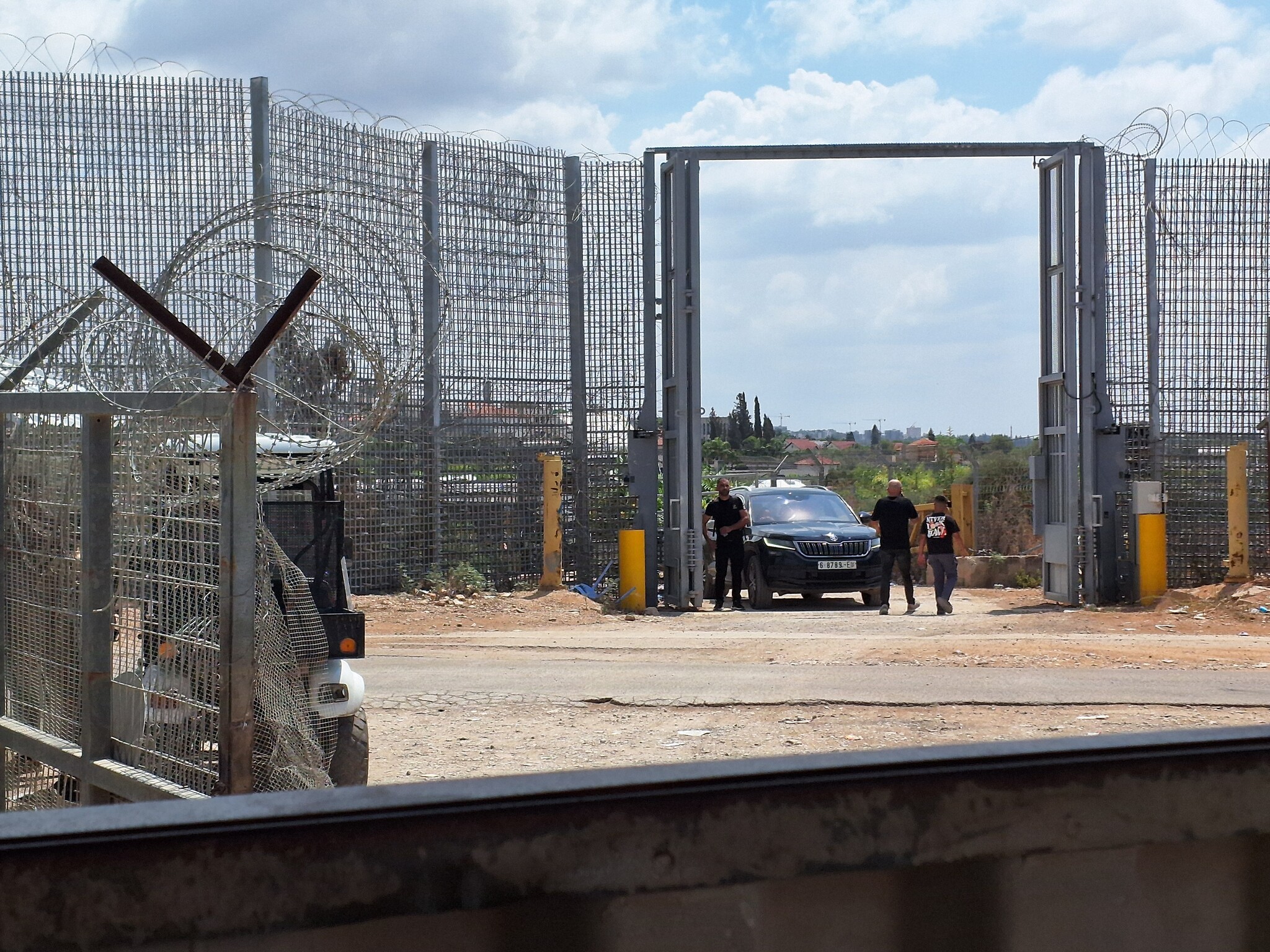 Ronit Dahan-RamatiAug-31-2026Habla. The gate is open
-
