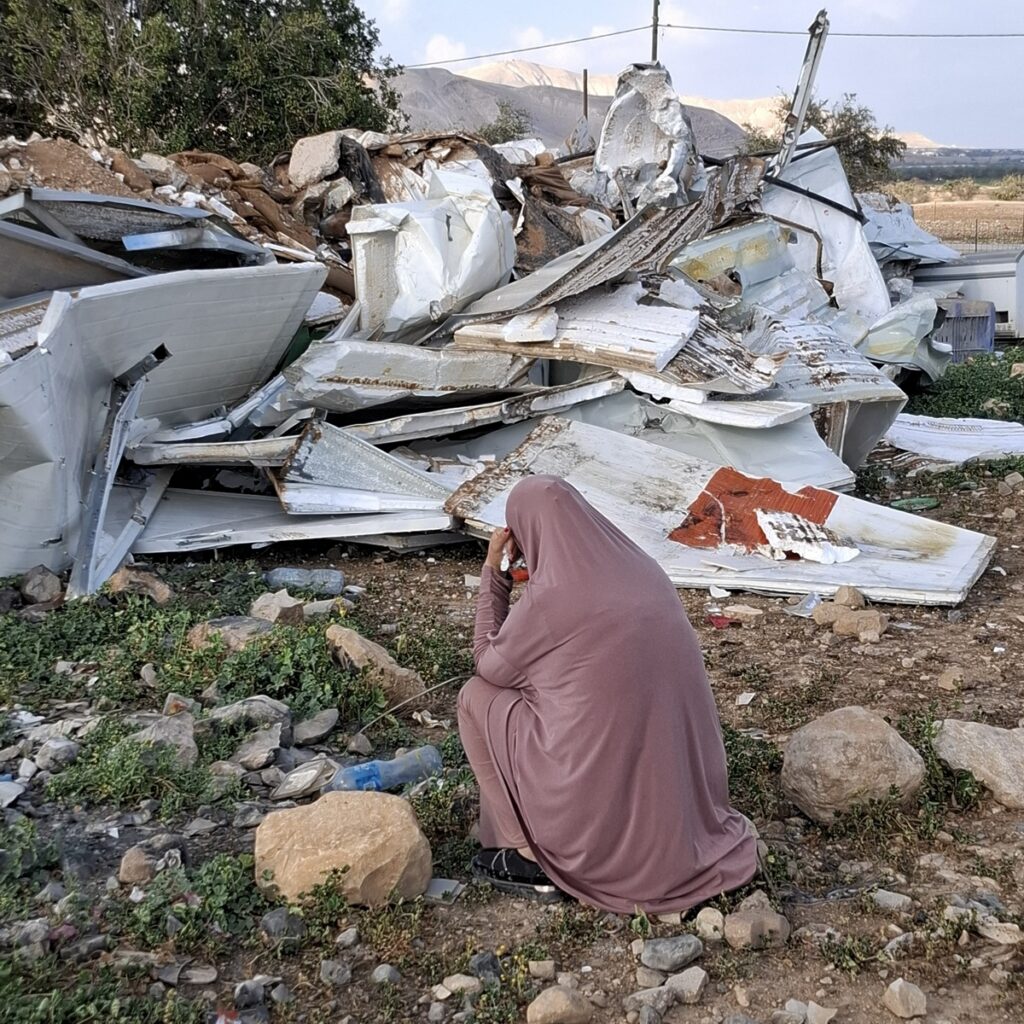
Threat of further demolition of tents at Khalet Khader (near Farissiya), following the two demolition operations carried out in the two recent months. Bedouins of the Palestinian Jordan Valley fear traveling the West Bank roads to market their produce. Entrances to the villages of Akraba and Jawarish have been blocked for over two months. What have they done wrong?
Tapuach-Zaatara Junction checkpoint
We did not see any vehicles being inspected. On our way back around 16:00, an army jeep was monitoring the road near the turn southward. Much construction material ready for work was seen around the junction, in addition to the fenced pedestrian paths constructed lately to the south and east of the junction.
Majdal Bani Fadel Junction
We stopped in a strange traffic jam on road 505. On the access road to the village was an army jeep parked, with a soldier standing on its roof, his weapon pointed, while other soldiers were standing on the ground, weapons pointed as well. When a car arrived from the village they stopped it for inspection, and after a minute or two it proceeded on its way. We disembarked to inquire what created this traffic halt on road 505. At the head of the line was an army jeep, keeping the traffic at a standstill. One of the soldiers said it was because of army maneuvers and that the road would be opened shortly. A minute later the road was opened.
Maale Efrayim checkpoint 10:30
Two armed soldiers stand in the rain at the junction. A private Israeli vehicle was parked alongside the watchtower, seen both on our way there and back.
Hamra Checkpoint
We observed construction work near the watchtower. When we approached, the checkpoint commander came and waved us away from the military installation, gently. Since we do not spend much time at that checkpoint, we did not argue with him. He was an easygoing and polite reservist. HE promised that although only one track is open to movement at the checkpoint (some many months now) he makes sure no long waiting lines form there. He seemed credible. On our way back at 15:30. A time when people are on their way home from work and there are usually long lines of vehicles waiting at the checkpoint, there were four cars waiting to cross from the east.
A visit with the Abdel Kader family
Near the Kfir Brigade HQ – the women are busy preparing cheese (see photo). They said that in the past they would sell their cheese in Ramallah, where prices seem to be higher. Now travel on the West Bank roads raises fear of being shot by soldiers, and the furthest they dare travel is to Nablus.
A visit with the Sabih family at Khalat Khader
On February 11, 2016, the tent of this friendly and welcoming elderly couple was demolished. We did not hear a word of complaint from them at the time. Two and a half weeks later, after receiving a small tent from the Red Cross, and while their belongings were still spread out in the open, their tent was demolished for the second time (February 29). We got there by chance that very day, and sat with them under the seething sun, without a bit of shade anywhere nearby. They seemed rather despairing that time. Now, after a month and a half without shelter, they seemed happy. Two new tents, one for kitchen purposes and the other for everything else, shone in the sun. They receive them a week ago from the Palestinian Authority, a gift from the European Union. Everything is shining clean and neat (in the photos below). They said that yesterday an Israeli army film crew came and filmed the new tents from afar. They fear this signals a new demolition order. From our experience, they might very well be right. We can only pray… They have been living there for about 40 years and making their living from farming in land that they lease, and from beekeeping. Their sons work with them, and their grandchildren come there from school every day to eat at grandma’s. One of the sons and two grandchildren live with them on a permanent basis.
Regional Councils of the Bedouin inhabitants in the north of the Palestinian Jordan Valley
From talks with families we learned that the Bedouins here have their own regional/municipal institutions although they are scattered in small family communities. Each region has a council (majles) made up of residents of the area, headed by a chief councilman. They are elected by heads of families, and receive backing and perhaps some financing from the Palestinian Authority. They mediate between the PA and the people of the area, and are supposed to provide for their welfare. They do receive donations from various sources, apparently. Since there is no tradition of government change, nor of informing the members of the council and reporting financial and other actions in any orderly fashion, naturally people suspect their handlings.