
Abu Dis, Container (Wadi Nar), Ras Abu Sbitan (Olive Terminal), Sheikh Saed, Mon 4.2.08, Afternoon
The sunny weather and the wonderful visibility stood out in a sharp
contrast to the sad sights and filth we saw all through our shift.
We started at Abu Dis on the western side of the wall. At the Pishpash
stood about eight boarder police soldiers, no Palestinians crossed.
One of the BPs was an officer who remembered us from some time ago in
Sheich Saed. He was very friendly and told us that only 350 people are
allowed to pass there. He also told us that the wall might be moved so
that these people will be included in the western side of the wall and
the pishpash will be closed.
We drove to the Zeitim crossing which looked rather deserted, very few
people crossed, mainly women. We decided to go to the other side of
the crossing via the Maale Adumim road. The checkpoint at the exit
from A Zaim village seemed unmanned. We turned to go through Azaria
but then noticed the red sign that has been put up in various places
lately, that forbids Israelis to enter. What does that mean? Is this
situation here to stay?
We drove on via Kedar to the container. There were no lines on either
side. A bored soldier carried on long telephone talks planning some
party while at the same time waving his hand toward the cars to pass.
Very few cars were checked. One taxi that arrived from Bethlehem was
stopped, papers were examined but after a few moments the taxi was
sent on its way. The turnstile for the pedestrians was stuck and they
all squeezed through a very narrow path next to it. A group of workers
returned from a days work building in Maale Adumim.
We continued to Sheich Saed. In order to go from one place to the
next, only a few kilometers apart one has to drive long and twisted
ways. This, of course, is the fate of those "lucky" Palestinians who
hold passing permits. We went to Ras El Amud and from there drove
along the road that is ironically called "The American way". The road
(under the jurisdiction of the Jerusalem municipality) is full of
holes and is getting filthier and filthier. Large heaps of building
waste surrounds it on both sides and on top of them garbage of all
kinds "pave" the road. Children run almost into the car wheels. A
third world just next to the Jerusalem fine neighborhoods.
At Sheich Saed the newly built checkpoint is manned by two or three
boarder police soldiers and the same number of civilian guards. We
were not allowed to enter and one of the soldiers enquired: "Why do
you want to go there? Aren't you afraid?" To our answer he just
frowned while checking thoroughly the plastic bags containing grocery
that two little girls carried through to Jabel Mucaber.
Abu Dis / Lazarus gate (formerly The Wicket)
See all reports for this place-
Abu Dis / Lazarus Checkpoint/Gate (east of the former “wicket”)
Construction of the wall in the Abu Dis area blocked all the gaps that allowed people to cross from al-Ezariya to the neighbourhoods of Abu Dis and Ras al 'Amud that are located within Jerusalem’s municipal boundary. The Lazarus checkpoint is a gate in the wall adjacent to the Lazarus Monastery. Until 2011 it had a door for pilgrims to al-Ezariya and for the monastery’s kindergarten pupils from al-Ezariya. The crossing is currently closed, but the site has infrastructure for conducting inspections.
-
Container (Wadi Nar)
See all reports for this place-
Wadi Nar Checkpoint ("Container", "The Kiosk") - a barrier for vehicles in Area B that is regularly manned - east of Abu Dis between Sawahra A Sharqiya and Bethlehem and its daughters. Controls Palestinian movement between the north and south West-Bank. Includes driving routes, access roads, spikes, traffic lights and signs. There is no pedestrian crossing. Open 24 hours a day with random checks enhanced on security alerts. The checkpoint is in Palestinian territory, allowing for separation between the north and the south Palestinian areas when necessary.
In 2015, the leading road from Azaria to Bethlehem was renovated, as well as the steep and narrow ascent to the Wadi Nar checkpoint, which was dangerously travelled in both directions! The temporary checkpoint was renovated and expanded, and pedestrian traffic was banned. From 2016, traffic travelling from the south bank to Azaria was directed to a one-way road near the Southern Keydar Jewish settlement.
Machsomwatch shifts visit this far-fetched checkpoint only occasionally.
(updated to July 2019)
-
Ras Abu Sbitan (Olive Terminal)
See all reports for this place-
A large checkpoint/crossing to the area of a-Tur, Abu Dis and the Old City; only for pedestrians. Located on Jerusalem’s municipal boundary.
One of the major crossings in Jerusalem’s central sector. It is located on the separation fence between the northern portion of the al-Ezariya neighborhood and the neighborhood of a-Tur and the rest of East Jerusalem. It is manned by Border Police soldiers and private security companies and operates 24 hours a day. Palestinians are forbidden to go through, other than permanent residents of East Jerusalem (holders of blue ID cards) and holders of work and commercial permits who are allowed through only on foot.
-
Sheikh Sa'ed
See all reports for this place-
A checkpoint limited to pedestrians, located on Jerusalem’s municipal boundary.
The checkpoint sits on the separation fence at the entrance to Sheikh Sa’ad, dividing it from its neighbourhood of Jabel Mukkabar. It’s manned by Border Police soldiers and private security companies and operates 24 hours a day. Palestinians are forbidden to go through, other than residents of Jabel Mukkabar or Sheikh Sa'ad who have permits. Both groups are permitted through only on foot. Residents of East Jerusalem who don’t live in Jabel Mukkabar are also allowed to cross to Sheikh Sa’ad, but not in the opposite direction; they must return through the Sawahira ash Sharqiya checkpoint.
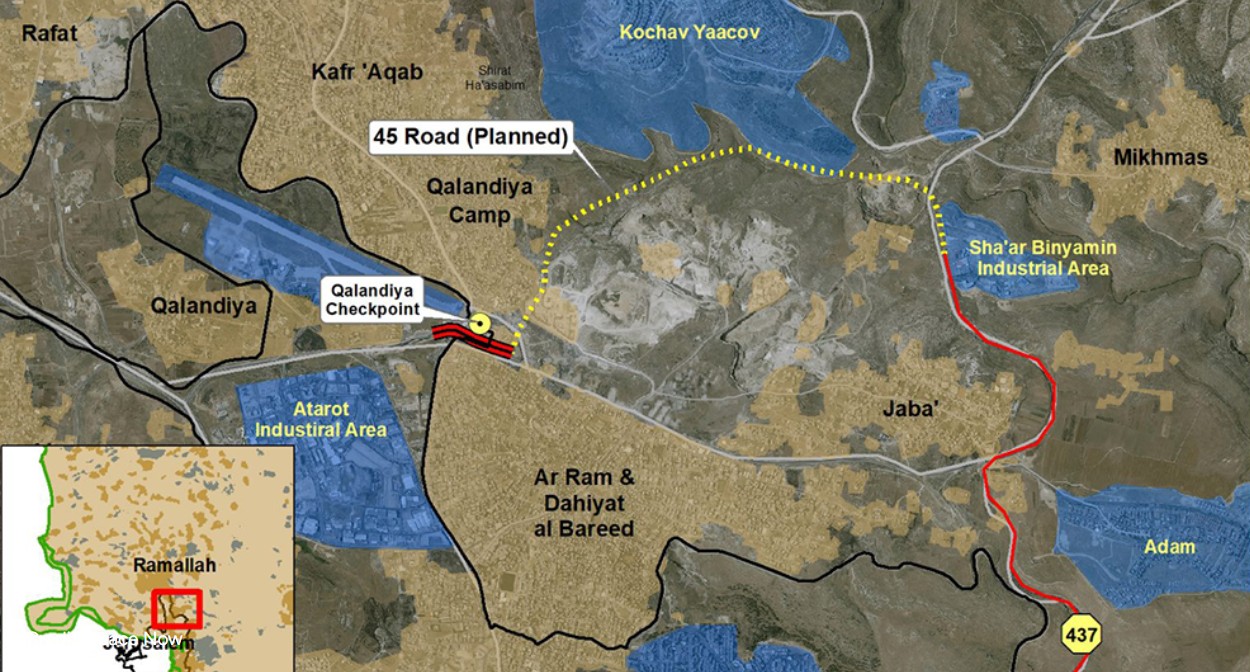 Anat TuegSep-9-2026Road 45. For Israelis only, from Road 60 near Kochav Ya'akov to the Qalandiya underpass
-
