
Abu Dis, Container (Wadi Nar), Ras Abu Sbitan (Olive Terminal), Sheikh Saed, Wed 16.1.08, Morning

The people standing in line tell us about their feelings, and about the bad road to Jerusalem and to Zeitim passage from their neighborhood. One cannot go through some parts of the road in the rain. They all are waiting for the Supreme Court decision next Wednesday about the fence in Sheikh Saed. We talk with the soldiers in the checkpoint – the commander and the checking woman soldier. They too suffer from the cold. We turn to the center, and through it to the commander of Zeitim DCO, Leiutenant Elisha, in order to find out if one can give up the list of names. He promises to do something about it. In the meanwhile the line ends. We are glad to say that the gate in the area of the checkpoint that leads to the houses at the side of the checkpoint is not locked, and the people living in those houses are coming and going through it.
Once again they argue with us where it is allowed to photograph, and once again the soldiers (who are suspecious but polite towards us) find out from their superiors that it is allowed to photograph in the checkpoint area, and that it is not a military area, because civilians go through it.
On the way to the car we see a sign announcing a plan of a new road – the eastern ring road that is supposed to lead from "Har Homa"(Zur Baher area) to the area of the the old train station near the Chan. (we do not understand what they mean, and if it means the area of the Jerusalem Chan why does the road reach Sawahara ?)
08:15 Cliff hotel and the upper pishpash. Through neglect and the window broken Cliff hotel the passage gate is close. A man and a woman soldier claim that many Palestinians go through it, and not only settlers from the house up the road. We are not allowed to go through, despite the logical fact that the whole area is part of the city of Jerusalem, but GCO edict is above any right, and the soldiers claim that there is such an edict. We do not demand to see it, but maybe it is worth doing so.
There is again negotiation about our right to photograph, and the woman soldier claims now that it is a violation of her human rights to take her picture against her will at the checkpoint. Neta does not take her picture (what is a nice girl like you doing in a place like that), but the question stays open. We think that being soldiers they don't have the usual civil rights, and they represent IDF.
There were about twenty taxis detained on the way to Jerusalem (but he took documents only to a student or one or two engineers, and had thought that the taxis should go on their way and leave the passengers at the checkpoint, and if they don't do it – "it is their problem"). We need to have a follow up on this checkpoint, and take care that the commander does not have too many initiatives. This checkpoint, that is in area B, is the most interesting of all the checkpoints for Limor Y. from the Civil Rights association. She is interested in violations of the rights of free movement of Palestinians in order to apply to the Supreme Court. All the taxis detained were released while we were there. Happily, this was done quickly.
Abu Dis / Lazarus gate (formerly The Wicket)
See all reports for this place-
Abu Dis / Lazarus Checkpoint/Gate (east of the former “wicket”)
Construction of the wall in the Abu Dis area blocked all the gaps that allowed people to cross from al-Ezariya to the neighbourhoods of Abu Dis and Ras al 'Amud that are located within Jerusalem’s municipal boundary. The Lazarus checkpoint is a gate in the wall adjacent to the Lazarus Monastery. Until 2011 it had a door for pilgrims to al-Ezariya and for the monastery’s kindergarten pupils from al-Ezariya. The crossing is currently closed, but the site has infrastructure for conducting inspections.
-
Container (Wadi Nar)
See all reports for this place-
Wadi Nar Checkpoint ("Container", "The Kiosk") - a barrier for vehicles in Area B that is regularly manned - east of Abu Dis between Sawahra A Sharqiya and Bethlehem and its daughters. Controls Palestinian movement between the north and south West-Bank. Includes driving routes, access roads, spikes, traffic lights and signs. There is no pedestrian crossing. Open 24 hours a day with random checks enhanced on security alerts. The checkpoint is in Palestinian territory, allowing for separation between the north and the south Palestinian areas when necessary.
In 2015, the leading road from Azaria to Bethlehem was renovated, as well as the steep and narrow ascent to the Wadi Nar checkpoint, which was dangerously travelled in both directions! The temporary checkpoint was renovated and expanded, and pedestrian traffic was banned. From 2016, traffic travelling from the south bank to Azaria was directed to a one-way road near the Southern Keydar Jewish settlement.
Machsomwatch shifts visit this far-fetched checkpoint only occasionally.
(updated to July 2019)
-
Ras Abu Sbitan (Olive Terminal)
See all reports for this place-
A large checkpoint/crossing to the area of a-Tur, Abu Dis and the Old City; only for pedestrians. Located on Jerusalem’s municipal boundary.
One of the major crossings in Jerusalem’s central sector. It is located on the separation fence between the northern portion of the al-Ezariya neighborhood and the neighborhood of a-Tur and the rest of East Jerusalem. It is manned by Border Police soldiers and private security companies and operates 24 hours a day. Palestinians are forbidden to go through, other than permanent residents of East Jerusalem (holders of blue ID cards) and holders of work and commercial permits who are allowed through only on foot.
-
Sheikh Sa'ed
See all reports for this place-
A checkpoint limited to pedestrians, located on Jerusalem’s municipal boundary.
The checkpoint sits on the separation fence at the entrance to Sheikh Sa’ad, dividing it from its neighbourhood of Jabel Mukkabar. It’s manned by Border Police soldiers and private security companies and operates 24 hours a day. Palestinians are forbidden to go through, other than residents of Jabel Mukkabar or Sheikh Sa'ad who have permits. Both groups are permitted through only on foot. Residents of East Jerusalem who don’t live in Jabel Mukkabar are also allowed to cross to Sheikh Sa’ad, but not in the opposite direction; they must return through the Sawahira ash Sharqiya checkpoint.
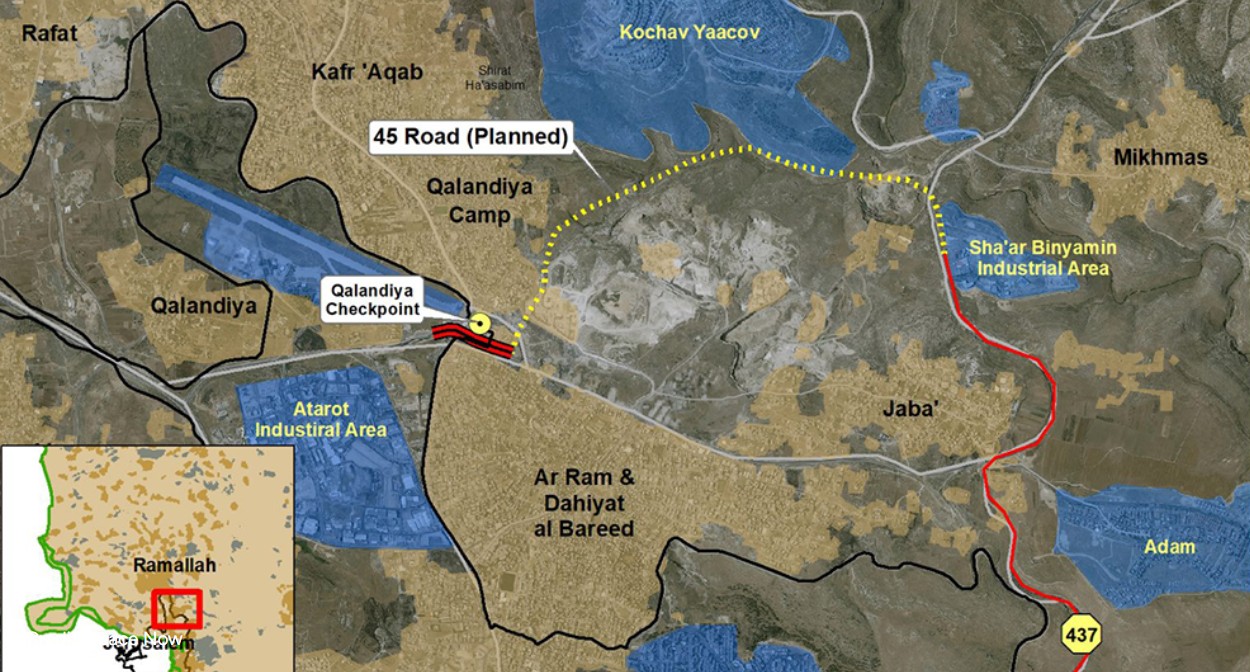 Anat TuegSep-9-2026Road 45. For Israelis only, from Road 60 near Kochav Ya'akov to the Qalandiya underpass
-
