
Abu Dis, Container (Wadi Nar), Sheikh Saed, Thu 15.7.10, Afternoon
14:30 – 17:30
Driving down Jabel Mukaber we noticed that the place looked cleaner than usual – also continuing later via the Road of the Americas and from Ras El Amud down to Abu Dis it is clear that the garbage is apparently collected on Thursday-mornings – there were no overflowing containers like we usually see on our Wednesday shifts. Not one of the containers has a lid, so cats and ravens are free to scatter rubbish all around and road sweepers are non-existent.
Sheikh Saed
The commander of the CP told us that if we entered we would not be allowed back out. He called his superior and asked whether ‘Watch-Women’ were allowed into ‘red’ and was told in no uncertain terms that we were not – a new regulation “Tzav Aluf”, we promised to report and inquire.
At the hotel in Abu Dis we saw a couple of Palestinian workers entering the gate on foot without being checked. The BP soldier would not let us pass. He said that Israelis could only enter if the settlers come to fetch them. When we asked him, whether in fact this was still Israel beyond the fence, he said: “Yes, it is a place where Jews and Arabs live together.”
At the Pishpash we saw the lowered, newly painted tiny metal door locked and despite enormous fortifications there was no military presence whatsoever.
We drove the new road along the wall to the right and again were impressed by the huge investments involved in the completion of yet another piece of the wall and the fences.
At the entrance to Maaleh Adumim we noted that the US-Aid road has not been completed and Palestinian drivers coming from El Azzariya have to deal not only with having to give the settlers the right of way, but also with only one lane, the other taken by construction works.
We arrived near Kedar earlier than usual and saw a number of huge machines from the distance. We entered to the right before the gate of the settlement, where the work on the extension is going ahead at top speed. Cement was being poured all over and the place looked like an ant hill with dozens of workers running and rushing to finish their day’s work. We spoke to a Palestinian contractor who admitted with a huge grin that there was no such thing as a ‘freeze’.
As soon as we walked down to the CP of Wadi Nar two soldiers approached us. We asked them whether indeed it is true that Israeli Arab vehicles with yellow number plates are now allowed in freely in both directions. They affirmed this, but said that not many of them make use of this road. It is clear that to reach Bethlehem from Jerusalem there are shorter ways.
Five minutes later they returned to us to inform us that we are no longer allowed to observe from where we always used to stand, but had to move back all the way up near the grocery store. We told them that it would be difficult for us to see what is going on and that we would report on this new regulation intended for our security. At that point many workers arrived and waited for transportation exactly at the spot designated for us – clearly the ‘safest’ place for us to be.
The traffic moved apace in both directions and there were no lines. Some Israeli vehicles with young drivers parked on the top to await a Palestinian vehicle, which had bumped into them. They planned to take revenge – we decided not to be witnesses to that confrontation.
Abu Dis / Lazarus gate (formerly The Wicket)
See all reports for this place-
Abu Dis / Lazarus Checkpoint/Gate (east of the former “wicket”)
Construction of the wall in the Abu Dis area blocked all the gaps that allowed people to cross from al-Ezariya to the neighbourhoods of Abu Dis and Ras al 'Amud that are located within Jerusalem’s municipal boundary. The Lazarus checkpoint is a gate in the wall adjacent to the Lazarus Monastery. Until 2011 it had a door for pilgrims to al-Ezariya and for the monastery’s kindergarten pupils from al-Ezariya. The crossing is currently closed, but the site has infrastructure for conducting inspections.
-
Container (Wadi Nar)
See all reports for this place-
Wadi Nar Checkpoint ("Container", "The Kiosk") - a barrier for vehicles in Area B that is regularly manned - east of Abu Dis between Sawahra A Sharqiya and Bethlehem and its daughters. Controls Palestinian movement between the north and south West-Bank. Includes driving routes, access roads, spikes, traffic lights and signs. There is no pedestrian crossing. Open 24 hours a day with random checks enhanced on security alerts. The checkpoint is in Palestinian territory, allowing for separation between the north and the south Palestinian areas when necessary.
In 2015, the leading road from Azaria to Bethlehem was renovated, as well as the steep and narrow ascent to the Wadi Nar checkpoint, which was dangerously travelled in both directions! The temporary checkpoint was renovated and expanded, and pedestrian traffic was banned. From 2016, traffic travelling from the south bank to Azaria was directed to a one-way road near the Southern Keydar Jewish settlement.
Machsomwatch shifts visit this far-fetched checkpoint only occasionally.
(updated to July 2019)
-
Sheikh Sa'ed
See all reports for this place-
A checkpoint limited to pedestrians, located on Jerusalem’s municipal boundary.
The checkpoint sits on the separation fence at the entrance to Sheikh Sa’ad, dividing it from its neighbourhood of Jabel Mukkabar. It’s manned by Border Police soldiers and private security companies and operates 24 hours a day. Palestinians are forbidden to go through, other than residents of Jabel Mukkabar or Sheikh Sa'ad who have permits. Both groups are permitted through only on foot. Residents of East Jerusalem who don’t live in Jabel Mukkabar are also allowed to cross to Sheikh Sa’ad, but not in the opposite direction; they must return through the Sawahira ash Sharqiya checkpoint.
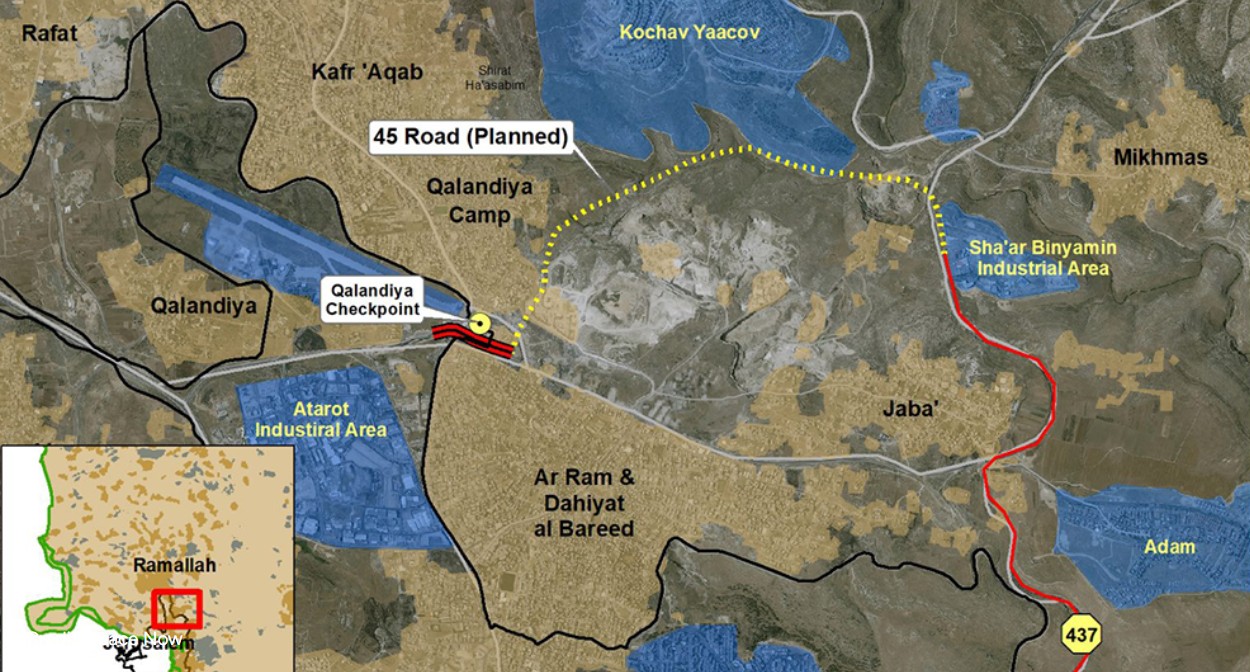 Anat TuegSep-9-2026Road 45. For Israelis only, from Road 60 near Kochav Ya'akov to the Qalandiya underpass
-
