
afternoon
HUWWARA, Thursday afternoon,25 December 2003WATCHERS: DG, DA, TL, DB En route we noticed that the Za’atra {?}checkpoint near the settlement of Tapuah was not manned. 13:00 HAWWARA (south) About 100 people who say they have been waiting for ages (a few hours) and that almost no one is let through. But when we get there the soldiers start letting people through at a reasonable rate, and they are polite. The line shortens rapidly. Four people are being held while their IDs are checked, the average wait is about an hour and a half. While we are there a phone call comes through that one of the men is indeed wanted. His hands are tied and he is placed near the barrier. TL asks a solider for his water bottle and gives the man a drink. The soldier raises no objection.HAWWARA (north) Very very sparse traffic. T one soldier doing the checking, the rest just mooch around and the line scarcely moves at all. At our request, one of the women soldiers goes to help in the checking and the line begins to move more rapidly. As at the southern end– the soldiers behave perfectly well. When there is a change over of military personnel, at 14:30, a new officer arrives and tries to get rid of us on the grounds that this is a closed military area. When we asked to see the order, he went away for five minutes and came back with an order closing the area, but it was not signed. We refused to accept it and stayed out. He ordered his soldiers to ignore us. ,p> There were 12 detainees, one of whom had been held for five hours. We went up to one of the soldiers and raised this man’s case. He didn’t reply, but he did start to deal with the matter and in about five minutes all but three of them — who, truth to tell, had been held for “only” a quarter of an hour — were set free.SA’ARA (?) Almost no one around. No taxis at the bottom and very very few people, mostly locals, at the checkpoint. As we go up, a jeep comes chasing after us, its siren blasting. and the soldier in the jeep asks what we’re doing up there. He says there is a “red alert”, reports of a terrorist on the way to the checkpoint and it would be better if we kept away. We told him we were prepared to take the risk and that we were staying. Considering that there was supposed to be a “red alert” in force, the soldiers at the checkpoint were all very good spirited. They were relaxed and larking around with one another at the expense of the very few Palestinians. The soldiers who were on guard on top were throwing stones down at their comrades and shouting out their plans for a trip to Amsterdam on their release. The few Palestinians who approached the checkpoint were deliberately made to wait a while: apparently so that they should feel….. One Sa’ara (?) man was detained together with his son. I asked one of the soldiers why and was told with a smirk, he can go, he is not being detained. I pointed out that the man’s ID was in the soldier’s hand. Again he smirked and replied that the ID belonged to “the man”. Since there was no one else there, I persisted and asked “Whose is it?” and he replied that it was his (i.e. the soldier’s), very pleased with himself. The man told us that his wife’s labour pains had begun that morning and that he had been refused permission at the checkpoint to proceed to the hospital in Nablus. So he had gone around the checkpoint and at 11.30 he had come back, this time via the checkpoint, whereupon he had been detained. He said he had six small children waiting at home. The soldier was having great fun at his expense and was vastly pleased with himself. I called Ofer who was in fact on leave, but he understood my anger ( and I was in fact so boiling with rage that it must have made itself heard in my voice). I phoned the DCO and the second in command there (a woman) said she would see to the matter. Along came the officer in charge of the checkpoint who was less “happy” and much more matter of fact. He said the Palestinian could go, but they would keep his car. The man agreed to this since he was so concerned about the youngsters at home alone, but then the commander had second thoughts and decided he would not return the man’s ID. It was getting dark and we decided to return home. We took the phone number of the Sa’ara man who is in charge of water and who is thus always at the checkpoint. Half an hour later, when we called, he told us the man had been set free to go home but that his car had been impounded. The jeep that had tried to stop us as we came up to Sa’ara arrived at the checkpoint about 15 minutes after us. A little while later we heard shots from the village, and this was repeated several times throughout our stay at the checkpoint. The officer in charge told us “something is going on in the village” and that the man in the jeep was the deputy commander of the gedud (at least that’s what I think he said, deputy something anyway). But he would not expand on just what the “something”was that was “going on” in the village. We asked Palestinians coming away from the village and they told us not to worry, it was nothing, only children throwing stones at the soldiers and the soldiers firing at them. We were stunned! That’s “nothing to worry about”? No, they explained, they aren’t really firing at the kids, it’s like a game, the soldiers fire into the air and no one gets hurt.On the way back we decided to stop at the gate at Mescha which a month ago used to be opened three times a day, at 07:00, at 13:00 and at 17:00 exactly so that the Palestinians could get to their fields. The first thing that happened was that we ran straight into a great piece of tin (?) which the soldiers had left some 30 metres in front of the checkpoint and which it was quite impossible to see in the dark. The car got a great bang and we had to ask the soldiers there to help us lift the car off it. But worst of all– the gate was closed. When does it open, we asked. Never, they answered. What about the mornings? In the fortnight that this group of soldiers had been there, they answered, the gate had not been opened once. That was what the “anarchists” were demonstrating about the next day: about the disgusting imprisonment of the villagers of Mescha. And the rest you all know……..
Huwwara
See all reports for this place-
The Huwwara checkpoint is an internal checkpoint south of the city of Nablus, at the intersection of Roads 60 and 5077 (between the settlements of Bracha and Itamar). This checkpoint was one of the four permanent checkpoints that closed on Nablus (Beit Furik and Awarta checkpoints to the east and the Beit Iba checkpoint to the west). It was a pedestrian-only barrier. As MachsomWatch volunteers, we watched therre since 2001 two shifts a day - morning and noon, the thousands of Palestinians leaving Nablus and waiting for hours in queues to reach anywhere else in the West Bank, from the other side of the checkpoint the destination could only be reached by public transport. In early June 2009, as part of the easing of Palestinian traffic in the West Bank, the checkpoint was opened to vehicular traffic. The passage was free, with occasional military presence in the guard tower. Also, there were vehicle inspections from time to time. Since the massacre on 7.10.2023, the checkpoint has been closed to Palestinians.
On February 26, 2023, about 400 settlers attacked the town's residents for 5 hours and set fire to property, such as houses and cars. Disturbances occurred in response to a shooting of two Jewish residents of Har Bracha by a Palestinian Terrorist. The soldiers stationed in the town did not prevent the arson and rescued Palestinian families from their homes only after they were set on fire. No one was punished and Finance Minister Smotrich stated that "the State of Israel should wipe out Hawara." Left and center organizations organized solidarity demonstrations and support actions for the residents of Hawara.Hawara continued to be in the headlines in all the months that followed: more pogroms by the settlers, attacks by Palestinians and a massive presence of the army in the town. It amounted to a de facto curfew of commerce and life in the center of the city. On October 5, 2023, MK Zvi established a Sukkah in the center of Hawara and hundreds of settlers backed the army blocked the main road and held prayers in the heart of the town all night and the next day. On Saturday, October 7, 23 The "Swords of Iron" war began with an attack by Hamas on settlements surrounding Gaza in the face of a poor presence of the IDF. Much criticism has been made of the withdrawal of military forces from the area surrounding Gaza and their placement in the West Bank, and in the Hawara and Samaria region in particular, as a shield for the settlers who were taking over and rioting.
On November 12, 2023, the first section of the Hawara bypass road intended for Israeli traffic only was opened. In this way, the settlers can bypass the road that goes through the center of Hawara, which is the main artery for traffic from the Nablus area to Ramallah and the south of the West Bank. For the construction of the road, the Civil Administration expropriated 406 dunams of private land belonging to Palestinians from the nearby villages. The settlers are not satisfied with this at the moment, and demand to also travel through Hawara itself in order to demonstrate presence and control.(updated November 2023)
.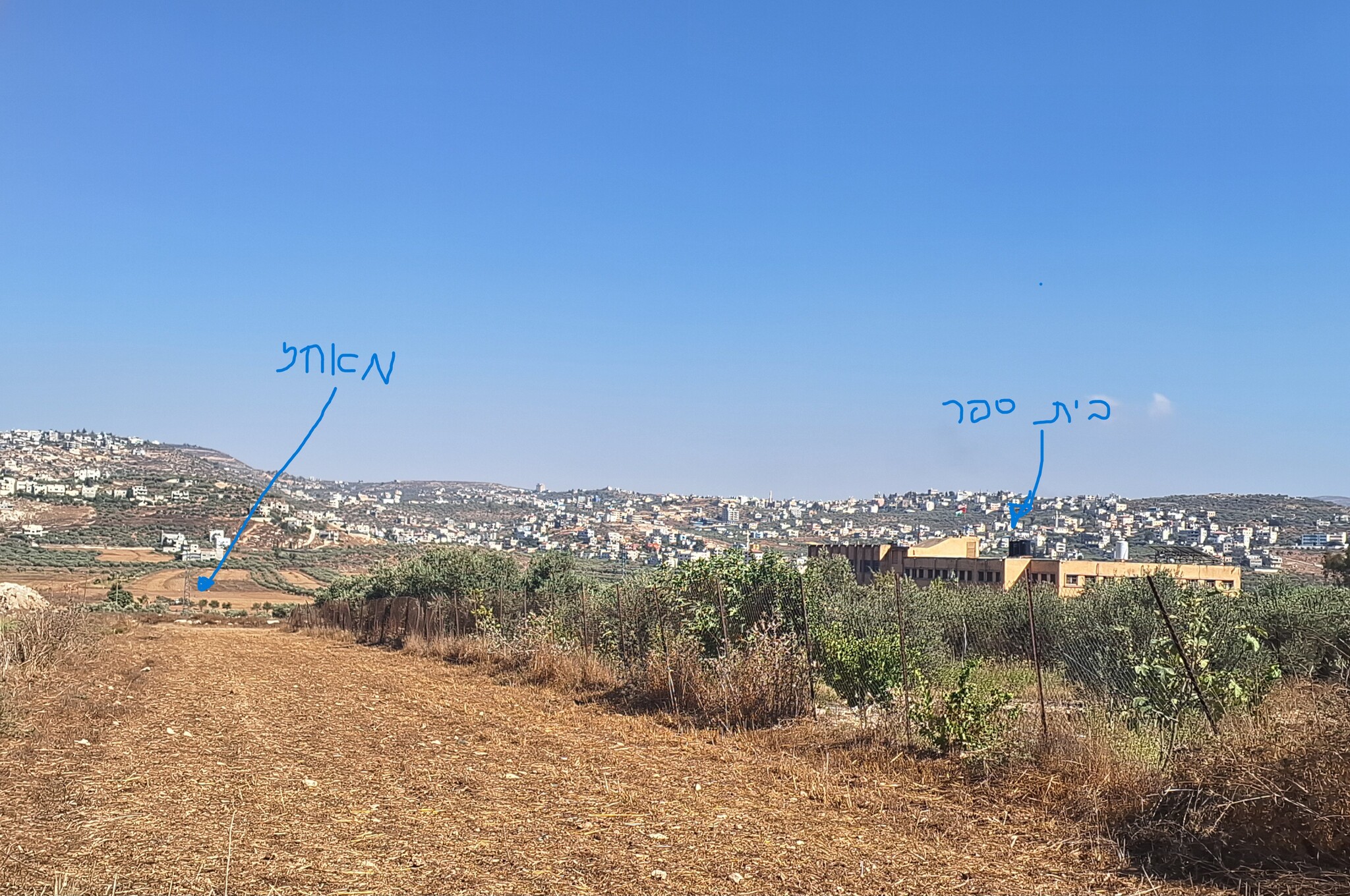 Ronit Dahan-RamatiAug-24-2026Huwara: The school on the outskirts of town and an outpost hidden among the trees
-
