
AM
HUWWARA, Saturday 17 April 2004 AM Observers: Tsofit, Michal S., Tova S., Nurit L., Hava, Amalia V. (reporting) color=red> Huwwara north We arrived at around 08:00 and split up into two groups. At Checkpoint 8, some men and a woman were detained. The soldiers were angry with the woman because someone who had appeared to be her friend had presented the cover of a document without the document being inside and had then left. The checkpoint commander shouted at her, waving his arms at her in an effort to coerce her into giving the soldiers information about her “friend”. At this stage he was nervous and angry. Later, everything calmed down and so did he, even cooperating with us and easing restrictions now and then. By 10:30 there were no detainees left and no line at the checkpoint.Huwwara south There was a different situation here. Dozens of people were clustered at the head of the line and a large group of some 30-50 had been detained in the “pen” (a shallow depression in the ground near and parallel to the line waiting to go through the checkpoint ). The lines of those waiting to go through the checkpoint were orderly (too much so for my taste). There was no crowding or shouting as often happens. When I asked one of the soldiers what had happened in the morning, he said there had been a commotion, “but we showed them” and now “they” [i.e. the Palestinians] were quiet.There was a line for women and children, a line for men over 35 and (a very dense) line for men under 35. In general, the checking was swift, particularly in the lines for women and older men. It was possible to have some kind of dialogue with most of the soldiers when it came to special requests: for example a son accompanying his mother who could scarcely walk because of surgery on her leg. He was banned from crossing because he’s under 35.But after we talked to A., the representative of the army’s District Coordinating Office (DCO), which deals with civilian matters, he was allowed through.Throughout our watch, the soldiers did their job while cursing and mocking the people at the checkpoint. They also displayed what one might term “unusual sensitivity” to “lies”, reflected in a number of cases where they thought documents were forged or when the real age of a Palestinian was not being given. Thus, a girl of 16, who said she was 14, and who was accompanying her mother and her father, who was in a wheelchair, was berated furiously by one of the soldiers before was she allowed to continue on her way. This incident led to a renewed series of shouts and curses directed at the entire Palestinian population by the same soldier.The detainees were held for very long periods and nothing we tried to do succeeded. The soldiers kept repeating that they didn’t want to detain them for longer than necessary but their papers had been sent for checking and hadn’t returned yet.There were constant exchanges between the detainees and the soldiers in the position closest to them. The soldiers there considered this to be provocation and reacted very angrily. The most extreme incident we saw occurred when two soldiers with drawn weapons escorted a 17-year-old youth towards the barbed-wire fence. I followed them and saw them handcuff him and tie him to the fence. When I protested and asked them to release him, they explained that they “had” to do it because he’d “been cheeky and caused problems”, but they promised to release him in five minutes. It finally turned out that they’d tied him loosely and he managed to free himself within a few minutes and was allowed to return to the line without further incidents.In my opinion, the soldiers at this checkpoint (we’ve seen some of them quite often) are emotionally exhausted and this is reflected in the verbal violence we heard and in their very low threshold of irritation.When we left at about 12:00, the checkpoint commander asked us to come again, thus confirming to some extent what we felt today: that our presence, even if we only observe and don’t intervene, helps the soldiers to extract themselves from extreme situations that they themselves have initiated.
Huwwara
See all reports for this place-
The Huwwara checkpoint is an internal checkpoint south of the city of Nablus, at the intersection of Roads 60 and 5077 (between the settlements of Bracha and Itamar). This checkpoint was one of the four permanent checkpoints that closed on Nablus (Beit Furik and Awarta checkpoints to the east and the Beit Iba checkpoint to the west). It was a pedestrian-only barrier. As MachsomWatch volunteers, we watched therre since 2001 two shifts a day - morning and noon, the thousands of Palestinians leaving Nablus and waiting for hours in queues to reach anywhere else in the West Bank, from the other side of the checkpoint the destination could only be reached by public transport. In early June 2009, as part of the easing of Palestinian traffic in the West Bank, the checkpoint was opened to vehicular traffic. The passage was free, with occasional military presence in the guard tower. Also, there were vehicle inspections from time to time. Since the massacre on 7.10.2023, the checkpoint has been closed to Palestinians.
On February 26, 2023, about 400 settlers attacked the town's residents for 5 hours and set fire to property, such as houses and cars. Disturbances occurred in response to a shooting of two Jewish residents of Har Bracha by a Palestinian Terrorist. The soldiers stationed in the town did not prevent the arson and rescued Palestinian families from their homes only after they were set on fire. No one was punished and Finance Minister Smotrich stated that "the State of Israel should wipe out Hawara." Left and center organizations organized solidarity demonstrations and support actions for the residents of Hawara.Hawara continued to be in the headlines in all the months that followed: more pogroms by the settlers, attacks by Palestinians and a massive presence of the army in the town. It amounted to a de facto curfew of commerce and life in the center of the city. On October 5, 2023, MK Zvi established a Sukkah in the center of Hawara and hundreds of settlers backed the army blocked the main road and held prayers in the heart of the town all night and the next day. On Saturday, October 7, 23 The "Swords of Iron" war began with an attack by Hamas on settlements surrounding Gaza in the face of a poor presence of the IDF. Much criticism has been made of the withdrawal of military forces from the area surrounding Gaza and their placement in the West Bank, and in the Hawara and Samaria region in particular, as a shield for the settlers who were taking over and rioting.
On November 12, 2023, the first section of the Hawara bypass road intended for Israeli traffic only was opened. In this way, the settlers can bypass the road that goes through the center of Hawara, which is the main artery for traffic from the Nablus area to Ramallah and the south of the West Bank. For the construction of the road, the Civil Administration expropriated 406 dunams of private land belonging to Palestinians from the nearby villages. The settlers are not satisfied with this at the moment, and demand to also travel through Hawara itself in order to demonstrate presence and control.(updated November 2023)
.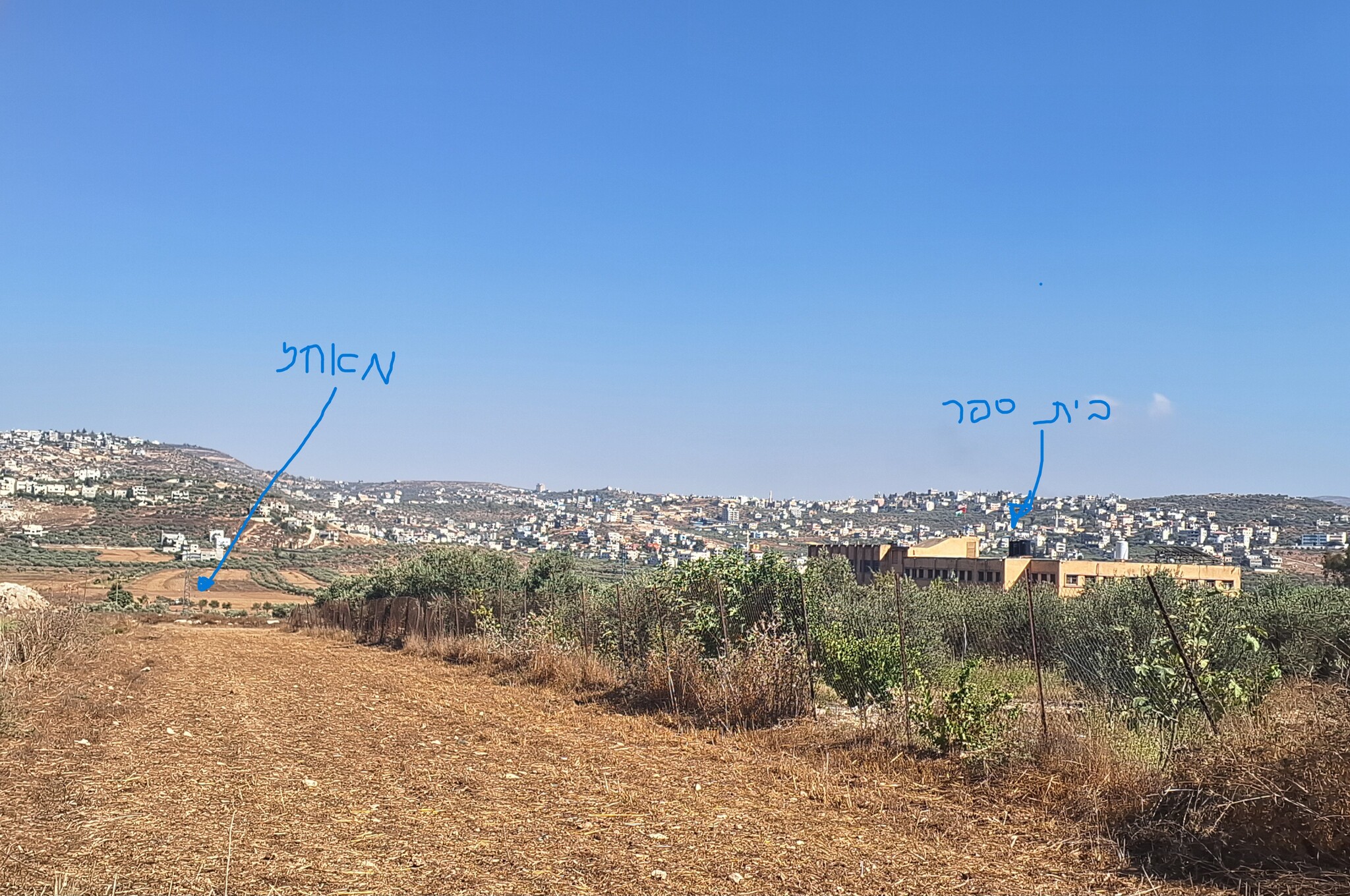 Ronit Dahan-RamatiAug-24-2026Huwara: The school on the outskirts of town and an outpost hidden among the trees
-
