
AM
HUWWARA, BEIT FURIK, SARRA, Sunday 9 May 2004 AMObservers: Chana L., Nilly K., Dina A. (reporting) colour=red> General:It was a very hot and dusty day, with temperatures up to 32 centigrade in Nablus. There was no water at the checkpoints and at Huwwara South no shade for the detainees (see below). The water issue has to be tackled at the organizational level – soldiers and officers on site aren’t the ones who give instructions to move a vehicle / water container to the checkpoints. Query: which other checkpoints have no proper water provision?In our first telephone call to the District Coordinating Office (DCO) [the section of the army that deals with civilian matters], we were told that they were not permitted to talk to us and that our contact person was the spokesperson for the Civil Administration. She told me today that tourists were not allowed to enter Nablus. In an attempt to check whether this was true, I tried contacting the Foreign Ministry but could get no immediate answer. I would like to know what happens to complaints made to the [army’s] “humanitarian” hotline. Are they registered and monitored? Is there a “reasonable” reaction time for a complaint? Today we nagged constantly about the water, but we have no “teeth” because we don’t know the answers to these questions. There was a very obvious civilian police presence at the presence at the junctions.07:45 — Sarra The metal arm of the barricade closing the approach road to the village was up. The checkpoint itself was deserted. Two soldiers who popped up on top of the hill when they heard our car said that “everybody’s gone through”.07:55 —Yizhar Junction Two police cars and policemen were in evidence, but there were no detained cars.08:00 — Huwarra South (into Nablus) Traffic was sparse and there were only a relatively small number of pedestrians on line (about 100 in all three lines).A particularly hostile officer informed us that if we remained there he would stop all movement through the checkpoint ; but we took no notice. The area set aside for the detainees is now surrounded by a barbed-wire fence, and in general, all internal passages inside the actual checkpoint have now been clearly marked out. . There were five detainees, whose ID cards were already in the process of being checked [against lists of suspects or wanted persons compiled and maintained by the General Security Services AKA the Shabak or Shin Bet]. They were all released after about 15 minutes, and the soldiers said they had been held for not more than 10 minutesA young couple (the man aged 33) with a doctor’s referral for fertility treatment at the Nablus hospital were refused permission to go through because they had no permits. We asked the soldiers to reconsider and to check the man’s details. This was done with surprising speed and they were allowed to pass through. We gave the couple the telephone number of the Physicians for Human Rights organization in case they encountered further problems. There was no water at the checkpoint . The container (2500 litres) had been disconnected from the water trough. According to one of the soldiers, someone broke a faucet in the trough and therefore the supply has been disconnected (punishment). We checked and found all the faucets in place , but there was the trough — on the one hand, and the container — on the other, with no connection between the two and who was to know whether there was any water all in the container ? Following a conversation with our Machsomwatch colleague Snait G., who alerted us to the problem of water supplies as long ago as the beginning of April, it turned out that the broken faucet story was being touted around two weeks ago, in other words this is the version offered as cover for the lack of water , although the faucets are in good working order. Perhaps the damage was caused to the connecting pipe. One of the passers-by told us that there used to be a smaller mobile container, but someone had punctured the wheels and stolen the wagon [on which it was moved around] and the container was taken away and not replaced. Whatever the case (whether this is deliberate collective punishment or simple bureaucratic negligence) there is an urgent need to provide water and shade for those using the checkpoint. The claim that damage has been caused to the water facilities is irrelevant. . If that really is the problem, then the army has to take care to guard the container and the entire water installation. . 08:20 Huwwara North (the exit from Nablus )There were far fewer people and cars than in the past. There were no detainees.There was a water container and a trough, but nothing was connected and there was no water. 08:45 — We called the “humanitarian” hotline about the lack of water at both sides of the checkpoint and were told that the complaint had been “registered”. There were two taxis at the side: nos. 7-0183-30 and 7-0145-38. The soldiers claimed that the keys had been confiscated because the drivers “had made a nuisance of themselves” and they would be returned “within a day or two” (we did not ask where the keys were).An Australian pilgrim wanted to visit Nablus for a special festivity held in one of the churches, but the soldiers claimed that tourists were barred from entry by an army order. At 09:00 we called the DCO to find out whether this was true, and were told, as soon as we identified ourselves, that they were not permitted to talk to us and that we must contact the spokesperson of the Civil Administration. She confirmed that there is indeed no entry to Nablus for tourists. All the pilgrim’s pleas about freedom of worship were in vain. We suggested that she should approach the Australian Embassy in Tel Aviv or the Australian consulate in East Jerusalem, or contact the church in Jerusalem and ask them to arrange a permit for her. 09:30 — AwartaThere was a line of 32 vehicles. The checkpoint was run by three soldiers who were efficient and fair. It was the first time that they had met any of our members, but they said that they had heard about us. At 09:45 we telephoned to the “humanitarian” hotline to check on progress about the water problem and learned that “it’s being dealt with”!09:40 — Beit FurikThe checkpoint was heavily manned . A wall made-up of two metre high concrete slabs has been erected between the field and the checkpoint area. It has one opening of about 1.5 metres wide. Here too there were very few people and no vehicles other than a truck loaded with hay. According to one of the soldiers, only food and animal feed was allowed through. There was a complicated discussion of what constitutes hay, but in the end the truck was allowed through.Water: again, there was a container and a trough, but the two were not connected and there was no water available. The soldiers said they gave their own water to people who asked for it. The “humanitarian” hotline told us, after another call, that the water problem had been passed on to the DCO for attention. 09:50 — At Awarta, the long line of vehicles had lessened somewhat to 18 . 10:10 — A phone call to the DCO was met by the answer that the water issue was “still being dealt with.”At 10:40 , yet another call to the DCO elicited exactly the same answer.At 10:50 we phoned the “humanitarian hotline” to check what was meant by “being dealt with” and how we can trace a complaint. 11:00 — on the way back to Tel Aviv, we saw a huge line of cars, mostly Israeli. Although we thought there might have been an accident or that perhaps there were road works in progress, it turned out to be an unannounced road-block , manned by police as well as army personnel . At 11:10 we again phoned the DCO to check the water issue. This time they told us they had informed the local army command at the checkpoint. At 12:00, when contacted again, the DCO response to our query as to whether the water had arrived was, “We don’t have an answer. We are not there”. An hour and a half later, at 13:30, the DCO told us, after yet another phone call, that the “water issue is still being dealt with. It has now been passed on the DCO duty officer.” We learned later, from a colleague who took part in the afternoon watch, that even by nightfall there was still no sign of any water at Huwwara checkpoint.
Huwwara
See all reports for this place-
The Huwwara checkpoint is an internal checkpoint south of the city of Nablus, at the intersection of Roads 60 and 5077 (between the settlements of Bracha and Itamar). This checkpoint was one of the four permanent checkpoints that closed on Nablus (Beit Furik and Awarta checkpoints to the east and the Beit Iba checkpoint to the west). It was a pedestrian-only barrier. As MachsomWatch volunteers, we watched therre since 2001 two shifts a day - morning and noon, the thousands of Palestinians leaving Nablus and waiting for hours in queues to reach anywhere else in the West Bank, from the other side of the checkpoint the destination could only be reached by public transport. In early June 2009, as part of the easing of Palestinian traffic in the West Bank, the checkpoint was opened to vehicular traffic. The passage was free, with occasional military presence in the guard tower. Also, there were vehicle inspections from time to time. Since the massacre on 7.10.2023, the checkpoint has been closed to Palestinians.
On February 26, 2023, about 400 settlers attacked the town's residents for 5 hours and set fire to property, such as houses and cars. Disturbances occurred in response to a shooting of two Jewish residents of Har Bracha by a Palestinian Terrorist. The soldiers stationed in the town did not prevent the arson and rescued Palestinian families from their homes only after they were set on fire. No one was punished and Finance Minister Smotrich stated that "the State of Israel should wipe out Hawara." Left and center organizations organized solidarity demonstrations and support actions for the residents of Hawara.Hawara continued to be in the headlines in all the months that followed: more pogroms by the settlers, attacks by Palestinians and a massive presence of the army in the town. It amounted to a de facto curfew of commerce and life in the center of the city. On October 5, 2023, MK Zvi established a Sukkah in the center of Hawara and hundreds of settlers backed the army blocked the main road and held prayers in the heart of the town all night and the next day. On Saturday, October 7, 23 The "Swords of Iron" war began with an attack by Hamas on settlements surrounding Gaza in the face of a poor presence of the IDF. Much criticism has been made of the withdrawal of military forces from the area surrounding Gaza and their placement in the West Bank, and in the Hawara and Samaria region in particular, as a shield for the settlers who were taking over and rioting.
On November 12, 2023, the first section of the Hawara bypass road intended for Israeli traffic only was opened. In this way, the settlers can bypass the road that goes through the center of Hawara, which is the main artery for traffic from the Nablus area to Ramallah and the south of the West Bank. For the construction of the road, the Civil Administration expropriated 406 dunams of private land belonging to Palestinians from the nearby villages. The settlers are not satisfied with this at the moment, and demand to also travel through Hawara itself in order to demonstrate presence and control.(updated November 2023)
.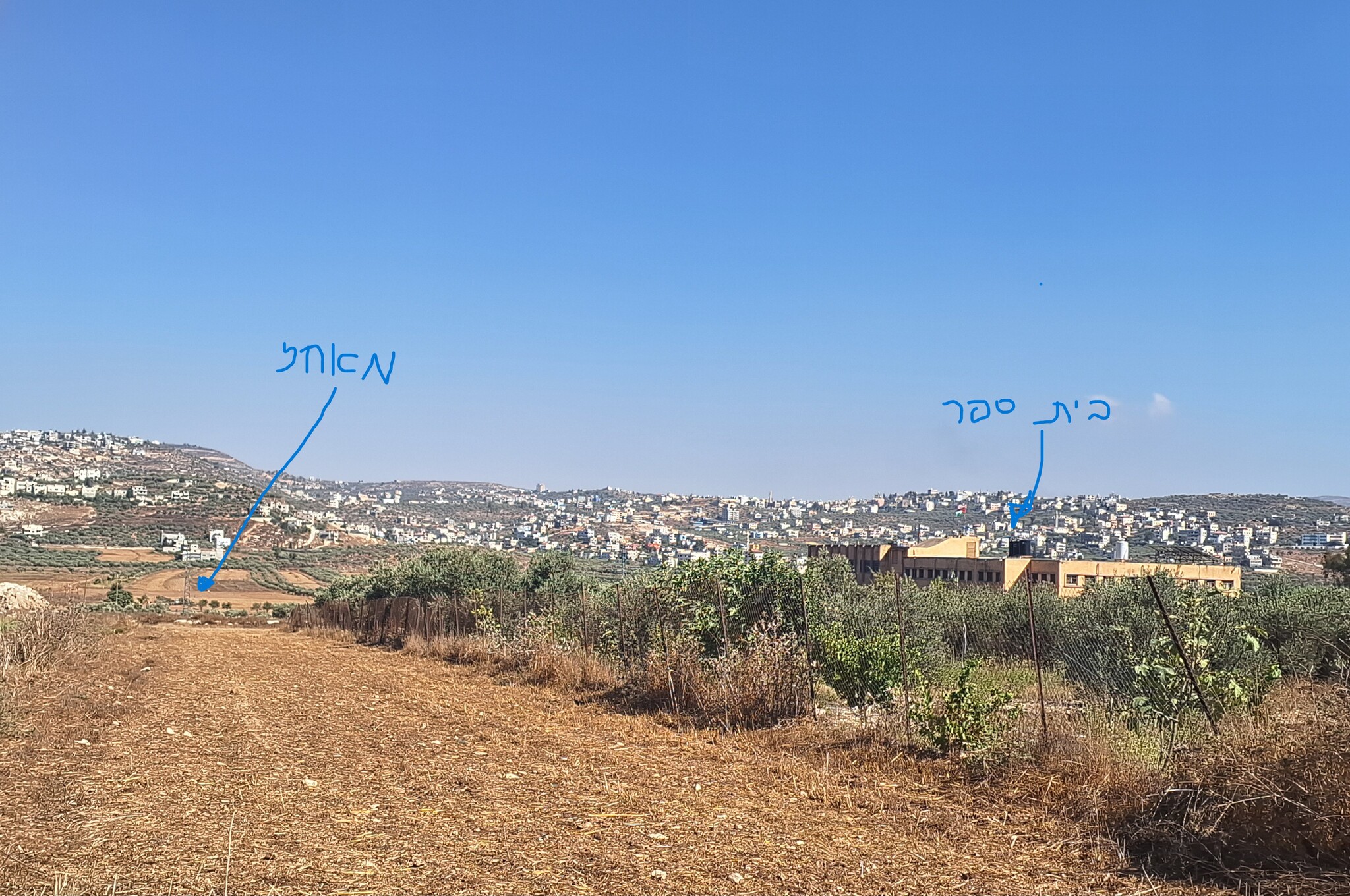 Ronit Dahan-RamatiAug-24-2026Huwara: The school on the outskirts of town and an outpost hidden among the trees
-
Sarra
See all reports for this place-
Sarra
The checkpoint is installed between the Palestinian village of Sera and the district city of Nablus,
Since 2011, internal barriers Located among the West Bank Israeli settlements have somehow allowed, Palestinian residents to travel and move and reach various Palestinian cities.
After the terrible massacre by the Hammas on October 7 upon Israelis in the communities around Gaza, internal checkpoints manned by the army were installed to prevent free passage for Palestinians.
Many restrictions were imposed on the Palestinians in the West Bank. The prevention of movement shuttered the possibility of making a living in Israel. The number of Palestinian attacks by Israeli extremist settlelers increased along with the radicalization of the army against the Palestinians.
The conduct at the Sera checkpoint is one of the manifestations of the restrictions on all aspects of the Palestinians' lives.
-
