
AM
HUWWARA, Saturday 29 May 2004 AM Observers: Amalia V., Hedva A., Vivi Z., (reporting) color=red>Because of this morning’s incident at Balata in which an Israeli officer was killed, the checkpoint was closed. He was evacuated through the Huwwara checkpoint. The morning watch was marked by serious incidents some of which are reported here. The soldiers must have found it hard to take the loss of their comrade and nevertheless continue to run the checkpoint as if nothing had happened. S., the DCO officer [the DCO is the army section that attends to civilian matters; it usually has representatives at the checkpoints, ostensibly to alleviate the lot of the Palestinians] did not intervene and, because of his personality, his presence was even disruptive.When we arrived at 08:00, there were hundreds of Palestinians south of the checkpoint, jeeps separated them from the checkpoint area and they were waiting quietly and obediently. The soldiers seemed stunned and grieving, and in some cases this was expressed in vengeful actions towards the crowd, which included women, men and numerous children and infants as well as old people. The lieutenant in charge was physically and verbally violent, cursed and shoved people with his rifle butt, pointed his rifle at the head of a baby in its father’s arms, rudely shoved an old man with a walking stick and from time to time got into a jeep and drove forward to push the people back like a herd of cattle. When we tried to intervene to moderate his behaviour, we were answered with a string of curses.All we could do was contact the DCO in Nablus to brief them. We also contacted the army office dealing with complaints against security personnel and the local army spokesman. We were told that such conduct was definitely unacceptable, but we don’t know if anything was done. At 09:30, the checkpoint was opened and the crowd of several hundred burst into a run for fear that the army would change its mind and close it again. All the Palestinians there went through without checking.S., from the DCO, was there the whole time but did not bother to intervene.Both sides of the checkpoint remained open for a time until the Zaka (Victim Identification) volunteers [a group of mostly ultra-religious Jews who comb the area of a fatal disaster to gather body parts for identification and burial] arrived to clean the road where the ambulance had driven with the wounded soldier who died later at the checkpoint. It was hard to believe what happened: the Zaka volunteers (or perhaps religious settlers from Yizhar) arrived, sought bloodstains and washed the road leading from Huwwara checkpoint towards Beit Furik checkpoint. The checkpoint was again closed for some considerable time while this went on. There was no shortage of drama this morning. At the southern checkpoint, a young Palestinian from Haris, an activist in Ta’ayosh, an Israel-Palestinian peace organization, who was shot in error three years ago and is in a wheel-chair, was waiting. The man, A.S., often goes through Huwwara checkpoint without delays and in his private car. Today his papers were not accepted nor were the medical certificates confirming that he had an appointment at Rafidiya hospital today. We made urgent calls to D. B., the army’s medical coordinator, to expedite the checking of his papers which had been sent to the General Security Services [also known by the Hebrew acronym Shabak or Shin Bet]. The telephone calls were effective, but he still waited more than two hours. The ambulance drivers argued with pedestrians who wanted to go through in a vehicle and agreed to take sick people only after receiving an “order” from the soldiers.There were some 10 detainees who had evaded the checkpoint or presented allegedly forged documents or were being detained at random. Nobody was released throughout our three hours there .At the northern checkpoint, there was a bitter end to the story of a Palestinian man who had received a beating. As we arrived, we saw a man lying on the concrete and shouting that he’d been beaten by the soldiers for no reason. He seemed to have a crippled right leg. He shouted that he was a cripple with various problems and with pains in his back. At first it seemed that the whole incident was a mistake, particularly since the soldiers were trying to pacify him, helped him get up, offered a chair in the shade, water, a handkerchief etc. He kept shouting that he was innocent and would do everything possible to complain to the papers. A major who arrived to deal with him, argued with S., from the DCO, who was watching indifferently from one side. In the end the man was taken away handcuffed in a military jeep, apparently under arrest. We didn’t succeed in finding out what had happened despite our calls to the “Moked” (Centre for the Defence of the Individual), Physicians for Human Rights, B’tselem, the DCO in Nablus and the army’s “humanitarian” hotline. The soldiers claimed that the man had run wild and tried to attack them. We have no details about him and no way of submitting a complaint or following-up. We reported it nonetheless to the “civil administration”, the army hotline and Nablus DCO.
Huwwara
See all reports for this place-
The Huwwara checkpoint is an internal checkpoint south of the city of Nablus, at the intersection of Roads 60 and 5077 (between the settlements of Bracha and Itamar). This checkpoint was one of the four permanent checkpoints that closed on Nablus (Beit Furik and Awarta checkpoints to the east and the Beit Iba checkpoint to the west). It was a pedestrian-only barrier. As MachsomWatch volunteers, we watched therre since 2001 two shifts a day - morning and noon, the thousands of Palestinians leaving Nablus and waiting for hours in queues to reach anywhere else in the West Bank, from the other side of the checkpoint the destination could only be reached by public transport. In early June 2009, as part of the easing of Palestinian traffic in the West Bank, the checkpoint was opened to vehicular traffic. The passage was free, with occasional military presence in the guard tower. Also, there were vehicle inspections from time to time. Since the massacre on 7.10.2023, the checkpoint has been closed to Palestinians.
On February 26, 2023, about 400 settlers attacked the town's residents for 5 hours and set fire to property, such as houses and cars. Disturbances occurred in response to a shooting of two Jewish residents of Har Bracha by a Palestinian Terrorist. The soldiers stationed in the town did not prevent the arson and rescued Palestinian families from their homes only after they were set on fire. No one was punished and Finance Minister Smotrich stated that "the State of Israel should wipe out Hawara." Left and center organizations organized solidarity demonstrations and support actions for the residents of Hawara.Hawara continued to be in the headlines in all the months that followed: more pogroms by the settlers, attacks by Palestinians and a massive presence of the army in the town. It amounted to a de facto curfew of commerce and life in the center of the city. On October 5, 2023, MK Zvi established a Sukkah in the center of Hawara and hundreds of settlers backed the army blocked the main road and held prayers in the heart of the town all night and the next day. On Saturday, October 7, 23 The "Swords of Iron" war began with an attack by Hamas on settlements surrounding Gaza in the face of a poor presence of the IDF. Much criticism has been made of the withdrawal of military forces from the area surrounding Gaza and their placement in the West Bank, and in the Hawara and Samaria region in particular, as a shield for the settlers who were taking over and rioting.
On November 12, 2023, the first section of the Hawara bypass road intended for Israeli traffic only was opened. In this way, the settlers can bypass the road that goes through the center of Hawara, which is the main artery for traffic from the Nablus area to Ramallah and the south of the West Bank. For the construction of the road, the Civil Administration expropriated 406 dunams of private land belonging to Palestinians from the nearby villages. The settlers are not satisfied with this at the moment, and demand to also travel through Hawara itself in order to demonstrate presence and control.(updated November 2023)
.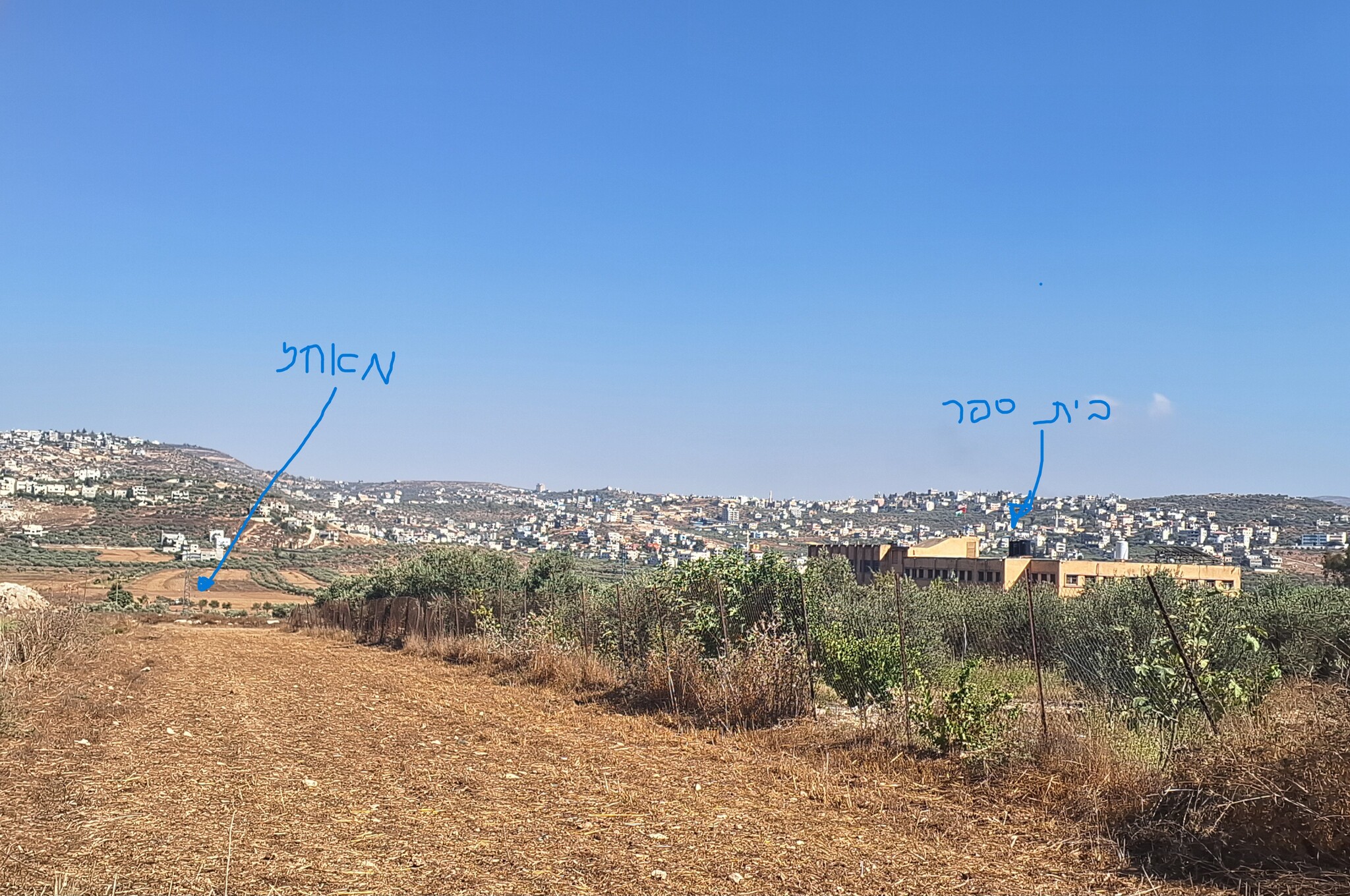 Ronit Dahan-RamatiAug-24-2026Huwara: The school on the outskirts of town and an outpost hidden among the trees
-
