
AM
HUWWARA, BEIT FOURIQ, TAPUAH JUNCTION, Sunday 13 June 2004 AMObservers: Hanna L., Nora P., Bina C. (new watcher), Dina A. (reporting) colour=red>In general:There was no water or shade; Confiscated cars and papers — we have lists of car numbers and case reports for possible future action on this issue; Problematic soldiers — the issue is one of extreme behaviour, beyond the standard inflexibility that we often encounter. I believe we should report this to back our demand that these soldiers are not assigned to serve at checkpoints; Harassing teachers/students — now that the university term is over, teachers andstudents have lost their status. We were told that there will be summer courses and we foresee a new area of harassment. If students and teachers enjoyed a special arrangement with the army throughout the academic year, there is no reason to deprive them of passage during the vacation [ both groups at an-Najah University in Nablus had special permits which allowed them passage through the checkpoints on Wednesdays, the end of the Palestinian academic week, and Saturdays, the start of the new week]; Guns pointed at civilians at the checkpoint – my understanding is that this is prohibited, but the army’s “humanitarian” hotline informed us that soldiers may stand with their guns at the “ready” position. It would useful to know exactly what that means. 08:00 At Huwwara South (for those going into to Nablus) and North (for those going in the opposite direction) there were only relatively thin lines. According to the officer , today there has been an “easing” of rules and the upper age of those who are automatically refused passage has been reduced from 35 to 30 [Palestinian men between the ages of 16 and 35 automatically fall under suspicion at checkpoints and are usually stopped; the upper age limit has apparently been dropped to 30]. The soldier in charge of the women’s line was particularly brutal: he seemed bent on deliberately humiliating and harassing, e.g. asking women to walk towards him exactly at the centre of the passage, neither to the left nor to the right, and always shouting these instructions. He made the women stand at a distance of some 30 cms from him with his gun pointed at their chests or faces. A 28-year-old teacher was refused passage on the grounds that the university term was over and so “he has nothing to look for in Nablus”. We asked the “humanitarian” hotline to intervene on the issue of the pointed gun and to give us the official regulations about teachers during the university vacation. A student from an-Najah University, accompanied by his elderly mother, was also refused passage; it was he who told us about the summer courses and of his fears that he will be harassed each time.After approximately 15 minutes a soldier informed me that teachers could go through the checkpoint; but the student was still refused .On the northern side of the checkpoint there were eight detainees who were all equipped with the documents they needed to present at the District Coordinating Office (DCO) to arrange permits [the DCO is the army section that handles civilian matters, as for example the granting of various permits; it usually has a representative at the checkpoint ostensibly to alleviate the lot of the Palestinians]. The soldiers claimed that their having the documents was not relevant to the “procedure” of withholding their ID cards and keeping them in the detainees’ area until clearance had been received. It seems to us that this is something new [the detainees’ ID card details are phoned through to a central point to be cross-checked against a list compiled and maintained by the General Security Service (GSS), also known by its Hebrew acronym as Shabak or Shin Bet, in an effort to weed out those regarded by the Israeli authorities as security risks]. We were approached by a young man on the southern side whose car, ID card, and driver’s licence had all been confiscated for five days. He had received his car and ID back, but not his licence. We will try to assist him.[The legality of such confiscation appears to be very questionable.]Since the soldier’s gun point was going up and down at random, we again called the “humanitarian” hotline, where we were told that soldiers need to hold the gun at the “ready” position.All the rest was “as usual” – detainees waiting in the sun for security clearance, families split up – fathers and sons not allowed to accompany wives and mothers, etc.09:15 — At Beit Fouriq there is now a new paved road, marked with arrows at the “junction”. All bright and absurd. The first soldier we talked to said himself that it was a shame that all that “money should be spent on it”.Soldiers at Beit Fouriq, too, talked about the “easing” of restrictions lowering the upper limit of the “suspect” age from 35 to 30.There was only one detainee. The line of those going through was again thin. The water container here was in working order; but there was no shade for those on line. The soldiers were shielded from the sun by shade net. There were five confiscated cars in the usual area. None of the soldiers could tell us how long they had been there – a day or two, although they did say that there was a “list”. The soldier watching the valley tried to stop us from going down to register the car numbers, claiming it was a “closed military are” and “very dangerous”. We explained exactly what is meant by a “closed military area” [the order establishing such an area must be signed by a senior officer and produced on demand; soldiers will often try this ruse to keep people away], and we have the car numbers.10:10 — At Awarta there was the usual routine of the endless line – about 30 trucks incoming, about 10 outgoing. There only three soldiers on duty, very young and “efficient”. They wanted to go home, and asked us for “Stop the Occupation” t-shirts.10:30 We stopped at the Tapuah junction because we had been told in Huwarra that there was a long line there. There were some 30 cars in the direction leading out of the occupied territories , and we were held up, too, and had our ID cards checked. The soldiers said there was an alert about the imminent infiltration of a woman terrorist.We did not come across any unannounced road blocks or any [Jewish Israeli] settlers.
Huwwara
See all reports for this place-
The Huwwara checkpoint is an internal checkpoint south of the city of Nablus, at the intersection of Roads 60 and 5077 (between the settlements of Bracha and Itamar). This checkpoint was one of the four permanent checkpoints that closed on Nablus (Beit Furik and Awarta checkpoints to the east and the Beit Iba checkpoint to the west). It was a pedestrian-only barrier. As MachsomWatch volunteers, we watched therre since 2001 two shifts a day - morning and noon, the thousands of Palestinians leaving Nablus and waiting for hours in queues to reach anywhere else in the West Bank, from the other side of the checkpoint the destination could only be reached by public transport. In early June 2009, as part of the easing of Palestinian traffic in the West Bank, the checkpoint was opened to vehicular traffic. The passage was free, with occasional military presence in the guard tower. Also, there were vehicle inspections from time to time. Since the massacre on 7.10.2023, the checkpoint has been closed to Palestinians.
On February 26, 2023, about 400 settlers attacked the town's residents for 5 hours and set fire to property, such as houses and cars. Disturbances occurred in response to a shooting of two Jewish residents of Har Bracha by a Palestinian Terrorist. The soldiers stationed in the town did not prevent the arson and rescued Palestinian families from their homes only after they were set on fire. No one was punished and Finance Minister Smotrich stated that "the State of Israel should wipe out Hawara." Left and center organizations organized solidarity demonstrations and support actions for the residents of Hawara.Hawara continued to be in the headlines in all the months that followed: more pogroms by the settlers, attacks by Palestinians and a massive presence of the army in the town. It amounted to a de facto curfew of commerce and life in the center of the city. On October 5, 2023, MK Zvi established a Sukkah in the center of Hawara and hundreds of settlers backed the army blocked the main road and held prayers in the heart of the town all night and the next day. On Saturday, October 7, 23 The "Swords of Iron" war began with an attack by Hamas on settlements surrounding Gaza in the face of a poor presence of the IDF. Much criticism has been made of the withdrawal of military forces from the area surrounding Gaza and their placement in the West Bank, and in the Hawara and Samaria region in particular, as a shield for the settlers who were taking over and rioting.
On November 12, 2023, the first section of the Hawara bypass road intended for Israeli traffic only was opened. In this way, the settlers can bypass the road that goes through the center of Hawara, which is the main artery for traffic from the Nablus area to Ramallah and the south of the West Bank. For the construction of the road, the Civil Administration expropriated 406 dunams of private land belonging to Palestinians from the nearby villages. The settlers are not satisfied with this at the moment, and demand to also travel through Hawara itself in order to demonstrate presence and control.(updated November 2023)
.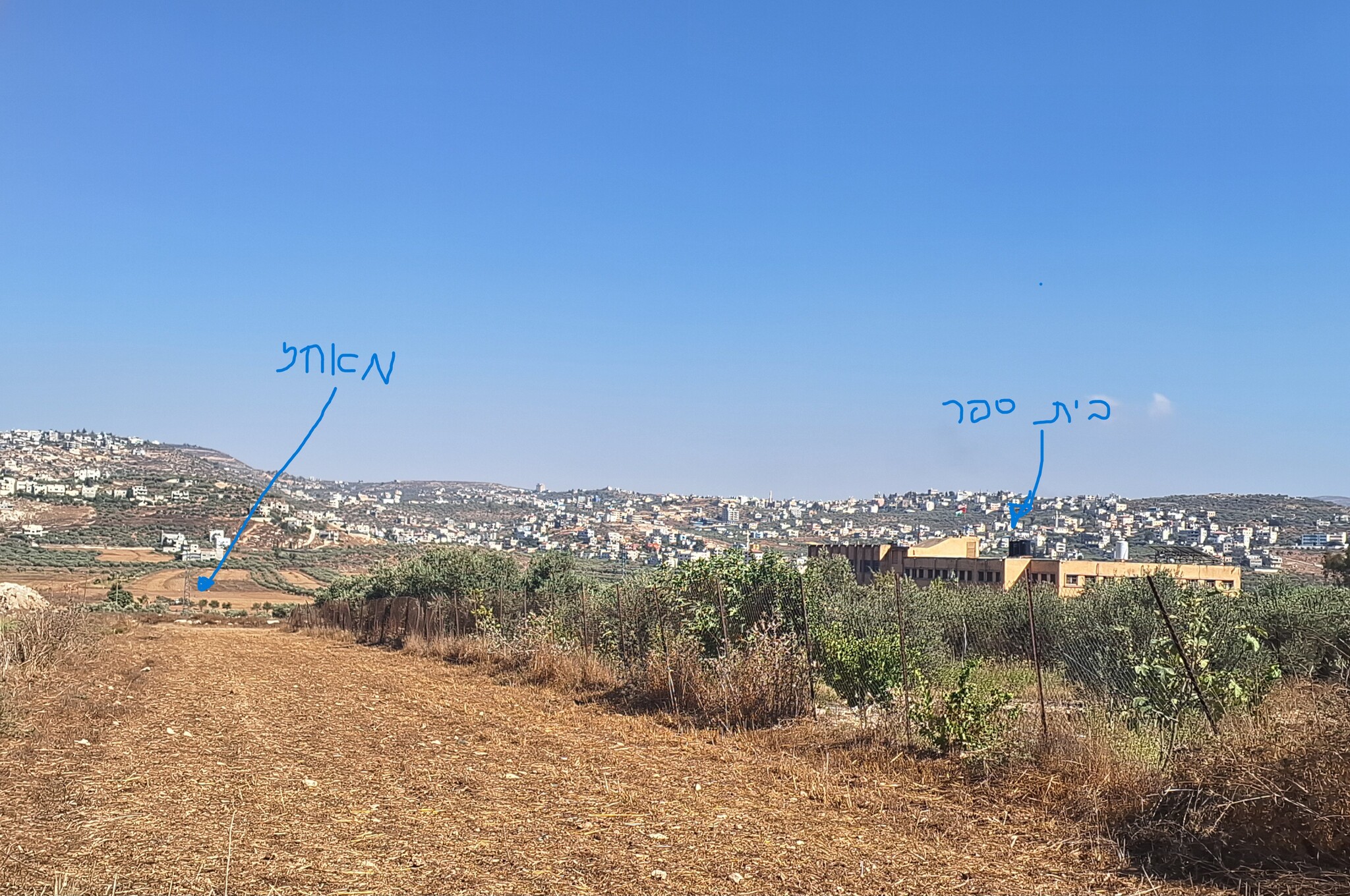 Ronit Dahan-RamatiAug-24-2026Huwara: The school on the outskirts of town and an outpost hidden among the trees
-
