
‘Anabta, Deir Sharaf, Habla, Jubara (Kafriat), Ras ‘Atiya, Sun 14.2.10, Afternoon
Summary
The dozens of enclaves caught between
the Wall on the East, and Israel
and the Green Line on the West, are defined as the “Seam Zone,” where
approximately 50,000 Palestinians live. The Wall itself is a combination of an 8 meter high concrete wall
mainly, but not always, built around Palestinian population centers. There is
also a 30-100 m.
wide “buffer zone” east of the Wall with electrified fences, trenches, sensors
and military patrol roads. The destruction and/or confiscation of Palestinian
property imposes severe restrictions on Palestinian movement, while many, many others
have only highly restricted access to the people who live in these enclaves. Most
of us probably aren’t familiar with the appropriately ugly terminology, found
in international law, for those living in the Seam Zone: “internally stuck
persons” (ISP’s). How true, just what we
keep experiencing on our shifts in the Seam Zone these days! Palestinians experience
rights violations, yet are unable to leave. Moreover, those Palestinians living
in the Seam Zone and the many others who work in the Seam Zone are effectively
required to obtain permits to live and work on their own land. Read on:
11:05 Gate 1392 Habla
Agricultural Gate
The gate is only open at 11:15,
so we hear from the people who work in the nurseries about more problems for the
Seam Zone people who own the land they work on: one hour to get through Eliahu
Gate, Gate 109, this morning, from 7:00-8:00. Another man, yet another nursery
owner, tells of his permit to build a shop, one room, duly done, just down the
main road, Route 55, but he could not open it (was forbidden), lost his six
workers and his livelihood, now puts up with a “limited ID.” “We don’t want to
work in Israel,
we just want to work on our own lands… we have nowhere else to go.”
11:50 — little action at the
gate today, other than sheep crossing, and our cowboy friend today is in charge
of horses, not sheep, four of them, which he brings to the gate to be handed
over to somebody waiting on the other side. Looks like a relay race, with no
winners. A driver dismounts from his truck, goes over to the soldier, shows his
ID, which is checked against a list (note that this man is going out of the
Seam Zone area).
12:15 Ras Atiya: Seam Zone
village
On the way past Alfe Menashe, we
can see road widening, plus two caravans and earth moving equipment, surely for
the beginnings of new housing in the settlement? We are also stopped by a group
of local men before we get to the checkpoint to hear complaints about “Daniel”
who appears to be on duty today, a military policeman.
When we get there, the commander
refuses to answer our questions. “I don’t answer questions…. what my name is
makes no difference…. have a nice day.” He says the same phrases over and over,
sounding like a broken record. We stand where are, and he repeats the mantra over
and over.
There’s little human or vehicular
traffic for quite a while. A young woman student, Al Quds Open University, has
no problem crossing from the village where she’s visited an aunt although she herself
lives in Ras Atira.
12:20 — two other women cross
the barrier road without having to enter the concrete building on the far
side., are just checked by a soldier standing in the middle of the crossing.
12:30 –a truck and two cars wait
on the far side. All the drivers and passengers enter the concrete building.
It’s hot and windy, and people wait at the lone turnstile to enter the building
in the time honored fashion of Occupation, “One by one.”
By now, the line of vehicles waiting
to be checked grows, but time is of no essence under Occupation. People wait
and wait some more.
A truck driver is in a long discussion
with a group of soldiers in the middle of the separation roadway. The military
policewoman from the concrete building comes out, stands far off on the barrier
roadway, making a phone call. People wait and wait some more.
A car, empty of passengers, is
thoroughly inspected inside and in the trunk, four soldiers standing around it,
working oh so slowly, or just gazing.
No noise, just the wind, and the
endless Occupation.
12:35 — a green jeep, a yellow
light atop it, appears on the Separation Barrier roadway, bearing a sign,
“Security, Seam Line,” and an un-uniformed man, gun in his back pocket,
emerges. More privatization. There are now six soldiers here plus one security guard.
12:45 — the white bus, empty
today, bearing the dove, the present form the Italian Government, appears, and
the driver stops to complain of all the problems created by the “situation:”
he, too, once worked in Israel….
Three young men wait with the Seam
Line Security man, but, at this point, we don’t understand what’s going on. A
few minutes later, a pickup truck, also bearing “Security, Seam Line” on it,
appears and whisks the young men off. At this point, the green jeep drives up
to us, comments how busily we’re writing all the time and tells us that the three
young men are helping to build the security fence….
On Route 55
Passing near Qedumim, we’re admiring
the huge patches, almost “ponds” of blue lupins, when, suddenly, from a dirt
path, just north of the settlement another pick up truck appears, “Security
Seam Line.” So, the Wall will begin to be built here now too?
Deir Sharaf
No checkpoint, no soldiers and
the unfinished roadway to and from the settlement of Shavei Shomron is a white
elephant, built at the expense of the Palestinians who owned the olive trees
that once grew there
14:00 Anabta
No soldiers, and the red traffic
light never changes as traffic flows in and out of the still pristine, deserted
checkpoint
14:10 Jubarra (Figs Crossing): Seam Zone village
Here, too, there’s a traffic
light, but this one is always green. Always green for the always locked gate
leading up to the Seam Zone village
of Jubarra. We have a lot
of trouble getting through the gate, in spite of phone calls, made by Tami,
prior to our arrival. “Nobody ever goes up there” we’re told. Eventually, a soldier
demands to see our “permit,” and this, it appears, is the tag we wear to show
we’re MachsomWatchers!
As we drive up to the village, we
note trees overflowing with yellow, unpicked lemons, one of the formerly empty poultry
farms now filled to the brim with tightly packed chickens; green fields, overflowing
with many small white flowers and a few red anemones, plus a herd of beautiful
goats, some of whose frolicking kids are a silky grayish blue color. A white
egret wanders happily in their midst, the shepherd, standing on the side of the
roadway seemingly lost in thought.
Gate 753
The gate has “grown up,” or
become institutionalized, as everything in this endless occupation. There is an
almost finished concrete house, a twin of the ones at Gate 1392 (Habla) or Ras
Atiya on the far side of the Separation Barrier, an earth mover near by,
digging a trench. The lights are on here, but there’s little action. A yellow
taxi still disgorges its passenger on the far side of the gate. A generator
hums noisily, a tractor crosses from the village, and we note that a fully laden
pickup truck makes its way, after inspection, along the Separation road to a
far off yellow house. The one nearer the crossing seems to be no more, but a
pile of rubble can be clearly seen, just off the separation roadway.
15:00 Jubarra gate
The soldier finally ambles over
to unlock the gate to let us pass, but insists, not only on checking the trunk,
and lifting up the carpet there but on the driver leaving her seat to open up
the back (not as in Israel proper).
'Anabta CP
See all reports for this place-
'Anabta CP
The checkpoint is located south of the village of 'Anabta, at the intersection of Road 60 (leading to Nablus at the entrance to Area A), with Road (57, 557, 5576) facing west towards the Einav settlement and the checkpoint at the exit from the West Bank - Figs checkpoint. Until 2010 we used to watch the intersection and report the long columns created due to a slow inspection of the vehicles in both directions.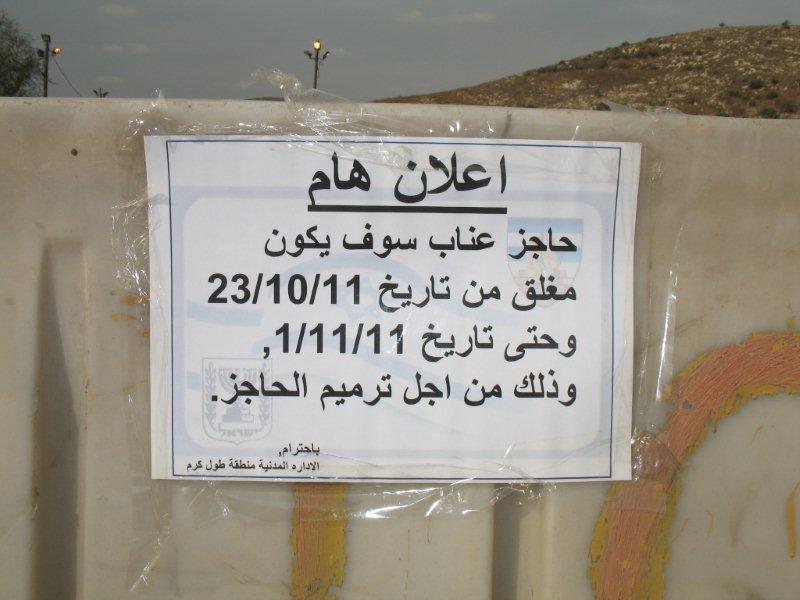 Oct-28-2011Anabta checkpoint 24.10.11
-
Deir Sharaf checkpoint
See all reports for this place-
Deir Sharaf checkpoint is located west of Nablus and south of the settlement of Shavei Shomron, at the entrance to the village of Deir Sharaf on the road leading to Nablus. The checkpoint was activated in early March 2009 after the Beit Iba checkpoint was closed. Palestinians are allowed through the checkpoint , but not for Israelis. Unlike the checkpoints leading to Qalqilya and Tulkarm, crossing of Israeli Palestinians is only allowed on Saturdays.
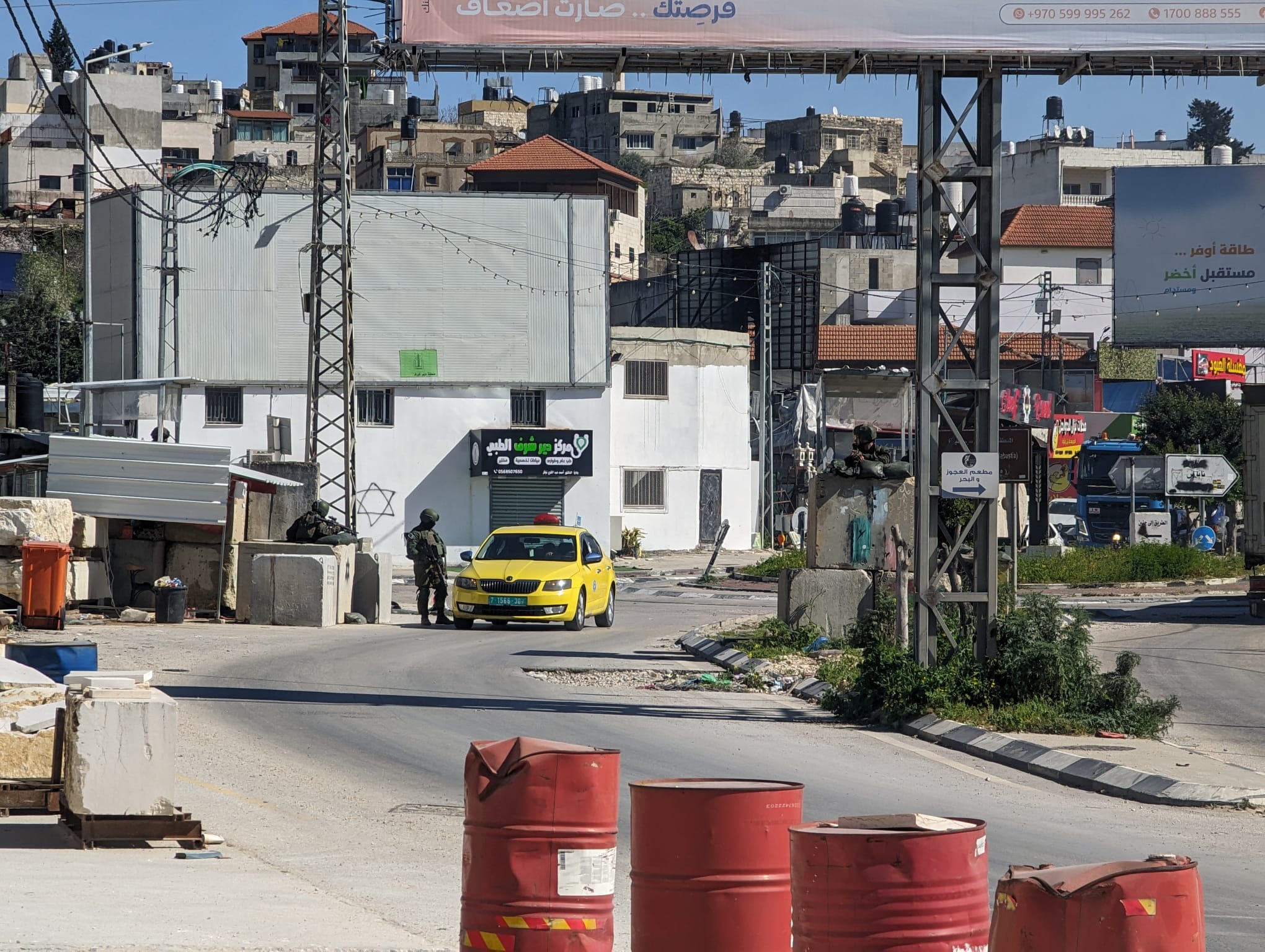 Nina SebaFeb-28-2024Deir Sharaf - the entrance to the village
-
Habla
See all reports for this place-
Habla CP (1393)
The Habla checkpoint (1393) was established on the lands of the residents of Qalqilya, on the short road that
connected it for centuries to the nearby town of Habla. The separation barrier intersects this road twice and cut off the residents of Qalqilya from their lands in the seam zone.(between the fence and the green line).
There is a passage under Road 55 that connects Qalqilya to the sabotage This agricultural barrier is used by the farmers and nursery owners established along Road 55 from the Green Line and on both sides of the kurkar road leading to the checkpoint.
This agricultural checkpoint serves the residents of Arab a-Ramadin al-Janoubi (detached from the West Bank), who pass through it to the West Bank and back to their homes. The opening hours (3 times a day) of this agricultural checkpoint are longer than usual, about an hour (recently shortened to 45 minutes), and are coordinated with the transportation hours of a-Ramadin children studying in the occupied in the West Bank.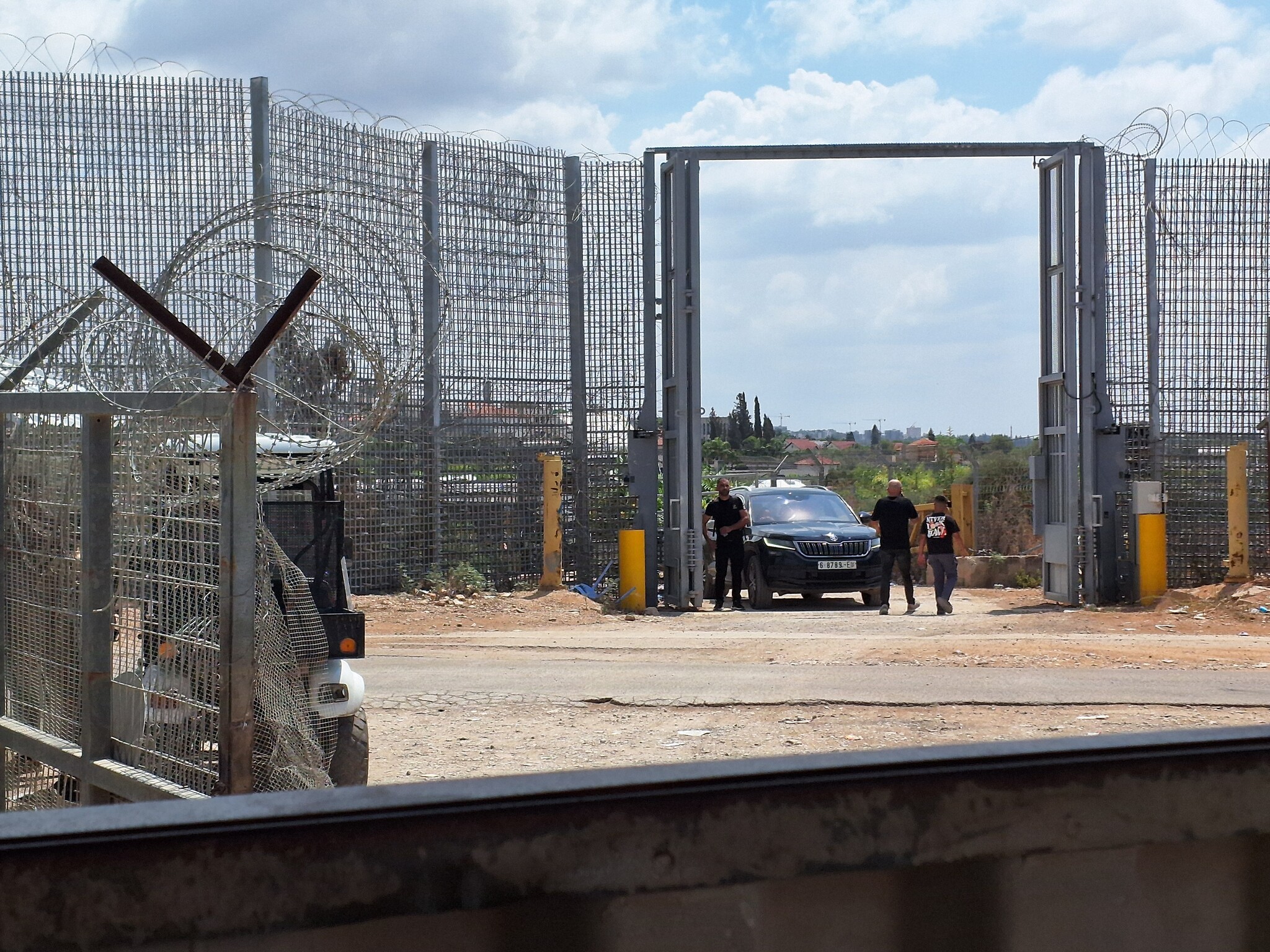 Ronit Dahan-RamatiAug-31-2026Habla. The gate is open
-
Jubara (Kafriat)
See all reports for this place-
The Jabra checkpoint was on Road 557, south of Tulkarm, on the side of the Figs Pass, which is located within the Palestinian Authority (a few kilometers east of the Green Line), and serves as an entry barrier from the territories to Israel. The checkpoint to the village of Jubara, which until 2013 was in the seam area, blocked and surrounded by a fence, was intended for the passage of the family members of the house next to the checkpoint, and also for the MachsomWatch volunteers (with special permission only), on their way to checkpoint 753. on the other side of the village. The soldiers supervising the "fig crossing" also supervised the crossing at this checkpoint, in our shifts we often waited a long time until the key was found and the gate opened. The checkpoint was abolished and became part of the separation fence that was moved west following the High Court.
-
Ras 'Atiya
See all reports for this place-
The checkpoint is presently on the Separation Barrier roadway, manned and open 12 hours a day, from 6:30 to 18:30. West of it is the large Seam Line village whose school is attended by children from the nearby villages east of the Barrier and many of whose inhabitants have permits to work in Israel. How long this checkpoint will remain in place is unknown, since construction of the Separation Wall, just by the settlement of Alfe Menashe, east of the present Separation Barrier, is endless, as is the creation of a new road and, obviously, a new checkpoint.
-
