
‘Anabta, Habla, Thu 5.8.10, Morning
Translation: Suzanne O.
Summary:
Two Bedouin tribes who stayed in the Alfei Menasheh enclave are so harassed that they are unable to attain even basic necessities – food (eggs and meat), kindergarten, calor gas canisters. They are under constant pressure to abandon their lands (private lands legally owned by them) and move to Izbet Tabib. All building works since 1967 are illegal.
At the entrance to Chabala we were told that landowners are threatened from the other side of the fence that they will be refused entry by the Shabak and, in future, will be unable to cross over to their land (and then their land will be confiscated because it will be claimed that it is not cultivated).
These are two examples of the attempts to dispossess landowners in the area of the junction with the territories.
The situation of the Bedouin is particularly difficult.
We saw how the helplessness of the Palestinian labourers to obtain their legal wages is being taken advantage of.
The roadblock at Shevei Shomron on Road 60 to Jenin was opened to Palestinians two days ago.
We also visited friends at Anabta and Beit Dejan.
Sha'ar Chabala
7:00 – 7:35 am.
On the other side of the gate in the direction of Chabala there are a lot of people. We can't see exactly how many. The gate opened 15 minutes ago.
4 – 5 people at a time are allowed into the inspection area and they leave after 3 – 4 minutes, and so on.
One of those crossing, a landowner in the juncture area, is concerned. He has an agricultural permit but he is refused entry by the Shabak and he was told at the DCO that whoever does not hold a magnetic card (which are not granted to those refused by the Shabak) will not be allowed to cross. Thus he will, de facto, lose the right to cultivate his land which will indirectly permit the civil administration to take it over.
We spoke to one of the labourers. He works in Moshav Yarchiv (within walking distance of the gate) and is paid NIS100 for a day's work.
How lucky is the Yarchiv resident to live so close to the territories. The minimum legal wage is about NIS160, apart from National Insurance, holiday, sick pay and the rest of the rights according to the laws of his country. And who will dare to claim them from him?
7:50 – 8:45 a.m. Remadin Tribe (in the Alfei Menasheh enclave)
Two Bedouin tribes are left in the enclave. The second – Abu Fardeh tribe – has a mukhtar (Arabic head of village).
We talked to the owner of the grocery shop in Remadin.
They are refugees since 1948 from the Beer Sheba area. They have about 100 dunams of land which are legally theirs
About a year ago the civil administration 'offered' to move them to Izbet Tabib. They refused.
The village is considered illegal. All building is prohibited. Until about a year ago a blind eye was turned, now no building is permitted. Most of the houses are built of corrugated iron.
Some of them work in Alfei Menasheh. Some of them have sheep. Once upon a time they all made a living from pasturing their sheep.
They get water from the industrial area of Alfei Menasheh. Electricity – a generator, 5 hours a day, 3 at night. And they live under boiling hot corrugated iron. Food cannot be stored in refrigerators.
There are practically no commodities in the grocery shop apart from cigarettes. In order to get commodities from Kalkilya the mukhtar has to get in touch 3 days in advance with a detailed list. Then the grocery shop owner crosses at Sha'ar Eliahu (109) and is inspected in the inspection area. Eggs and meat are not permitted to cross even for personal use. Even calor gas canisters have to be ordered in advance. He asked us to find out what can be done to ease the problems he is confronted with at the Eliahu crossing.
UNWRA distributes basic food necessities every three months.
There is no kindergarten. School is at Chabala and Ras a-Tira.
In this way they are slowly suffocated until they give in, are dispossed and cede their lands to the State of Israel and the settlers.
We went to the old Kalkilya roadblock to experience how easy it is these days to get into Kalkilya.
Nablus erea
'Anabta CP
See all reports for this place-
'Anabta CP
The checkpoint is located south of the village of 'Anabta, at the intersection of Road 60 (leading to Nablus at the entrance to Area A), with Road (57, 557, 5576) facing west towards the Einav settlement and the checkpoint at the exit from the West Bank - Figs checkpoint. Until 2010 we used to watch the intersection and report the long columns created due to a slow inspection of the vehicles in both directions.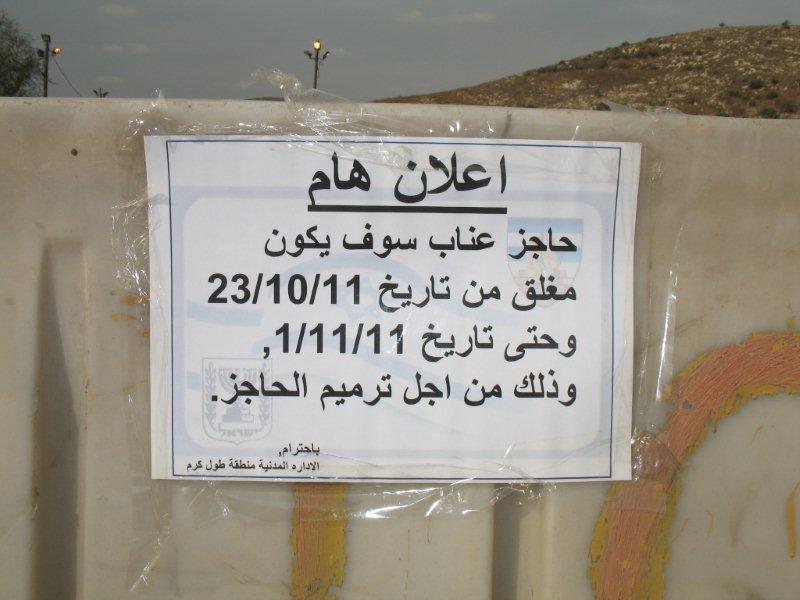 Oct-28-2011Anabta checkpoint 24.10.11
-
Habla
See all reports for this place-
Habla CP (1393)
The Habla checkpoint (1393) was established on the lands of the residents of Qalqilya, on the short road that
connected it for centuries to the nearby town of Habla. The separation barrier intersects this road twice and cut off the residents of Qalqilya from their lands in the seam zone.(between the fence and the green line).
There is a passage under Road 55 that connects Qalqilya to the sabotage This agricultural barrier is used by the farmers and nursery owners established along Road 55 from the Green Line and on both sides of the kurkar road leading to the checkpoint.
This agricultural checkpoint serves the residents of Arab a-Ramadin al-Janoubi (detached from the West Bank), who pass through it to the West Bank and back to their homes. The opening hours (3 times a day) of this agricultural checkpoint are longer than usual, about an hour (recently shortened to 45 minutes), and are coordinated with the transportation hours of a-Ramadin children studying in the occupied in the West Bank.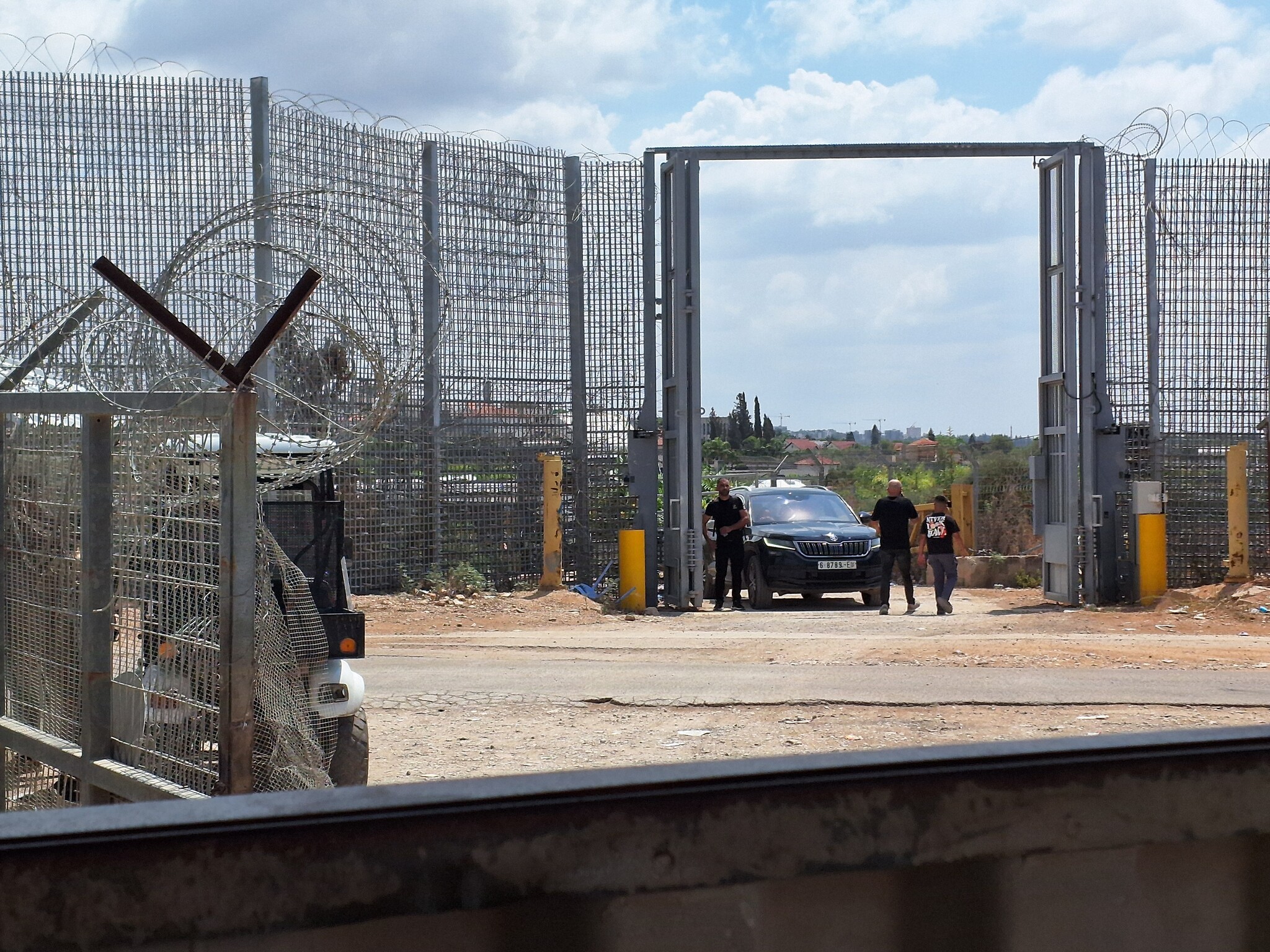 Ronit Dahan-RamatiAug-31-2026Habla. The gate is open
-
