
‘Anabta, Irtah (Sha’ar Efrayim), Jubara (Kafriat), Sun 7.6.09, Morning
Translation: Galia S.
The tactics they use to keep us away from the checkpoints are getting more sophisticated.
07:10 – On the northern side more than 200 people are crowded together, waiting for the turnstile to open. A few minutes after our arrival, the gates open and people surge out in groups of tens, rushing toward the next turnstile. A most disturbing sight. People, among them older people, women and children, are running to the buses and minibuses which are waiting on the other side of the terminal on their long way to visit their dear ones in prison or to begin another hard workday.
A voice comes from one of the loudspeakers, "Tell her to come without the bag with the buttons!" The Red Cross person translates. "Open only this bag!" says the voice of the security company man. We can scarcely see through the slits of the fence. Within minutes the area empties. Three men come out of the checkpoint structure and go back toward Tulkarm. To our question why they are going back, one of them says he had a meeting with a lawyer in Taiyba. The story is that two and a half years ago, while working, he had an accident. He had been working at that place for 17 years and every month got a salary slip on which the social security deduction was recorded, or that's what he thought. When he had the accident and had to undergo three surgeries at Barzilai Hospital, he was shocked to find out he was not insured. The lawyer told him he wasn't covered because he didn't have health insurance. In addition to that, it turned out that the boss had gone into bankruptcy. There is no one he can talk to and he feels lost. We have told him to turn to the Physicians for Human Rights – Israel and to "Kav la'Oved" [a voluntary organization that advises and helps foreign workers].
He has an additional problem. The "Shabak" [Israeli General Security Service] denies him the renewal of his permit to work in Israel. They have told him explicitly that they want him to cooperate with them. He refuses and he pays the price.
07:45 – We moved to the front of the checkpoint. Five buses are waiting at the parking lot for the prisoners’ families. They won't leave until they are all full. Precious time is lost. The course of checks inside the terminal is long and exhausting. The travel to the gates of the prison also takes between 3 and 4 hours without a stop. There are small children in the bus, often unaccompanied by an adult. The child is sometimes the only one who gets the permission for the visit. Such a long travel without a stop is inhuman and humiliating particularly for women and older people. Patrols of the military police and the Israeli police will escort the buses all the way to the prisons.
We are prohibited from parking our vehicle in the enlarged and almost empty parking lot of the terminal workers and are sent to park in the smaller and tightly packed area, where the minibuses wait for the workers. "Military zone; parking here is prohibited!"
A man and his daughter from Tulkarm hurry to the bus. The father tells us that his son has been in Nakeb Prison – Ktsi'ot Prison – for almost 4 years. He is 18 now and has been caught hurling stones when he was 14.
A lot of people are waiting for employers in the shed close to the parking lot. A group of men get up and hurry to a big vehicle waiting on the road, not in the parking lot. I ask them where they are going and what work they are going to do. They answer – they have no idea. They go because it's work.
Two women soldiers from the DCO [District Coordination Office of the IDF Civil Administration that handles passage permits] approach the buses. One of them gets on the bus and checks the list of visitors. The other one, with a gun hanging on her body, stands guard close to the bus.
There is a line of women and children near the toilets. Women and small children pass the time near the swings.
We get to the exit gate to Israel. About 20 people are standing opposite the gate. They want to go back home and ask to open the turnstile for them. "No work", says one of them.
08:30 – A man from Jenin who left his home at 03:00 in the morning and has just come out of the terminal insists on stopping and talking to us, asking to listen to what he has to say. What he tells us is something we have heard many times. In the terminal structure, he says, there are 3 X-ray machines. One is at the entrance; another one is 30 meters further. Passing these two machines is no problem. While passing the third machine a kind of selection is made. People are sent randomly to different rooms: some are sent to the X-ray room while others are sent to a room where manual checks are carried out. Sometimes people stay in the room over an hour. This procedure repeats itself every day. The man is deathly afraid (his words) of radiation. He says that sometimes he tries to refuse to enter the X-ray room, explaining that he doesn't want to go through the X-ray machine but they make him enter. He asks us to enter the room and see for ourselves. (In my opinion, we can consult the Physicians for Human Rights about this issue)
Jubara
08:50 – We pass by and don't stay. As we pass, the checkpoint looks empty.
Anabta
09:20 – The red sign that warns against entering zone A has been moved a few hundred meters southward in the direction of the junction. A number of roadblocks, camouflage nets and a shack make a checkpoint before a checkpoint. The part that has just been enlarged plus the additional driving lanes can scarcely be seen (binoculars might help).
As soon as we arrive, the soldiers get nervous. Forbidden is the work used most and, of course, also 'Stand here' or 'Stand there!' The usual arguments precede their relenting and letting us take pictures from a closer place. A civilian, a worker of the contractor's company determinedly approaches us, take out a pen and some paper and asks for our details. "It's a military zone!" he says in a heavy Russian accent, speaking as if he has an authority in the place. The officer has to calm him down and probably update him about the division of labor in the area.
There is traffic of heavy vehicles at the checkpoint. A lot of cars wait at the junction to enter Tulkarm.
'Anabta CP
See all reports for this place-
'Anabta CP
The checkpoint is located south of the village of 'Anabta, at the intersection of Road 60 (leading to Nablus at the entrance to Area A), with Road (57, 557, 5576) facing west towards the Einav settlement and the checkpoint at the exit from the West Bank - Figs checkpoint. Until 2010 we used to watch the intersection and report the long columns created due to a slow inspection of the vehicles in both directions.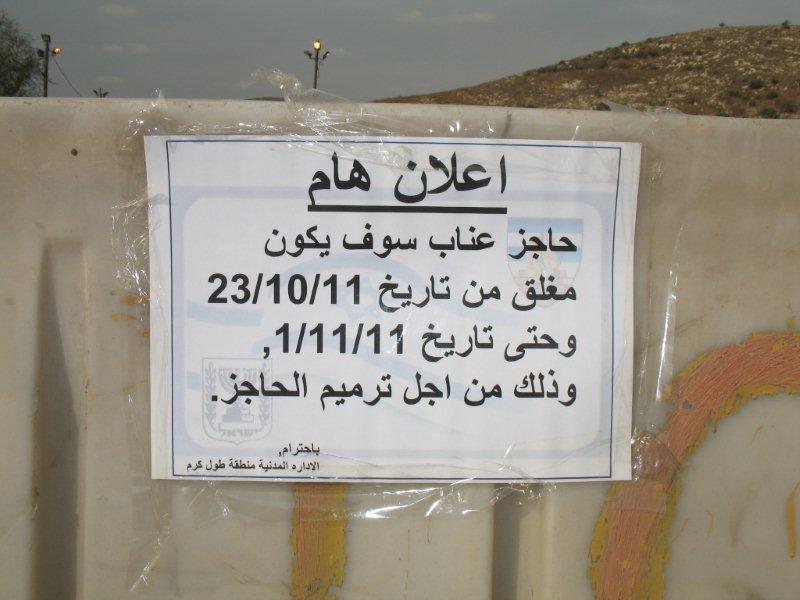 Oct-28-2011Anabta checkpoint 24.10.11
-
Irtah (Sha'ar Efrayim)
See all reports for this place-
The checkpoint is for Palestinians only. It is the main barrier to the passage of workers from the northern West Bank to Israel. Workers with a permit to work in Israel and also for trade (with appropriate permissions), medicine, and visiting prisoners. One can cross the checkpoint only on foot. The checkpoint is located north of Road 557 and south of Tulkarm. Operated by a civil security company, opening hours: between 4:00 and 19:00 on weekdays. As members of Machsom Watch, we began our shifts to this location in 2007. We arrived before it opened at 4 in the morning and report since, on the harsh conditions and the long and crowded queues of workers. The workers who pass by continue their journey by transportation to work throughout Israel. In the first period of its activity, about 3,000 and then 5,000 people passed through this checkpoint every day. Due to the small number of checking points and arbitrary delays for long periods of time in the "rooms", workers feared losing their transportation. Hence workers leave their homes at 2:30 at night to be among the first. Today, 15,000 pass and the transition is faster. Workers are still leaving their homes very early to get past the checkpoint at 7 p.m. In an adjacent compound, there is a terminal for the transfer of goods on a commercial scale, using the back-to-back method.
-
Jubara (Kafriat)
See all reports for this place-
The Jabra checkpoint was on Road 557, south of Tulkarm, on the side of the Figs Pass, which is located within the Palestinian Authority (a few kilometers east of the Green Line), and serves as an entry barrier from the territories to Israel. The checkpoint to the village of Jubara, which until 2013 was in the seam area, blocked and surrounded by a fence, was intended for the passage of the family members of the house next to the checkpoint, and also for the MachsomWatch volunteers (with special permission only), on their way to checkpoint 753. on the other side of the village. The soldiers supervising the "fig crossing" also supervised the crossing at this checkpoint, in our shifts we often waited a long time until the key was found and the gate opened. The checkpoint was abolished and became part of the separation fence that was moved west following the High Court.
-
