
‘Anata-Shu’afat, Container (Wadi Nar), Mon 6.2.12, Afternoon
We first visited Anata where both vehicular traffic and pedestrian traffic moved smoothly,.
Wadi Nar
We took our usual route down to Azariah and then proceeded toward Wadi Nar. About 250 meters before reaching the top of the hill, there was a backup of traffic. We noticed that the drivers in front of us had turned off their motors and some were just walking around. After waiting about 15 minutes, we were able to move about 20 meters and then were stopped once again. We waited about another 10to 15 minutes and once again could move just about 4 car lengths. At that point, Chana said that she was going to walk to the checkpoint and see what was happening. While she was gone, the same pattern repeated itself. While we were waiting, some cars just turned around (on this very narrow, curving, dangerous one-way road) and decided to go back down the hill.
Chana reached the checkpoint and saw that the soldiers were very, very slowly checking out each and every vehicle. She asked why there was this terrible delay. The response was that it was none of her business and he didn’t have to tell her anything. She told them that drivers along the way reported waiting up to an hour and he said that he didn’t care if they waited for 5 hours. She said that this was causing unnecessary antagonism at which point he pointed his rifle at her and said she better go back to where she came from or he would have her arrested. Chana said that she came from a home for the elderly and he could go ahead and arrest her. He then retorted that he had the greatest respect for the elderly!
Chana’s approach must have helped somewhat because instead of waiting 15 minutes between moving ahead, the wait was down somewhat,. The meanwhile, I started making calls, but had difficulty getting through to a person and just kept leaving messages. I finally got through to an office and reported on the situation. The message was obviously delivered because within minutes, we were moving at a slow but reasonable pace. In all, it took us over an hour to travel a distance which should have taken 5 minutes.
When we got to the top of the road, there was absolute and total confusion. Vehicles were converging on the checkpoint from 4 directions – from the road that we were on from Azariah, from the south, from Sawahre, and most dangerous, from the one way road (that is supposed to lead in the opposite direction from the checkpoint) in the direction of Qedar. Apparently, drivers saw the blocked up road that we were on and chose to go the wrong way, up the “down” road. As a result that road was also totally blocked up as well and it was impossible for us to turn left and park our car as we usually do. Were it not for several individuals who took it upon themselves to try to sort out the impossible mess, the situation could have really gotten out of hand, At that point, the previously super cautious soldiers simply waved anyone who could extricate himself from the mess through the checkpoint without so much as a glance. One of the self appointed traffic managers managed to stop the traffic and enabled us to circle round and follow the road toward Sawahre.
We have been going to Wadi Naar for at least four years and never saw such a scene. In fact for the past few years, there was rarely anything of significance to report. However yesterday, something really went haywire. It should be noted that this incident took place between 1 p.m. and 3 p.m. – not even during an especially busy time of day
Checkpoint Shu'afat camp / Anata-Shu'afat (Jerusalem)
See all reports for this place-
The Shu’afat checkpoint is located in the northern part of East Jerusalem at the exit from the village of Anata and the Shu’afat refugee camp, which are located in the area annexed to Jerusalem in 1967. The refugee camp borders the Shu’afat neighborhood to the west, Pisgat Ze’ev to the north, the French Hill neighborhood to the south and the planned expansion of Ma’aleh Adumim to E-1 in the east. It was established in 1966 for 1948 refugees from the West Bank and was populated after the Six Day War by persons who had been expelled from the Jewish Quarter. Today its population comprises some 25,000 people holding blue ID cards and some 15,000 people with Palestinian ID cards. The camp lacks adequate infrastructure and services, and suffers from poverty, neglect and overcrowding. All its buildings are connected to the public electricity and water infrastructure, but not all are connected to the sewer system. The camp’s services are provided by UNRWA, except for those such as health clinics and transportation of pupils to schools in Jerusalem. In 2005, the Israeli High Court of Justice rejected a suit by the residents requesting that the route of the separation fence be drawn such that the camp would remain on the Israeli side, but conditioned its approval of the route on the establishment of a convenient and rapid crossing facility for the inhabitants of the neighborhood, most of whom are residents of Jerusalem.
A temporary checkpoint operated there until December, 2011. It was extremely congested during rush hours, and dangerous for pedestrians (especially children) because of inadequate safety provisions. The new checkpoint was inaugurated south of the old one, for public and private transportation and for pedestrians, intended solely for the residents of the camp – holders of blue ID cards, and those with Palestinian ID cards who possess appropriate permits. There are five vehicle inspection stations at the checkpoint, and two for pedestrians (one of which is currently closed) where scanners have been installed but are not yet operating. According to the army, representatives of government agencies will also be present to provide services to residents of the neighbourhood. The pedestrian lanes are very long, located far from the small parking lots, and accessible through only a single revolving gate.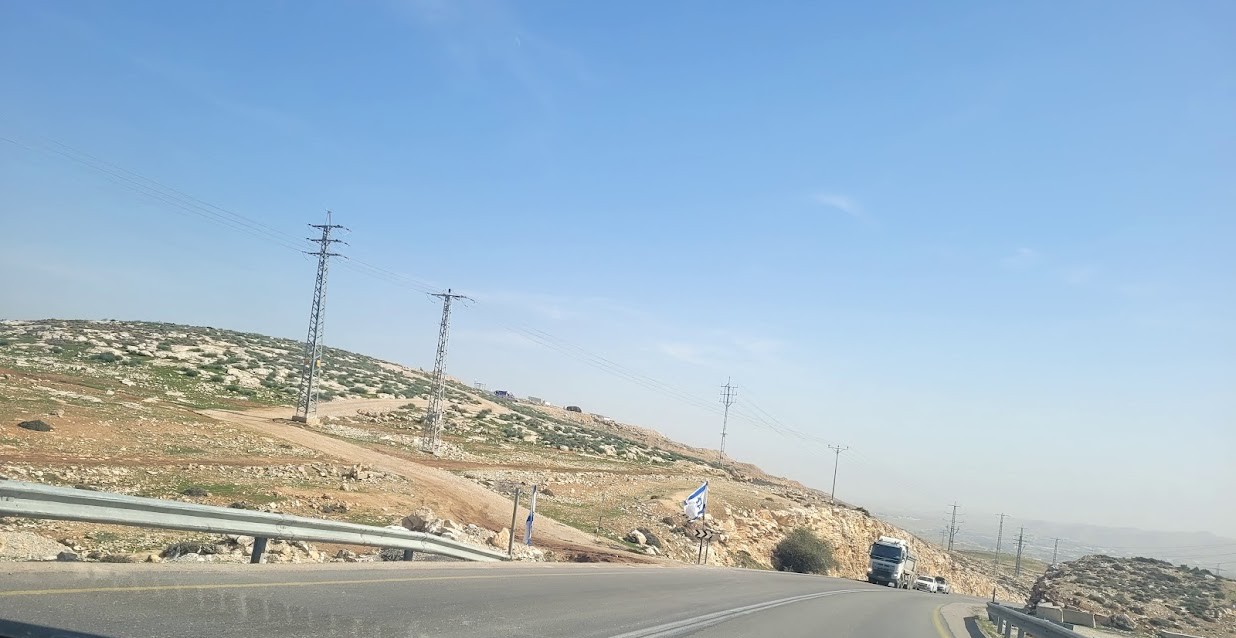 Anat TuegJan-25-2026Anata: A new outpost has been built south of the junction
-
Container (Wadi Nar)
See all reports for this place-
Wadi Nar Checkpoint ("Container", "The Kiosk") - a barrier for vehicles in Area B that is regularly manned - east of Abu Dis between Sawahra A Sharqiya and Bethlehem and its daughters. Controls Palestinian movement between the north and south West-Bank. Includes driving routes, access roads, spikes, traffic lights and signs. There is no pedestrian crossing. Open 24 hours a day with random checks enhanced on security alerts. The checkpoint is in Palestinian territory, allowing for separation between the north and the south Palestinian areas when necessary.
In 2015, the leading road from Azaria to Bethlehem was renovated, as well as the steep and narrow ascent to the Wadi Nar checkpoint, which was dangerously travelled in both directions! The temporary checkpoint was renovated and expanded, and pedestrian traffic was banned. From 2016, traffic travelling from the south bank to Azaria was directed to a one-way road near the Southern Keydar Jewish settlement.
Machsomwatch shifts visit this far-fetched checkpoint only occasionally.
(updated to July 2019)
-
