
‘Anata-Shu’afat, ‘Isawiya (East Jerusalem)
Shuafat
12:45 Arrival.
Numerous pupils disembarked from their buses outside the camp, and crossed through the turnstiles to enter the camp.
We went in and saw an enormous line of cars. From talk with the drivers we learned that they have to wait for half an hour to one hour (depending on where they join the line) in order to leave their neighbourhood which, as we know, is part of united Jerusalem.
We left via the pedestrian checkpoint. 20 waited ahead of us. Crossing time was 15 minutes. People said that since our arrival the tempo had picked up. We asked why only one window was open and were told it was because of the x-ray machine.
Of course it's always possible for 2 persons to put their belongings on the machine as is done at the airport.
Upon exit, we observed the pace of cars crossing.
Only two lanes were open, and the rate was 1/2 a minute for each car. For both lanes 20 cars crossed in 10 minutes.
The policemen there immediately took the trouble to shoo us off, claiming we were in the way. This, of course, was not the case. We stood at a distance behind a fence on the pedestrian path, which was free, without getting in the way of any one crossing. Obviously, the bother had to do with the presence of someone observing.
From one of the buses all the passengers were made to disembark, including women with babies and elderly folk who required the use of canes.
There were no soldiers at the Isawiya checkpoint, only the concrete blocks which impede traffic.
'Isawiya (East Jerusalem)
See all reports for this place-
Isawiya is an Arab neighborhood in East Jerusalem, located on the eastern slopes of Mount Scopus in northern Jerusalem, on the edge of the Judean Desert. It is limited by the Slopes of Mount Scopus National Park, which was declared in 2012 to prevent the expansion of the neighborhoods of A-Tur and Isawiya. It has about 16,000 residents, but the neighborhood does not have a service and commercial center — a fact that causes the residents to consume services in the commercial center of the adjacent Jewish neighborhood French Hill .Most of the residents of the neighborhood work in Jerusalem.
The municipal plan for the neighborhood has been held up for years. This causes housing shortage and culminates in extensive demolitions of unpermitable home extentions and any new building. Unrest and violence follow, and police enters houses at night and throws gas graneds near schools.,.
-
Checkpoint Shu'afat camp / Anata-Shu'afat (Jerusalem)
See all reports for this place-
The Shu’afat checkpoint is located in the northern part of East Jerusalem at the exit from the village of Anata and the Shu’afat refugee camp, which are located in the area annexed to Jerusalem in 1967. The refugee camp borders the Shu’afat neighborhood to the west, Pisgat Ze’ev to the north, the French Hill neighborhood to the south and the planned expansion of Ma’aleh Adumim to E-1 in the east. It was established in 1966 for 1948 refugees from the West Bank and was populated after the Six Day War by persons who had been expelled from the Jewish Quarter. Today its population comprises some 25,000 people holding blue ID cards and some 15,000 people with Palestinian ID cards. The camp lacks adequate infrastructure and services, and suffers from poverty, neglect and overcrowding. All its buildings are connected to the public electricity and water infrastructure, but not all are connected to the sewer system. The camp’s services are provided by UNRWA, except for those such as health clinics and transportation of pupils to schools in Jerusalem. In 2005, the Israeli High Court of Justice rejected a suit by the residents requesting that the route of the separation fence be drawn such that the camp would remain on the Israeli side, but conditioned its approval of the route on the establishment of a convenient and rapid crossing facility for the inhabitants of the neighborhood, most of whom are residents of Jerusalem.
A temporary checkpoint operated there until December, 2011. It was extremely congested during rush hours, and dangerous for pedestrians (especially children) because of inadequate safety provisions. The new checkpoint was inaugurated south of the old one, for public and private transportation and for pedestrians, intended solely for the residents of the camp – holders of blue ID cards, and those with Palestinian ID cards who possess appropriate permits. There are five vehicle inspection stations at the checkpoint, and two for pedestrians (one of which is currently closed) where scanners have been installed but are not yet operating. According to the army, representatives of government agencies will also be present to provide services to residents of the neighbourhood. The pedestrian lanes are very long, located far from the small parking lots, and accessible through only a single revolving gate.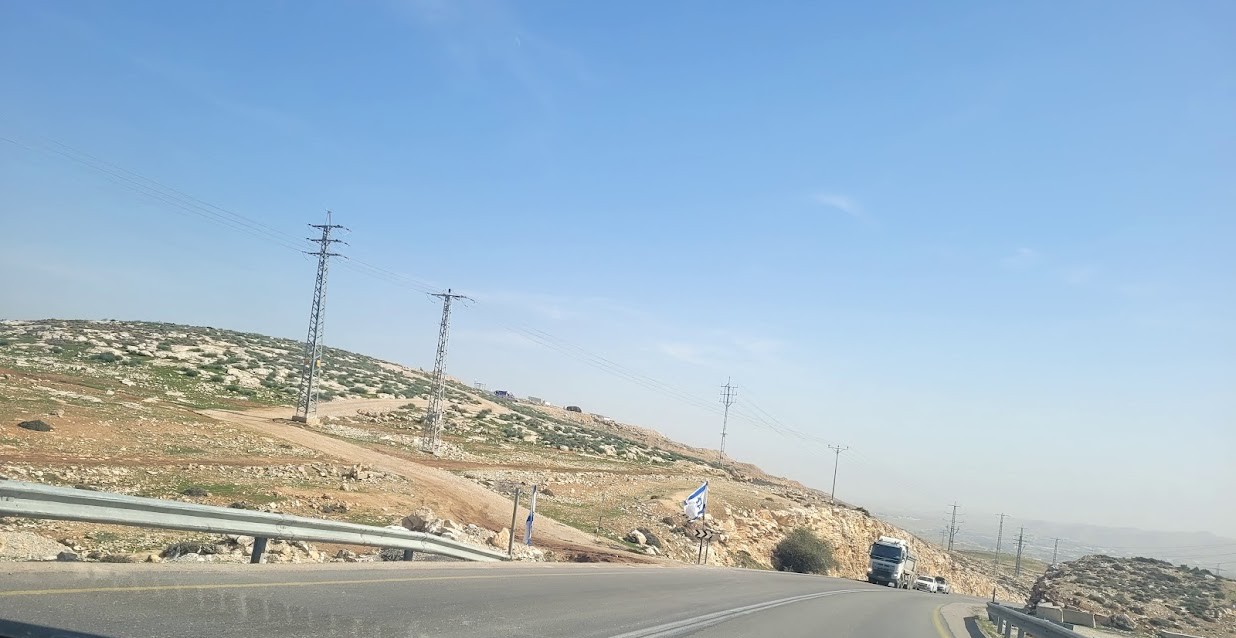 Anat TuegJan-25-2026Anata: A new outpost has been built south of the junction
-
