
Back to reports search page

‘Anata-Shu’afat, Tue 24.4.12, Morning

Tags: Children
Observers: Anat Toeg, Nava Jenny Eliashar (reporting)
Apr-24-2012
| Morning


Date: 24/04/2012, a.m.
Observers: )
 
 
7:10 Anata
 
In the parking lot: 8 buses, 6 assistants are responsible for security and for guiding the many children streaming into th square.
The assistants are paid by the bus company, Tzurim Hasaot, from Tzur Baher, who own the municipal license for transporting pupils from municipal schools.  Private schools arrange their own transportation which picks up pupils from their homes.
The chairperson of the comittee says the lot is "temporary" until the building abutting will be demolished — a low and neglected concrete building called "the junkies house" used by drug dealers.  Thereafter a spacious and secure station will be built.
The bus traffic flows in an orderly fashion, swift and supervised. Most of the girls are in school uniform: black pants, green dress, black sweater and white head scarf.  The boys wear jeans with a shirt and/or a fleece jacket.  In other schools the uniform resembles the one I wore 50 years ago: blue skirt, azure blouse.  Nostalgia.
 
The chairperson describes the situation as quiet but explosive. "Until the situation in the camp was stabilised, there was plenty of hard work to keep order.  Stones were thrown every day.  Today is quiet, but it would take just one hard-headed policeman to generate an event."
Fatah's Tanzim is partly responsible for the quiet by getting rid of the drug dealers.  The manner of "getting rid" was not described.
 
7:40 Anata
 
The elementary school for boys is located directly behind "the junkies house", an island of tranquillity and sanity in the area.
The guard at the gate lets us in and we are immediately surrounded by dozens of smiling children eager to try the little Hebrew or English they've studied.
One boy takes a couple of peanuts from his pocket and offers them to me, "a special gift for a visitor."  The teachers ask us to enter the office, lest the boys' disrupted routine get out of hand.
 
7:50 Anata
 
There is a sudden silence in the lot.  We watch an unusual pedagogic exhibit. The pupils stand in front of their classrooms in two rows, performing "morning gymnastics" led by the physical training teacher.  After that one boy reads a morning prayer, then another with a voice worthy of stardom on "A Star is Born" completes the prayer with amazing singing.  And then the teacher orders them to turn around, stamp twice, and enter the class rooms.
 
The headmaster greets us, and explains the unusual shape of the building which used to be an active market, as a result of which there are problems with the suitability of classrooms which used to be shops.  As he put it:
    First it was a cattle market
    Then it was a vegetable market
    Now it's an educational market
And indeed, the children (around 1000) study in rooms which used to be shops, and during recess play in the spaces which used to accomodate portable stalls.  The good news is that a separate building on the edge of the market, with an inner courtyard,  has been bought/rented.  This is where the first-graders study and play.  Restoration will be completed next year to accomodate second grade, protecting the little ones from the melee of older boys.

  • Checkpoint Shu'afat camp / Anata-Shu'afat (Jerusalem)

    See all reports for this place
    • The Shu’afat checkpoint is located in the northern part of East Jerusalem at the exit from the village of Anata and the Shu’afat refugee camp, which are located in the area annexed to Jerusalem in 1967. The refugee camp borders the Shu’afat neighborhood to the west, Pisgat Ze’ev to the north, the French Hill neighborhood to the south and the planned expansion of Ma’aleh Adumim to E-1 in the east.  It was established in 1966 for 1948 refugees from the West Bank and was populated after the Six Day War by persons who had been expelled from the Jewish Quarter.  Today its population comprises some 25,000 people holding blue ID cards and some 15,000 people with Palestinian ID cards.  The camp lacks adequate infrastructure and services, and suffers from poverty, neglect and overcrowding.  All its buildings are connected to the public electricity and water infrastructure, but not all are connected to the sewer system.  The camp’s services are provided by UNRWA, except for those such as health clinics and transportation of pupils to schools in Jerusalem.  In 2005, the Israeli High Court of Justice rejected a suit by the residents requesting that the route of the separation fence be drawn such that the camp would remain on the Israeli side, but conditioned its approval of the route on the establishment of a convenient and rapid crossing facility for the inhabitants of the neighborhood, most of whom are residents of Jerusalem.

      A temporary checkpoint operated there until December, 2011.  It was extremely congested during rush hours, and dangerous for pedestrians (especially children) because of inadequate safety provisions.  The new checkpoint was  inaugurated south of the old one, for public and private transportation and for pedestrians, intended solely for the residents of the camp – holders of blue ID cards, and those with Palestinian ID cards who possess appropriate permits.  There are five vehicle inspection stations at the checkpoint, and two for pedestrians (one of which is currently closed) where scanners have been installed but are not yet operating.  According to the army, representatives of government agencies will also be present to provide services to residents of the neighbourhood.  The pedestrian lanes are very long, located far from the small parking lots, and accessible through only a single revolving gate.
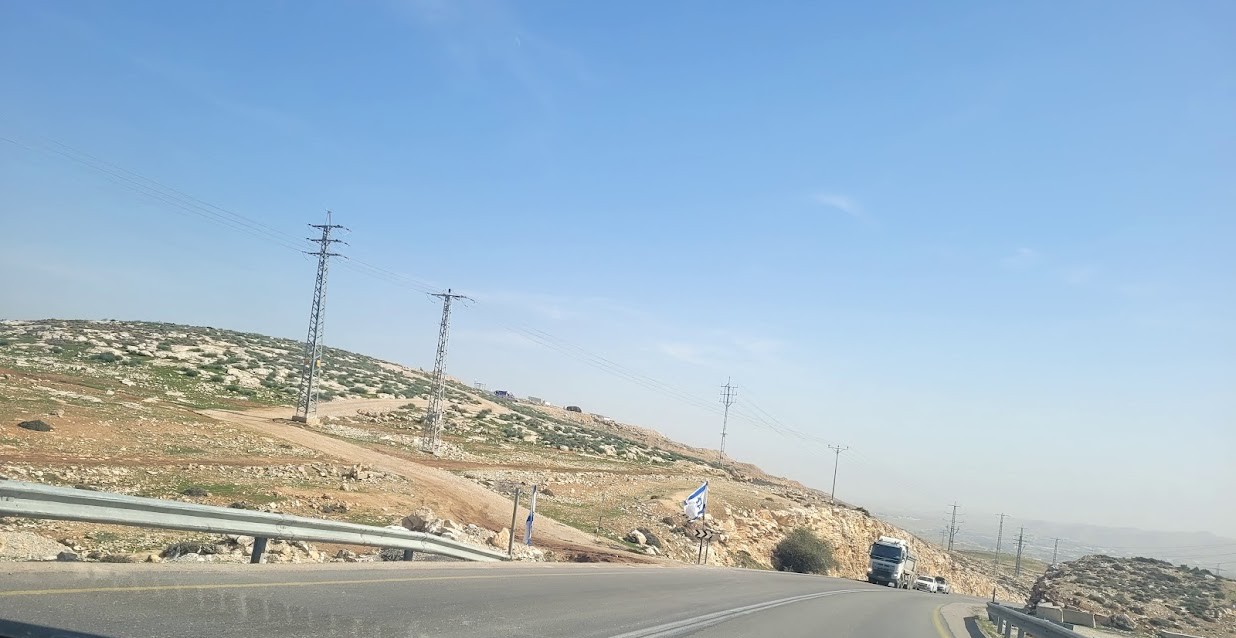
       

      ענאתא: מאחז חדש קם דרומה לצומת
      Anat Tueg
      Jan-25-2026
      Anata: A new outpost has been built south of the junction
Donate

DIGITAL EXHIBITION

25 Years in the Field.

Images that show why we’re still here. 

Enter the exhibition
