
‘Anin, Barta’a-Reihan, Thu 31.10.13, Afternoon
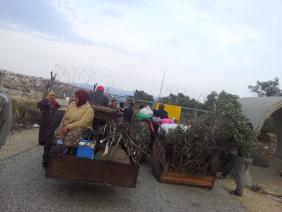
14:50 – Reihan – Barta'a Checkpoint, Seamline Zone Side
When we arrive one of the drivers tells us: "The checkpoint is much better now." We descend the sleeve together with the seamstresses, who appear pleasant and pretty after a day's work in the sewing factory just as they did in the morning. Students going the other way are returning from the university for the weekend to Barta'a or other villages in Wadi Ara. A few laborers are also returning. One of them tells us that he had to get up at 02:00 in the morning to get to Irtach by 04:00. A young couple with a toddler and baby cross to the seamline zone. The mother proudly pulls the baby's blanket aside so that we can see her baby girl. As we ascend the sleeve two girls come down by themselves, and turn to speak with someone. Evidently they are shouting to their father, who is a resident of West Barta'a in Israel. The man is a Bedouin, originally from the southern part of the country and has a business stuffing pillows. He is married to a Palestinian woman from ARabeh near Jenin for the past ten years and has been unable to receive a permit to unite his family. His wife lives in ARabe with a son from a previous marriage and he lives in Barta'a with their daugheters who are aged 9 and 7. His sister helps him care for the girls. Each Thursday he brings them to Reihan Checkpoint and their uncle, their mother's brother, takes them to visit their mother. Each Saturday they return to their father. He claims that people can acuse him of being irresponsible, but he cannot cross the checkpoint with them at Reihan, only at Tul Karem or Jalameh, which are far away. The girls must cross back to Israel at Tul Karem, and their father picks them up there and returns with them to Barta'a. The girls go to an Israeli-Arab school in West Barta'a. This is their usual life routine.
Since we had spent time speaking with the girls' father and wished to get to A'anin checkpoint at 15:30 when it opens, we decided not to go to Shaked-Tura Checkpoint and drove directly to A'anin.
15:35 – A'anin Checkpoint
The checkpoint did not open on time, and about 30 men and women were waiting when we arrived. The soldiers began getting organized to open the checkpoint at 15:40 and the checkpoint opened at 15:50. After each group of people crosses a soldier closes the gate, but does not lock it. People ask if the checkpoint will be open tomorrow, which is Friday. According to the answer from the Liaison and Coordination Administration this morning, it will not be open. One of the men reports that his second wife's permit arrived, but her permit is for crossing at Barta'a Checkpoint and not A'anin. A young girl, who spoke English, also told us that she received a permit for Barta'a checkpoint. She was permitted to cross at A'anin and was told she would be permitted to come back there in the afternoon, but only today. Other women arrive and cross.
At 16:05 all crossing stops and soldiers begin running after a teenage boy. They announce that there is an "incident". We don't know whether it has to do with the youth or not. The soldiers lock the gate at the center of the checkpoint. The soldiers leave in a jeep and drive towards the seamline zone, locking the gate behind them. We are told to ask the officer, who reports that "we are dealing with people's lives here." He promises the soldiers will return. Meanwhile another 30 men and women arrive and wait in front of the locked gate. At 16:30 we called the Liaison and Coordination Administration but no one knew what was happening except that there had been an "incident" and that the soldiers would be back in a few minutes. At 17:05 the checkpoint was still closed. At the Liaison and Coordination Administration people told us that the soldiers were on their way back. Ithey arrived at 17:10. It is almost dark and a chilly wind is blowing. One soldier opens the gate and the other one closes it again after each group of people enters. A policewoman checks people's ID cards with a flashlight. It is dark, and things go slowly. By 17:40 everyone has crossed. Some drive home on ther tractors, and others must walk home in the dark. We are fortunate to drive home in our car.
'Anin checkpoint (214)
See all reports for this place-
'Anin checkpoint (214)
'Anin checkpoint is located on the Separation Fence east of the Israeli community Mei Ami and close to the village of Anin in the West Bank. It is opened twice a week, morning and afternoon, on days with shorter light time, for Anin farmers whose olive groves have been separated from the village by the fence it became difficult to cultivate their land. Transit permits are only issued to those who can produce ownership documents for their caged-in land, and sometimes only to the head of the family or his widow, eldest son, and children. Sometimes the inheritors lose their right to tend to the family’s land. The permits are eked out and are re-issued only with difficulty. 55-year-old persons may cross the checkpoint (into Israel) without special permits. During the olive harvest season (about one month around October) the checkpoint is open daily and more transit permits are issued. Names of persons eligible to cross are held in the soldiers’ computers. In July 2007, a sweeping instruction was issued, stating that whoever does not return to the village through this checkpoint in the afternoon will be stripped of his transit permit when he shows up there next time. Since 2019, the checkpoint has not been allways locked with the seam-line zone gate (1 of 3 gates), and the fence around it has been broken in several sites.
-
Barta’a-Reihan Checkpoint
See all reports for this place-
This checkpoint is located on the Separation Fence route, east of the Palestinian town of East Barta’a. The latter is the largest Palestinian community inside the seam-line zone (Barta’a Enclave) in the northern West Bank. Western Barta’a, inside Israel, is adjacent to it. The Checkpoint is open all week from 5 a.m. to 9 p.m. Since mid-May 2007, the checkpoint has been managed by a civilian security company subordinate to the Ministry of Defense. People permitted to cross through this checkpoint into and from the West Bank are residents of Palestinian communities inside the Barta’a Enclave as well as West Bank Palestinian residents holding transit permit. Jewish settlers from Hermesh and Mevo Dotan cross here without inspection. A large, modern terminal is active here with 8 windows for document inspection and biometric tests (eyes and fingerprints). Usually only one or two of the 8 windows are in operation. Goods, up to medium commercial size, may pass here from the West Bank into the Barta’a Enclave. A permanent registered group of drives who have been approved by the may pass with farm produce. When the administration of the checkpoint was turned over to a civilian security firm, the Ya’abad-Mevo Dotan Junction became a permanent checkpoint. . It is manned by soldiers who sit in the watchtower and come down at random to inspect vehicles and passengers (February 2020).
-
