
‘Anin, Barta’a-Reihan, Tura-Shaked
Barta’a-Reihan Checkpoint 14:50 – 15:20
One minibus is parked at the upper exit from the sleeve. From here it is possible to see that the lower parking lot is full. Israeli transports bring workers who get off at the fenced path (sleeve) to the terminal on the way home to the West Bank. The people meet us kindly, say hello. The passage is quick. Inside the terminal one window is open.
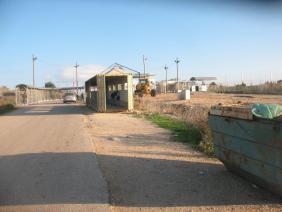
Tura Checkpoint 15:30 – 15:50
A few cars and pedestrians pass in two directions. A young man with an 8-months-old child waits for his uncle from Umm-Reihan.
A resident of Nazlet Zeid (the West Bank) passes to visit his daughter and her family in Daher El Malec (the Seam Line). The man is the principal of a high school, is happy about the presence of a visitor from Japan, and opens a conversation on the need for a quiet life. He says that the checkpoint will be locked exactly at 19:00 and in order to return home he will have to arrive before that.
In the area of the checkpoint there are, it appears, 6-8 soldiers who just walk around, wasting their time and our tax money.
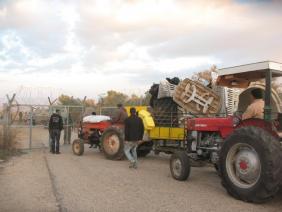
Anin Checkpoint 16:00 – 17:00
There are many people waiting next to the locked gate of the checkpoint. Women, men, young people, tractors, donkeys. The people greet us, happy to see other faces. They recognize Shula and Neta, especially. One of them suggested selling us olive oil. The tractors are loaded with used furniture. Two women asked if we could help them with the harvest.
All the sacks of olives that had been picked today were loaded with collective help, including our Japanese  visitor, on one tractor. On each sack was an identifying mark of the owner.
The gate was opened a little after 16:00. An army vehicle arrives with 3-4 soldiers whose faces are covered. A young man told us that one of the soldiers, who speaks Arabic, joined in cursing them and didn’t speak to them nicely.
At first the women passed, and then the gate was closed until the tractor with the olives passed. Afterward, groups of pedestrians passed in groups of five. After them passed the tractor with used furniture, which was detained for a short inspection. In another tractor used clothing was found, which was not allowed to pass. A representative of the Liaison and Administration Coordination: “For security reasons it is forbidden to transfer a computer through here and I am not going to prison for him. . . Those are the instructions and that is the end of it. . . If it were up to me . . . it could pass.”

16:45– Everyone who was waiting had passed. A van arrives with an officer. The soldiers come and, in deference to our feelings, they uncover faces; thus it was possible to respond to their questions and arrive at an understanding that there is no agreement on anything relating to the statement on our tags, “No to checkpoints.”
16:50– We left. The man from the Liaison and Administration Office said that they would stay until 17:00. It began to get dark and it was cold. On the way we saw two young men who were walking to the checkpoint. We returned and saw that indeed, the soldiers were still there and the young men passed through.
'Anin checkpoint (214)
See all reports for this place-
'Anin checkpoint (214)
'Anin checkpoint is located on the Separation Fence east of the Israeli community Mei Ami and close to the village of Anin in the West Bank. It is opened twice a week, morning and afternoon, on days with shorter light time, for Anin farmers whose olive groves have been separated from the village by the fence it became difficult to cultivate their land. Transit permits are only issued to those who can produce ownership documents for their caged-in land, and sometimes only to the head of the family or his widow, eldest son, and children. Sometimes the inheritors lose their right to tend to the family’s land. The permits are eked out and are re-issued only with difficulty. 55-year-old persons may cross the checkpoint (into Israel) without special permits. During the olive harvest season (about one month around October) the checkpoint is open daily and more transit permits are issued. Names of persons eligible to cross are held in the soldiers’ computers. In July 2007, a sweeping instruction was issued, stating that whoever does not return to the village through this checkpoint in the afternoon will be stripped of his transit permit when he shows up there next time. Since 2019, the checkpoint has not been allways locked with the seam-line zone gate (1 of 3 gates), and the fence around it has been broken in several sites.
-
Barta’a-Reihan Checkpoint
See all reports for this place-
This checkpoint is located on the Separation Fence route, east of the Palestinian town of East Barta’a. The latter is the largest Palestinian community inside the seam-line zone (Barta’a Enclave) in the northern West Bank. Western Barta’a, inside Israel, is adjacent to it. The Checkpoint is open all week from 5 a.m. to 9 p.m. Since mid-May 2007, the checkpoint has been managed by a civilian security company subordinate to the Ministry of Defense. People permitted to cross through this checkpoint into and from the West Bank are residents of Palestinian communities inside the Barta’a Enclave as well as West Bank Palestinian residents holding transit permit. Jewish settlers from Hermesh and Mevo Dotan cross here without inspection. A large, modern terminal is active here with 8 windows for document inspection and biometric tests (eyes and fingerprints). Usually only one or two of the 8 windows are in operation. Goods, up to medium commercial size, may pass here from the West Bank into the Barta’a Enclave. A permanent registered group of drives who have been approved by the may pass with farm produce. When the administration of the checkpoint was turned over to a civilian security firm, the Ya’abad-Mevo Dotan Junction became a permanent checkpoint. . It is manned by soldiers who sit in the watchtower and come down at random to inspect vehicles and passengers (February 2020).
-
Tura-Shaked
See all reports for this place-
Tura-Shaked
This is a fabric of life* checkpoint through which pedestrians, cabs and private cars (since 2008) pass to and from the West Bank and the Seam-line Zone to and from the industrical zone near the settler-colony Shaked, schools and kindergartens, and Jenin university campuses. The checkpoint is located between Tura village inside the West Bank and the village of Dahar Al Malah inside the enclave of the Seam-line Zone. It is opened twice a day, between 7 a.m. and 10 a.m., and from 12 noon to 7 p.m. People crossing it (at times even kindergarten children) are inspected in a bungalow with a magnometer. Names of those allowed to cross it appear in a list held by the soldiers. Usually traffic here is scant.
- fabric of life roads and checkpoints, as defined by the Terminals Authority in the Ministry of Defense (fabric of life is a laundered name that does not actually describe any kind of humanitarian purpose) are intended for Palestinians only. These roads and checkpoints have been built on lands appropriated from their Palestinian owners, including tunnels, bypass roads, and tracks passing under bridges. Thus traffic can flow between the West Bank and its separated parts that are not in any kind of territorial contiguity with it. Mostly there are no permanent checkpoint on these roads but rather ‘flying’ checkpoints, check-posts or surprise barriers. At Toura, a small (less than one dunam) and sleepy checkpoint has been established, which has filled up with the years with nearly .every means of supervision and surveillance that the Israeli military occupation has produced. (February 2020)
 Mar-21-2022Anin Checkpoint: A magnificent breach in the center of the checkpoint
-
