
‘Anin, Shaked, Tayba-Rummana, Thu 7.6.12, Morning
.Translator: Charles K.
06:00 A’anin agricultural gate
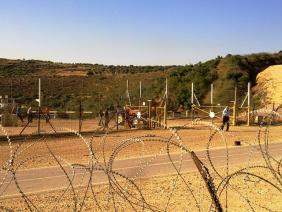
About 30 people and some tractors wait in the middle of the checkpoint. The first two people crossing approach us angrily. Summer vacation has begun; they brought their children to spend the day with them. But the soldiers refused and the children, aged 7 and 10, returned home disappointed. At that moment Wahel, the district DCO representative at Salem, arrived, and explained to us the complicated arrangements: there are two types (at least) of crossing permits for this checkpoint – one is an exit permit to the seam zone for employed persons, and the second for agricultural purposes. Even though children under 16 cross with their parents, they’re not allowed to go through on the basis of an “employment” permit, because it’s good for the entire seam zone (which has no real border all the way to Tel Aviv and beyond). Children may cross with their parents if the latter have an “agricultural” permit, which is valid only for the parents’ land in the seam zone (near the checkpoint). Since the two men crossed with an “employment” permit, they weren’t allowed to take their children with them to work.
06:32 The gate closed in a tractor driver’s face. We asked Wahel to intervene quickly because it seemed to us that the driver might have been punished for arriving late. It turned out that he’d come only to ask about his crossing permit. Wahel said the permit awaits him
at Salem (“it’s been there for a while”); the Palestinian representatives just have to come and get it.
06:55 “Fabric of life” checkpoint at Shaked.
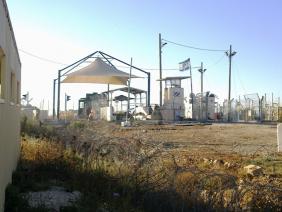
The checkpoint becomes more sophisticated every day – fences, more fences, a canopy, inspection windows, a long fenced corridor and other control mechanisms, all this leading us to the unsubstantiated assumption that soon this will be privatized. An increasing flow of people (and goats) to the seam zone, and of vehicles, primarily to the West Bank. There are almost no children because school vacation started at the beginning of June. A long, heartfelt, polite, unresolved discussion with a reservist, a supporter of Lieberman, ended when a soldier approached him; he left us and
returned to his post.
08:00 Tayibe-Rumaneh agricultural crossing
Border Police soldiers (“We’re always glad to see you”) arrive exactly on time and open the checkpoint to the eight people who cross regularly and one more person. The latter is asked to empty his backpack and shake each item of clothing: 3 pairs of pants, shirts, a shaving kit, hair gel. His permit is valid for one day, but the contents of his backpack indicate he intends to stay longer. The outcome: he’ll leave the backpack east of the checkpoint, on the West Bank side, and he’ll cross west to the seam zone. We drove him to one of the Palestinian villages; on the way we tried, unsuccessfully, to find out what the story was. Then we told him who we are, but he apparently didn’t understand our Arabic
'Anin checkpoint (214)
See all reports for this place-
'Anin checkpoint (214)
'Anin checkpoint is located on the Separation Fence east of the Israeli community Mei Ami and close to the village of Anin in the West Bank. It is opened twice a week, morning and afternoon, on days with shorter light time, for Anin farmers whose olive groves have been separated from the village by the fence it became difficult to cultivate their land. Transit permits are only issued to those who can produce ownership documents for their caged-in land, and sometimes only to the head of the family or his widow, eldest son, and children. Sometimes the inheritors lose their right to tend to the family’s land. The permits are eked out and are re-issued only with difficulty. 55-year-old persons may cross the checkpoint (into Israel) without special permits. During the olive harvest season (about one month around October) the checkpoint is open daily and more transit permits are issued. Names of persons eligible to cross are held in the soldiers’ computers. In July 2007, a sweeping instruction was issued, stating that whoever does not return to the village through this checkpoint in the afternoon will be stripped of his transit permit when he shows up there next time. Since 2019, the checkpoint has not been allways locked with the seam-line zone gate (1 of 3 gates), and the fence around it has been broken in several sites.
-
Tayba-Rummana
See all reports for this place-
Tayba-Rummana is an agricultural checkpoint. It is located in the separation fence in front of the eastern slopes of the Israeli city of Umm al-Fahm. The Palestinian villages next to the checkpoint are Khirbet Tayba and Rummana. Dozens of dunams of olive groves were removed from their owners, the residents of these villages on the western side of the separation fence. The Palestinian villages next to the checkpoint are Khirbet Tayba and Rumna. Dozens of olives dunams were removed from these villages' residents and swallowed up in a narrow strip of space, on the western side of the separation fence. The checkpoint allows the plantation owners who have permits to pass. Twice a week, the checkpoint opens for fifteen minutes in the morning and evening. During the harvest season, it opens every day for fifteen minutes in the morning (around 0630) and fifteen minutes in the afternoon (around 1530). (February 2020).
-
Tura-Shaked
See all reports for this place-
Tura-Shaked
This is a fabric of life* checkpoint through which pedestrians, cabs and private cars (since 2008) pass to and from the West Bank and the Seam-line Zone to and from the industrical zone near the settler-colony Shaked, schools and kindergartens, and Jenin university campuses. The checkpoint is located between Tura village inside the West Bank and the village of Dahar Al Malah inside the enclave of the Seam-line Zone. It is opened twice a day, between 7 a.m. and 10 a.m., and from 12 noon to 7 p.m. People crossing it (at times even kindergarten children) are inspected in a bungalow with a magnometer. Names of those allowed to cross it appear in a list held by the soldiers. Usually traffic here is scant.
- fabric of life roads and checkpoints, as defined by the Terminals Authority in the Ministry of Defense (fabric of life is a laundered name that does not actually describe any kind of humanitarian purpose) are intended for Palestinians only. These roads and checkpoints have been built on lands appropriated from their Palestinian owners, including tunnels, bypass roads, and tracks passing under bridges. Thus traffic can flow between the West Bank and its separated parts that are not in any kind of territorial contiguity with it. Mostly there are no permanent checkpoint on these roads but rather ‘flying’ checkpoints, check-posts or surprise barriers. At Toura, a small (less than one dunam) and sleepy checkpoint has been established, which has filled up with the years with nearly .every means of supervision and surveillance that the Israeli military occupation has produced. (February 2020)
 Mar-21-2022Anin Checkpoint: A magnificent breach in the center of the checkpoint
-
