
At-Tuwani - violent harassment by settlers accompanied by soldiers
On Monday, 6.11.23, J. from At-Tuwani called, and said that armed settlers, some in uniform, broke into his brother M. house, which is on the outskirts of the village in the direction of Havat Ma’on. They beat him and damaged the house. The situation in At-Tuwani is very difficult in recent weeks, as the Village Group also reported:
We are again in At-Tuwani, again at M.’s place and again M. says that what was at his place yesterday is the same as what was the day before and on all the other days. M. with his wife and four children (3, 7, 9, and half a year old), live in the last house of the village, very close to the Havat Maon outpost, which was established in 1997 near the Maon settlement that was established in 1981, on the one hand, and At-Tuwani, which has existed since at least the 19th century, on the other hand. The people of Havat Ma’on and the IDF soldiers used to harass M. and his family a long time before the current war. But these days their visits to their house with the army have become unbearable. His wife and children went to stay with their grandparents for a few days to breathe for a moment. I urged M. that although it is the same story as in previous days, he will tell it in detail, both because it is important to us, and also because it is important for him to ventilate a little the growing traumas.
And so says M: “On Sunday, November 5 at 4:00 p.m., three armed settlers in military uniforms arrived at the tabun where my brother’s wife was baking bread for the family, and my two daughters were beside her. I immediately went down from the second floor towards the tabun. One of them approached me and asked: ‘Who is the manager here?’ ‘, and before I could say a word, he hit me in the chest with his rifle. I asked him: ‘What do you want, what happened’? And he said: ‘You are sitting on your second floor and watching me.’ I told him that we were inside the house, and I walked a few Steps towards the house in order to make a phone call to the Israeli activists in the village. At this time, the settler went up to the second floor and beat both my brother K. before he could say a word, and his 15-year-old son. When K. asked what the matter was, the settler hit him again, this time with a strong blow on his neck. He also wanted to hit the small children who were on the second floor at the time, but they hurried and ran downstairs. At that time, the five Israelis arrived, and started taking pictures. The three settlers gathered outside the house. The Israelis called the police. When the police arrived and saw “soldiers”, They refused to intervene even though it was explained to them (what they knew themselves), that these were settlers in uniform. The attackers remained in place until dark.” I asked M. how he differentiates between soldiers entering his house and settlers in uniform entering his house. M. said: With soldiers you can talk. Settlers immediately strike. And apart from that, M. said: “I know the people of Havat Ma’on and recognize them even when their faces are covered.”
J., M’s older brother, was returning at that time on his tractor from Yatta, buying food for the family. At the entrance to the village there is a military post that is sometimes manned and sometimes not. This time it was manned. A soldier (it is not clear whether a soldier or a settler) stopped J. and told him: “You have three choices: 1. Return to Yatta. 2. I will stop you and the others and the tractor. 3. I will kill you.” J. returned to Yatta.
Since then we have been in almost daily contact. Yesterday, Wednesday, November 8, 23, in the evening, J. called and said that settlers accompanied by soldiers were outside M.’s house. He himself is there as well with 3 Israeli volunteers. He said that Attorney Kamar was trying to call the police and asked me to call the DCO. I called the Hebron DCO and they referred me to the army or the police, not to them.
Around 11 o’clock at night I called him and he said that “good” soldiers had arrived and the settlers had left. They sleep in shifts in house M.
A-Tuwani
See all reports for this place-
A-Tuwani
The locals came to a-Tuwani during the 20th century from the village of Yatta. They settled in abandoned ruins, utilizing the arable land, pastures for grazing sheep and the abundance of natural caves for habitation. The residents who settled in the caves came from families who could not purchase land for houses in the mother villages, as well as shepherds who did not have enough land to graze. They were joined by clan members who quarreled with other families in the mother locality.
Some of the residents today live in concrete buildings built above the caves. In the area of the village are several water cisterns and an ancient water well called 'Ein a-Tuwani. Local residents are forced to buy water in containers and transport them through many road blocks to the village. With the help of international organizations, an electrical system was installed in the village. In the late 90s of the 20tTh century, an elementary school was established in the serving several small villages in the area.
In 2004, MachsomWatch began visiting and reporting from the Khirbet Tuwani cave village, which suffers badly from the settlers of nearby outposts, and especially from the extremist Ma'on outpost. . The settlers contaminate cisterns, poison the flocks and uproot trees.Particularly notable is the harassment of children from the surrounding villages on their way to school in a-Tuwani, so much so that military escort of children is required to separate them from the attackers (this was arranged following an initiative of the organization's members). In the past year, the escort has been without the vital presence of overseas volunteers.
Near a-Tuwani there are several families who have returned to the caves due to the incessant demolitions of the civil administration (as there is a total construction ban in all of area C). Destroyed are not only residential and agricultural buildings, but also water pipes, machinery. Even water cisterns are clogged up. a-Tuwani residents have created an association for non-violent demolition protests, but in the past year the army’s harsh harassment and settler violence have intensified and escalated. The incident of the small generator confiscation, which left a young man paralyzed, is one of many examples - any legitimate protection of property rights leads to violence and even shootings by the army and the civil administration.
Updated April 2022
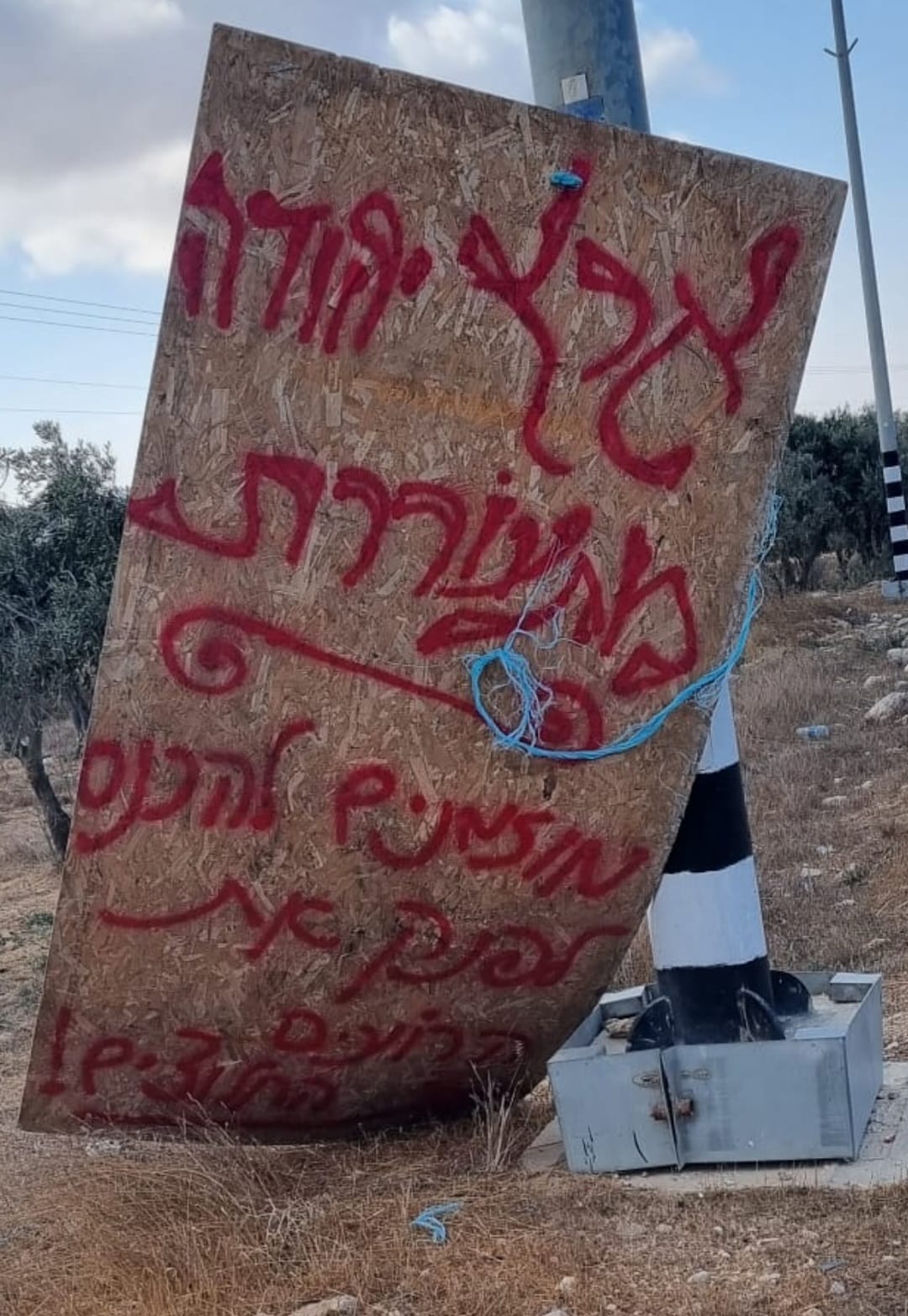 Smadar BeckerOct-17-2026A sign placed by those who call themselves the Pioneer Shepherds, at the outpost adjacent to Qawawis
-
