
‘Atara, Qalandiya, Sun 9.11.08, Afternoon
Siluad
15:15- On the right side of
road number 60 to the north, a little bit after the turn to Ofra, we
saw a line of cars that was curving slowly like a sank, but we couldn't
see its head.
We got out of the vehicle and
walked towards the fence that closes on the village Siluad and prevent
its residents from coming to the high way. A transit driver that saw
us told us where we could find a breach in the fence and enter the village.
At the end of the long line we found a checkpoint. We hopped over the
fences, climbed the rocks and felt like the founders of Reashon Lezions
who cried: "We found water!", We cried: "We
found a checkpoint".
But according to the army's
definition this is (merely) a blockage.
For the Palestinians it doesn't
mater how we call it, their daily reality is that it takes them
much more time to get back home for no good reason. The pretext is that
they must show their license, allow armed strangers feel them and pried
in their personal possessions, answer the soldiers nagging questions,
such as: "where are you heading" or "how are you",
ruin their engines while waiting on a steep slope with the car and
all the time being friendly to the soldiers so that they don't think
them rude and punish them.
The soldiers from the unit
Kfir, who didn’t' say much to us, would only tell us that for the
time being this is where the blockage is going to be.
- A driver that was
on his way back to Ramala, on the road that goes beneath the high way,
said that earlier he had to wait an hour to enter Siluad. We counted
30 cars that were waiting. - 15:35- When we were
on our way back we saw three soldier from the blockage carrying luggage
on their backs and entering the pillbox on top of the hill near by,
and tens of car headed on without disturbance.
Atara checkpoint:
15:50- The checkpoint commander
hurried towards us, he demanded that we take our vehicle away from where
we usually park it and asked that we don't "hang about" in
the checkpoint. We did as he asked.
The soldiers worked quickly
and we didn't see any extraordinary events. But it felt as though they
were working without coordination amongst themselves: They were mostly
busy checking vehicles only from one of the four directions. When a
jam was formed at one of the other lines they allowed the vehicles from
that direction to pass without an inspection and then headed to inspect
the vehicles from a different side. They asked all the passenger of
the transits to get of and stand nicely in a straight line by the side
of the checkpoint. From previous observations we can assume that this
is a normal procedure at this place.
Someone pulled out a camera
and wouldn't stop taking photos of us.
When we left one of the soldiers
came to us and said: "Just so you know, when you are here it
take the Arabs three times longer to pass". We asked him to
explain how it was possible, he wouldn't answer and just kept taking
photos.
Qalandiya checkpoint:
17:00- The rubbish and neglect
were everywhere. What happened to the "grandiose" terminal
and the shinning human pens that were placed at the entrance, upon which
loads of garbage is piling up? Do they really call this a boarder crossing?
- Two inspection posts
were open while we were there. There wasn't much pressure at the line,
it's more likely that it is because of the small number of passers then
the efficiency of the soldiers. - At the vehicle lane
we saw a group of car with guests heading to a wedding at Ramala,
their cars were decorated with flowers and ribbons. When they recognized
us standing by the side of the checkpoint they opened their windows
and waved at us, we waved back. One of the women sent us a kiss and
we greeted them and said: Mazal Tuv and Mabruk.
'Atara
See all reports for this place-
'Atara Checkpoint
Situated at the northern entrance to Ramallah from Route 465, called also Bir Zeit Checkpoint. Nowadays only remains of what used to be a busy checkpoint remain, a pillbox and concrete blocks.
-
Qalandiya Checkpoint / Atarot Pass (Jerusalem)
See all reports for this place-
Click here to watch a video from Qalandiya checkpoint up to mid 2019 Three kilometers south of Ramallah, in the heart of Palestinian population. Integrates into "Jerusalem Envelope" as part of Wall that separates between northern suburbs that were annexed to Jerusalem in 1967: Kafr Aqab, Semiramis and Qalandiya, and the villages of Ar-Ram and Bir Nabala, also north of Jerusalem, and the city itself. Some residents of Kafr Aqab, Semiramis and Qalandiya have Jerusalem ID cards. A terminal operated by Israel Police has functioned since early 2006. As of August 2006, northbound pedestrians are not checked. Southbound Palestinians must carry Jerusalem IDs; holders of Palestinian Authority IDs cannot pass without special permits. Vehicular traffic from Ramallah to other West Bank areas runs to the north of Qalandiya. In February 2019, the new facility of the checkpoint was inaugurated aiming to make it like a "border crossing". The bars and barbed wire fences were replaced with walls of perforated metal panels. The check is now performed at multiple stations for face recognition and the transfer of an e-card. The rate of passage has improved and its density has generally decreased, but lack of manpower and malfunctions cause periods of stress. The development and paving of the roads has not yet been completed, the traffic of cars and pedestrians is dangerous, and t the entire vicinity of the checkpoint is filthy. In 2020 a huge pedestrian bridge was built over the vehicle crossing with severe mobility restrictions (steep stairs, long and winding route). The pedestrian access from public transport to the checkpoint from the north (Ramallah direction) is unclear, and there have been cases of people, especially people with disabilities, who accidentally reached the vehicle crossing and were shot by the soldiers at the checkpoint. In the summer of 2021, work began on a new, sunken entrance road from Qalandiya that will lead directly to Road 443 towards Jerusalem and Tel Aviv. At the same time, the runways of the old Atarot airport were demolished and infrastructure was prepared for a large bus terminal. (updated October 2021)
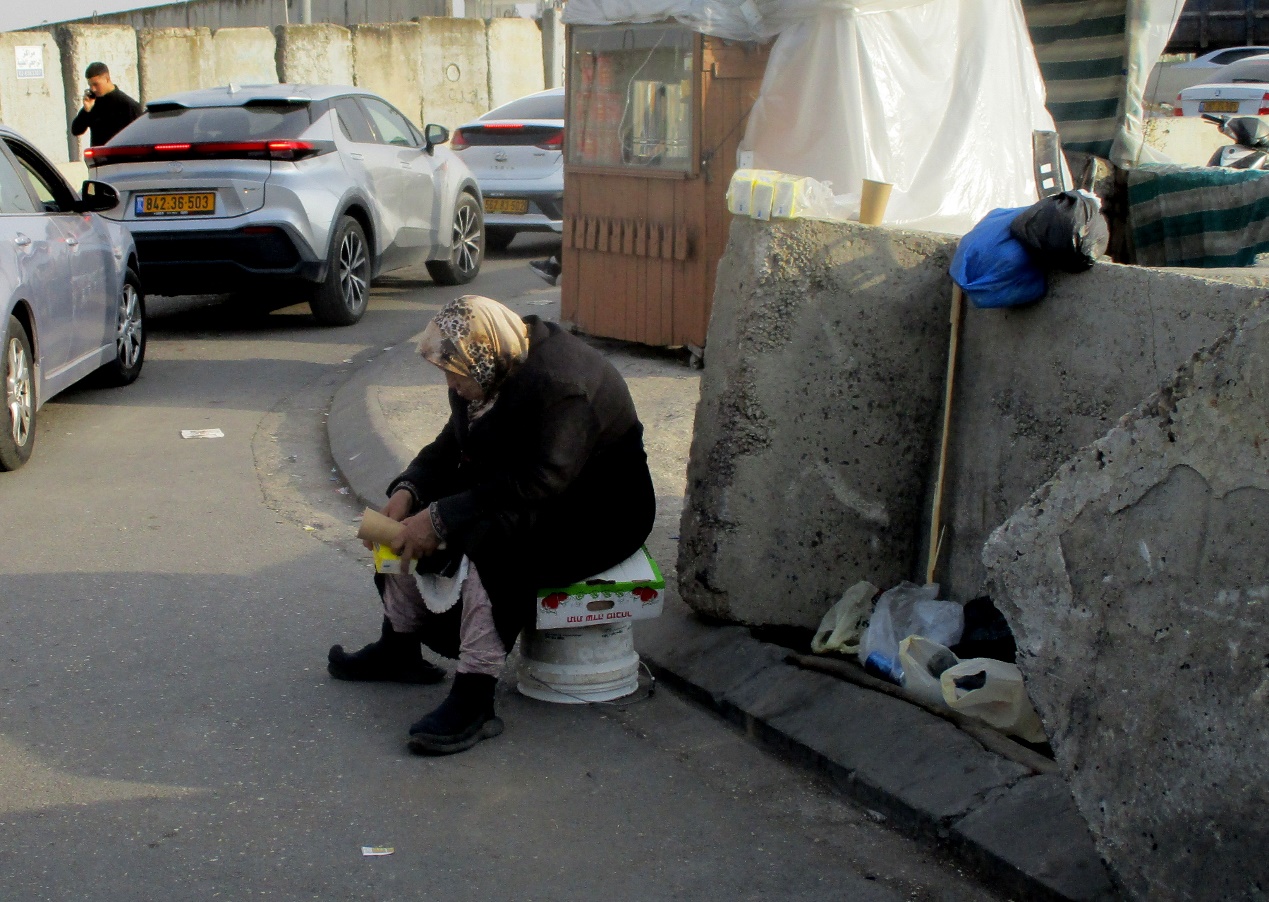 Tamar FleishmanOct-11-2026Qalandiya. Female Beggar
-
