
‘Atarot, Ar-Ram, Qalandiya, יום ב’ 26.10.09, אחה”צ
15:10: We drove past Atarot CP on our way to Qalandiya. There were 4 vehicles in line but traffic was moving.
15:15 – Qalandiya: As we drove toward the southern square of Qalandiya we could see that traffic from Jerusalem was backed up for quite a distance. By the time we reached the square (about 2 minutes), we joined a horrific traffic jam. It took more than half an hour to just get around the square and reach the parking lot at the northern CP entrance. An ambulance coming from Jerusalem somehow managed to creep ahead until is also came to a standstill in the square, sirens shrieking. There was quite a large contingent of policemen present, including Babayan and Eli, with whom we are well acquainted. They were not actually directing traffic, but somehow their presence stopped people from jumping the queue and violating traffic laws (like driving in the wrong direction) so in the end, little by little the traffic did eventually inch ahead. As we crossed the CP going north, we could see a group of armed soldiers sheltering together behind the Wall. Not far from them, two kids threw a stone at the cars ahead of us. A woman got out and shouted at them to stop throwing stones at Palestinians. Many people were milling around in and near the parking lot, especially young men. Passersby told Natanya that there had been an exciting football match in A-Ram: Palestine vs. Jordan, and that this was the reason for the crowds.
We were several cars behind the ambulance. When we reached the northern square, we saw that ambulance personnel were treating an elderly man for injuries. It later turned out that while crossing the square on foot the man had had a dizzy spell and fallen and hurt himself (he was not injured by the rock throwing). Apparently the reason that the ambulance crossed the CP was that they were returning an incubator which belonged to the hospital in Ramallah. After depositing the incubator (and the attending doctor) on the ground at the side of the parking lot, the ambulance departed to return to Jerusalem leaving the doctor to wait to be picked up by people from his own hospital.
16:00: Inside the CP three passageways were working (very slowly). Lines, however, were not very long. Behind us stood a group of 25 middle-aged French tourists who had just visited Ramallah and were returning to Jerusalem. They had nothing good to say about the Occupation. After passing through Passageway No. 2 we waited to see how the tourists would fare, and saw that they were not having any major problems. But one of them, a man with 2 hearing aids, was instructed to remove the aids and send them through the X-ray machine before crossing through the magnetic barrier. Of course, without the hearing aids he couldn't hear what the soldiers were telling him which created a minor problem. But he too eventually made it to the Jerusalem side of the barrier.
16:25: On emerging from the CP into the southern square we saw that the policemen were actively trying to alleviate the ongoing traffic jam by opening the gate in the Wall between Qalandiya and
A-Ram and directing some of the traffic in that direction. The line of traffic from Jerusalem was still backed up for a considerable distance. We spoke with Babayan and Eli, who attributed all the problems to the stone throwers, and continued around the square. Within a minute we noticed that the police had closed the gate in the Wall and walked off, trapping all the traffic in the square once again. We tried to phone both Babayan and Eli but neither answered their cell-phones. Meanwhile we noted that the bus-stop had been moved and positioned at the exit from the new terminal facility being built on the western end of the CP. We could not find out if this was a permanent or just a temporary arrangement.
16:30: All the traffic in the square was at a standstill again.
On our way back through the CP we noted that the biometric machines were still out of order.
Three pedestrian passageways were still operating. Emerging into the northern square we could see that a long line of traffic was backed up on the road from Ramallah.
16:50: We left Qalandiya on our way back to Jerusalem. We discovered more traffic jams en route, but at the CPs that we passed, Lil and Hizmeh, traffic was flowing unhampered by the soldiers on duty
'Atarot
See all reports for this place-
Atarot
Atarot was a workers' settlement destroyed during the War of Independence, where the Arab village of Qalandiya now stands, in the southwestern part of Atarot Airport, built by the British Mandate. After 1967, the Atarot industrial zone was established nearby, and until the completion of the wall from the Qalandiya checkpoint to Road 443, a checkpoint was in place. A new Jewish neighborhood is currently planned for the old airport area.
-
A-Ram
See all reports for this place-
two kilometers south of Qalandiya and 300 metres north of Neve Yaacov Junction, in Dahiyat el-Barid Quarter. Checkpoint has operated since 1991, in a Palestinian area annexed to Jerusalem in 1967. The checkpoint has been inactive since the middle of 2009.
The wall was built on the road that led to Jerusalem. Since then the situation in the town has deteriorated. Houses are abandoned and half finished, most of the businesses have closed. Severe neglect around the fence and on the streets. Those who could left. Updated January 2024
-
Qalandiya Checkpoint / Atarot Pass (Jerusalem)
See all reports for this place-
Click here to watch a video from Qalandiya checkpoint up to mid 2019 Three kilometers south of Ramallah, in the heart of Palestinian population. Integrates into "Jerusalem Envelope" as part of Wall that separates between northern suburbs that were annexed to Jerusalem in 1967: Kafr Aqab, Semiramis and Qalandiya, and the villages of Ar-Ram and Bir Nabala, also north of Jerusalem, and the city itself. Some residents of Kafr Aqab, Semiramis and Qalandiya have Jerusalem ID cards. A terminal operated by Israel Police has functioned since early 2006. As of August 2006, northbound pedestrians are not checked. Southbound Palestinians must carry Jerusalem IDs; holders of Palestinian Authority IDs cannot pass without special permits. Vehicular traffic from Ramallah to other West Bank areas runs to the north of Qalandiya. In February 2019, the new facility of the checkpoint was inaugurated aiming to make it like a "border crossing". The bars and barbed wire fences were replaced with walls of perforated metal panels. The check is now performed at multiple stations for face recognition and the transfer of an e-card. The rate of passage has improved and its density has generally decreased, but lack of manpower and malfunctions cause periods of stress. The development and paving of the roads has not yet been completed, the traffic of cars and pedestrians is dangerous, and t the entire vicinity of the checkpoint is filthy. In 2020 a huge pedestrian bridge was built over the vehicle crossing with severe mobility restrictions (steep stairs, long and winding route). The pedestrian access from public transport to the checkpoint from the north (Ramallah direction) is unclear, and there have been cases of people, especially people with disabilities, who accidentally reached the vehicle crossing and were shot by the soldiers at the checkpoint. In the summer of 2021, work began on a new, sunken entrance road from Qalandiya that will lead directly to Road 443 towards Jerusalem and Tel Aviv. At the same time, the runways of the old Atarot airport were demolished and infrastructure was prepared for a large bus terminal. (updated October 2021)
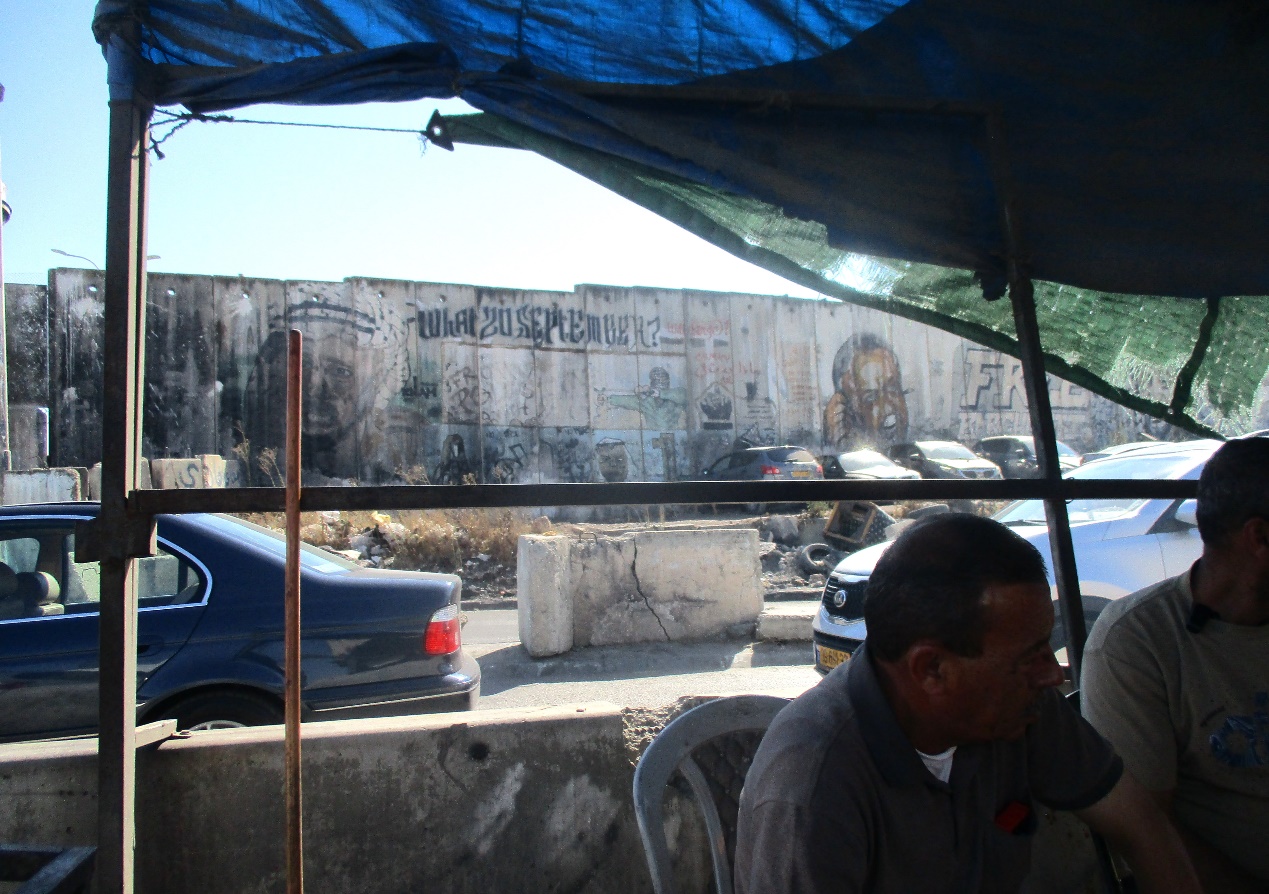 Tamar FleishmanJul-21-2026Qalandiya. Conversation in the shadow of the wall
-
