
‘Awarta, Beit Furik, Huwwara, Za’tara (Tapuah), יום ב’ 19.1.09, בוקר
Translation: Suzanne O.
Summary: On Saturday at Beita soldiers beat people, overturned greengrocery stalls in the market, threatened to fire and threw stun grenades. The road between Za'atra and Huwwara was closed. The people are too frightened to complain to the police.
There are new orders every other morning as to who is permitted to cross Awarta roadblock in the mornings.
The roadblock commander at Huwwara terrorises the few stallholders who risked returning to the car park. One of the stallholders was beaten three weeks ago and needed treatment in hospital.
The inspection of outgoing vehicles from Nablus is very slow. The passengers have to cross via the pedestrian crossing and hundreds wait in the car park.
The police were called because we didn't consent to stand outside the roadblock (in the 'sterile area').
Marda – open. Zeita – closed, as usual.
Za'atra (Tapuach) Junction
7:30 a.m.
There are few vehicles in the queues. The reservists are helpful and give explanations to questions. A bus from Nablus to Ramallah is held up for an inspection of documents. The driver said that at Huwwara the roadblock is 'OK'.
Beita Junction
7:30 a.m.
A Border Police jeep is parked at the entrance. There are 3 soldiers, one of them middle aged. We are "interfering with the inspection" (apart from them and us there is no one else around). Until we arrived we saw that vehicles were leaving without being checked, during the time we were there one vehicle was inspected as it entered.
We talked to 3 youngsters who crossed; they told us that lately there is a roadblock at the entrance to the village every day.
On Saturday soldiers and Border Policemen threw stun grenades, overturned crates of vegetables in the wholesale market at the entrance to the village, threatened the stallholders that if they did not leave they would be shot and beat anyone they wanted to. In addition the road between Za'atra Junction and Huwwara was closed to Palestinian traffic.
We suggested that they make a complaint to the police (with the help of 'Yesh Din') but they said that they fear reprisals. Even so we left a calling card with them.
Beit Furiq
8:00 a.m.
There are 3 preoccupied soldiers. At this time of day there are only ingoing cars to Nablus. Not one was inspected.
Awarta
8:10 a.m.
There is a long queue of cars from the direction of Nablus, over 20 of them. The soldier demands that we move back to Madison Way. We stay.
A car with yellow number plates is parked for a long time arguing with the soldiers. The driver tells us that he forgot to bring his passport (?) with him. Finally he is permitted to continue on.
Later the commander explained the orders to us: lorries – only ID cards and the loads are inspected (it is not clear how); cars – only VIPs are permitted to cross, the rest are sent to Huwwara, no matter how long they have waited. Only the privileged among the VIPs are permitted to drive on the Madison route (the apartheid road leading from Huwwararoad block eastward).
At Huwwara a taxi driver who had crossed at Awarta, and he is not a VIP, told us that he had just been held up a long time; it is always worth arguing because then sometimes even the beaurocracy folds. During the extensive occupation one learns to survive.
Huwwara
8.30 – 10:40 a.m.
When we got there we found the roadblock commander (lieutenant) and his deputy (1st sergeant) arguing with the stallholders.
About a month ago, on the orders of Captain Abu Rokon of the DCO, all the stallholders were forced out. These are people with families, hardship cases, who have found a way of making a living in spite of the high level of unemployment in the territories. Why were they forced out? At first it was claimed that it caused mess (anyone seeing the state of the roadblock and how it is run – this is not the problem, they should consider people first, then the grounds!), the other claim: until the roadblock is closed (it was supposed to be closed a month ago!) there should be no turmoil. What the real reason is, if there is one – who knows? But life is more powerful than edicts and slowly, slowly the stalls returned. What did the roadblock commander want? Apparently to frighten them. He told us that the mess bothers him ((there is no) again the mess). We showed him the pile of rubbish beside the new fence of the shiny new roadblock. The stallholders said that Zaharan allows them to be there, only the roadblock commander makes problems for them.
One of them told us that a stallholder (a relative) was badly beaten 3 weeks ago and needed hospital treatment.
8:40 a.m.
The roadblock is practically empty; there are about 5 people in the 'humanitarian' queue and another queue.
The roadblock commander comes over to banish us according to the orders of the Battalion Commander, pinned up on the wall of the kiosk. This time the claim is that he is responsible for our safety. We explain that it does not permit us to see and report. He called the police and did not take any further notice of us.
Most of those entering and leaving via the 'humanitarian' queue (women, children and older men) show their ID cards; their baggage is inspected by a military policewoman from behind a window. They open and take out of their bags clothes, shoes… a tourist with two large rucksacks. The military policewoman requests a screwdriver from the soldiers in order to open something. Finally she gives in. Two women lift a large bag so that the policewoman can put her hand out of the window and feel what is in it.
We check the cell to find out whether there is anyone in there. It is empty. The door is situated in the opposite direction from where we stand, so we have to go forward to see it.
9:10 a.m.
The vehicle roadblock: for those entering there is no inspection; the x-ray machine is in place; there is no sniffer dog.
At the exit: there are 8 vehicles. This queue grows as the inspection becomes slower.
A taxi driver with his wife and children is held up a long time for inspection. Finally – they cross. We cannot find out anything because the roadblock commander does not speak to us ("because you are breaking the law") and forbids the rest of the soldiers to speak to us.
He spreads a strip with spikes alongside the lane for incoming vehicles.
9:25 a.m.
A vehicle comes near. The passengers alight at a distance of about 10 metres. The vehicle is inspected, boot as well. It is then sent to the x-ray machine with its load.
A bus draws up. All the passengers alight. The driver brings all the ID cards. An argument starts, also between the soldiers; the driver returns to the bus and comes back with a load of permits. The DCO representative arrives. He takes the permits for inspection. Meanwhile a queue builds up from the direction of the entrance to Nablus. A Palestinian driver dare not cross the roadblock before a soldier beckons him, and here, suddenly, they can cross freely. One driver does not understand or does not risk it and waits and waits. When we mention it to the soldier it does not bother him ("a few minutes, it's not terrible, let him wait").
And then the police, who were called in our honour, turn up. The policeman says he was told we had caused an affray. The conversation with the policeman was amicable. He requested that we do as the commander says. He does not know who is right. He has an accident (not serious) to deal with and he is being held up here. Here the roadblock commander is the authority, he suggests that we talk to the officers at the Ariel police station and also gives us the telephone number. There is also an underlying threat: I do not want to arrest you and take you to the station.
At the same time the roadblock commander speaks to Nettie and says that he is holding up the inspections because of us and, if we leave, he promises to get rid of the queue within 15 minutes. Indeed the vehicle queue has grown and we cannot see the end of it. He also apologises that he did not talk to us. He has helped our women when they obey instructions.
We left the vehicle area.
10:15 a.m.
We returned about 15 minutes later. The queue is as long as it was before. Now bus passengers are taken off and have to cross the roadblock via the pedestrian crossing. The roadblock is full of people and several hundred are crowded in the car park and on the road, because the vehicle inspection is very slow. We phoned Zaharan and he promised to come right away.
Meanwhile they have started to inspect ingoing vehicles. An Israeli vehicle is turned away.
10:25 a.m.
We leave.
Beita – there is no military vehicle at the entrance or anywhere around.
Za'atra – the queues are short in all directions. A bus is inspected in the area.
'Awarta
See all reports for this place-
Awarta, an internal checkpoint in the heart of the West Bank, is located east of the Hawara checkpoint, at the junction of Roads 555 (which was forbidden for Palestinian traffic in this area) and the entrance road to Nablus. It was one of the four checkpoints that surrounded Nablus until 2009. We used to watch it at Huwwara shifts because it was the only one where goods could be transferred to and from Nablus, using the back-to-back method. It was operated by the army, from 06:00 to 20:00. Until 2009.
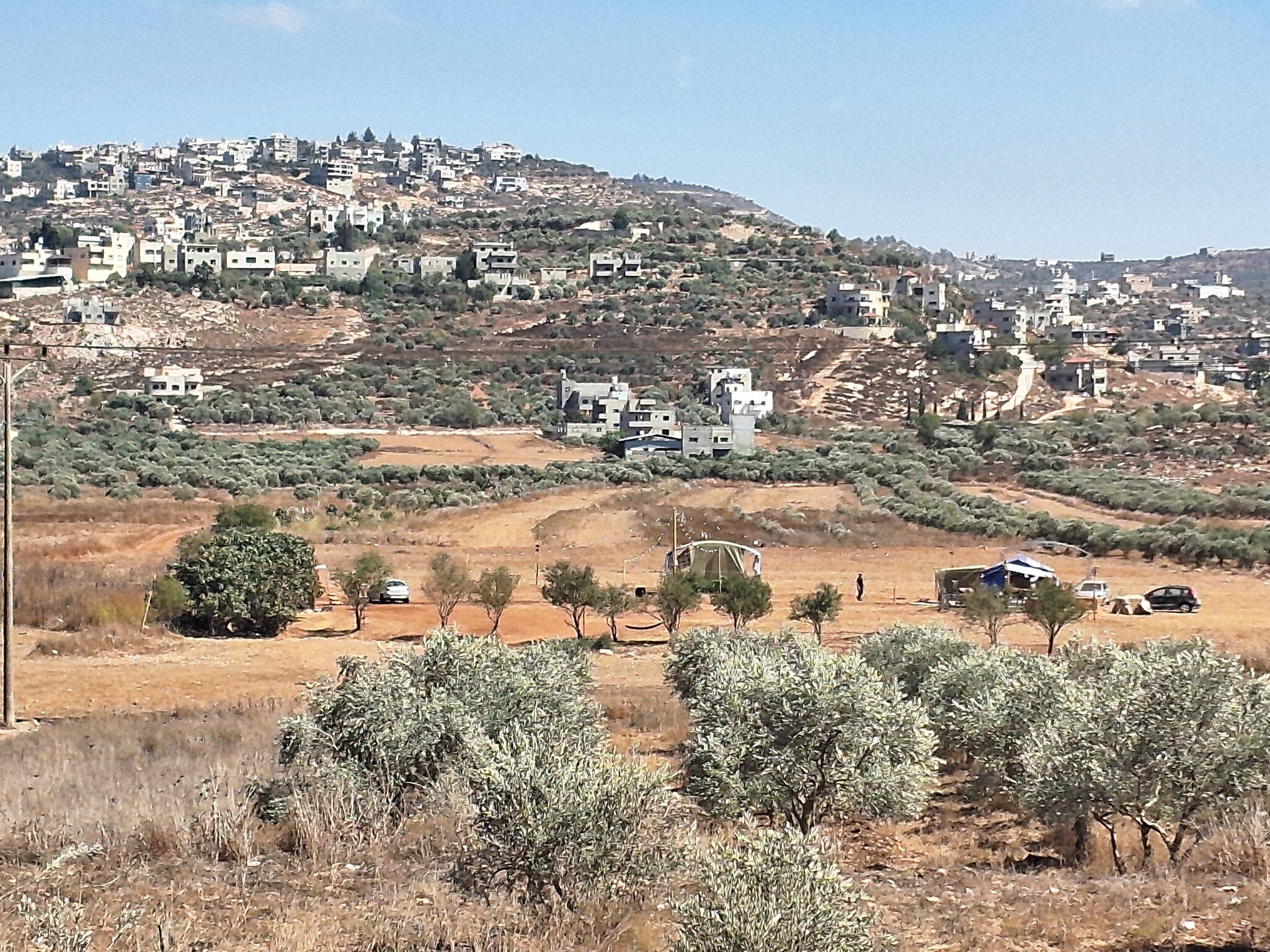 Ronit Dahan-RamatiSep-10-2026Awarta. Outpost below the town
-
Beit Furik checkpoint
See all reports for this place-
One of the three internal checkpoints that closed on the city of Nablus - Beit Furik to the east, Hawara to the south, Beit Iba to the west. The checkpoint is located at the junction of Roads 557 (an apartheid road that was forbidden for Palestinians), leading to the Itamar and Alon Morea settlements and Road 5487. The checkpoint was established in 2001 for pedestrians and vehicles; The opening hours were short and the transition was slow and very problematic.Allegedly, the checkpoint is intended to monitor the movement to and from Nablus of the residents of Beit Furik and Beit Dajan, being the only opening outside their villages. Since May 2009 the checkpoint is open 24 hours a day, the military presence is limited, vehicles can pass through it without inspections, except for random inspections. (Updated April 2010)
-
Huwwara
See all reports for this place-
The Huwwara checkpoint is an internal checkpoint south of the city of Nablus, at the intersection of Roads 60 and 5077 (between the settlements of Bracha and Itamar). This checkpoint was one of the four permanent checkpoints that closed on Nablus (Beit Furik and Awarta checkpoints to the east and the Beit Iba checkpoint to the west). It was a pedestrian-only barrier. As MachsomWatch volunteers, we watched therre since 2001 two shifts a day - morning and noon, the thousands of Palestinians leaving Nablus and waiting for hours in queues to reach anywhere else in the West Bank, from the other side of the checkpoint the destination could only be reached by public transport. In early June 2009, as part of the easing of Palestinian traffic in the West Bank, the checkpoint was opened to vehicular traffic. The passage was free, with occasional military presence in the guard tower. Also, there were vehicle inspections from time to time. Since the massacre on 7.10.2023, the checkpoint has been closed to Palestinians.
On February 26, 2023, about 400 settlers attacked the town's residents for 5 hours and set fire to property, such as houses and cars. Disturbances occurred in response to a shooting of two Jewish residents of Har Bracha by a Palestinian Terrorist. The soldiers stationed in the town did not prevent the arson and rescued Palestinian families from their homes only after they were set on fire. No one was punished and Finance Minister Smotrich stated that "the State of Israel should wipe out Hawara." Left and center organizations organized solidarity demonstrations and support actions for the residents of Hawara.Hawara continued to be in the headlines in all the months that followed: more pogroms by the settlers, attacks by Palestinians and a massive presence of the army in the town. It amounted to a de facto curfew of commerce and life in the center of the city. On October 5, 2023, MK Zvi established a Sukkah in the center of Hawara and hundreds of settlers backed the army blocked the main road and held prayers in the heart of the town all night and the next day. On Saturday, October 7, 23 The "Swords of Iron" war began with an attack by Hamas on settlements surrounding Gaza in the face of a poor presence of the IDF. Much criticism has been made of the withdrawal of military forces from the area surrounding Gaza and their placement in the West Bank, and in the Hawara and Samaria region in particular, as a shield for the settlers who were taking over and rioting.
On November 12, 2023, the first section of the Hawara bypass road intended for Israeli traffic only was opened. In this way, the settlers can bypass the road that goes through the center of Hawara, which is the main artery for traffic from the Nablus area to Ramallah and the south of the West Bank. For the construction of the road, the Civil Administration expropriated 406 dunams of private land belonging to Palestinians from the nearby villages. The settlers are not satisfied with this at the moment, and demand to also travel through Hawara itself in order to demonstrate presence and control.(updated November 2023)
.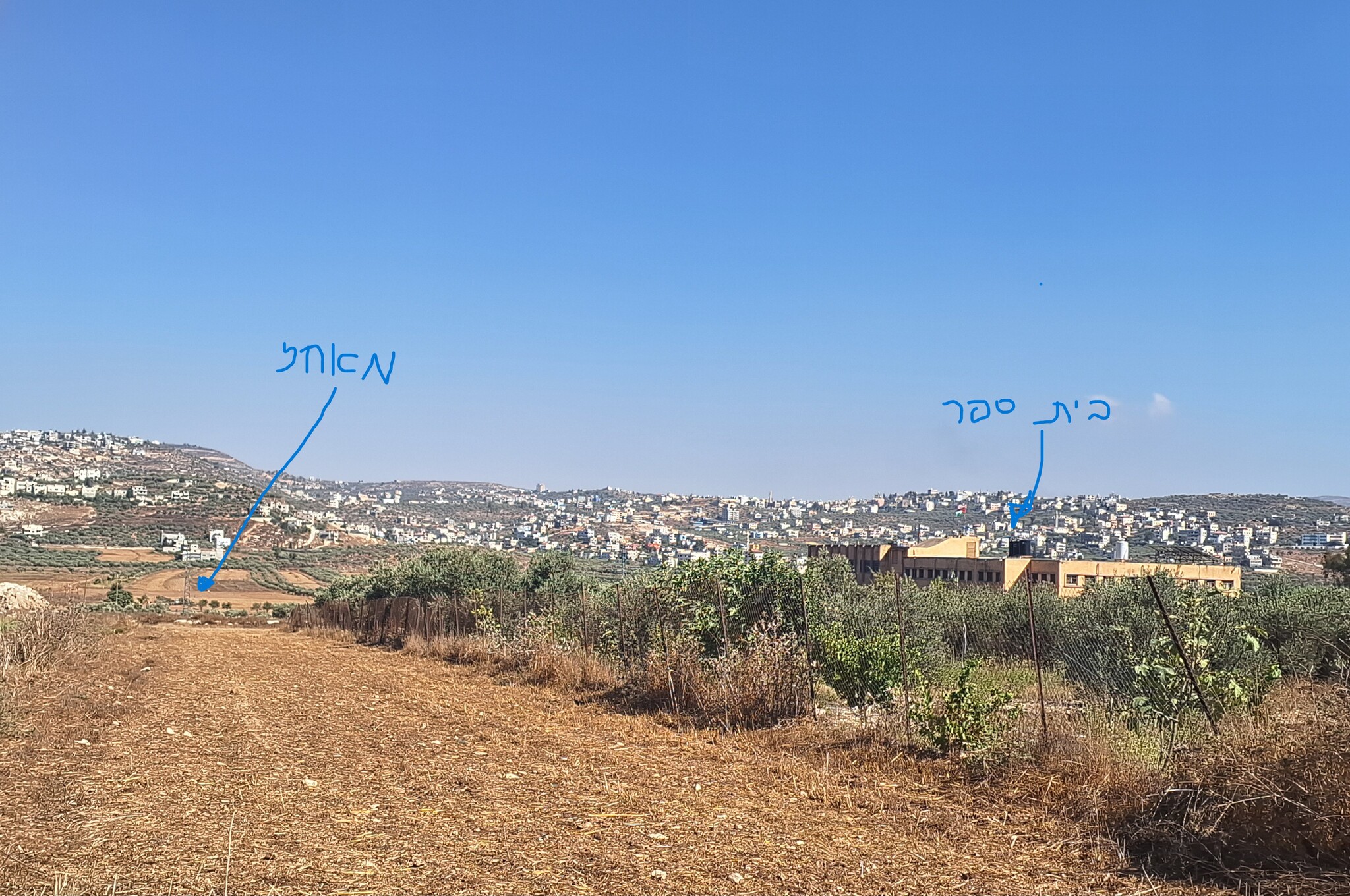 Ronit Dahan-RamatiAug-24-2026Huwara: The school on the outskirts of town and an outpost hidden among the trees
-
Za'tara (Tapuah)
See all reports for this place-
Za'tara (Tapuah) Za'tara is an internal checkpoint in the heart of the West Bank, at the intersection of Road 60 and Road 505 (Trans-Samaria), east of the Tapuah settlement. This checkpoint is the "border" marked by the IDF between the north and south of the West Bank, in accordance with the policy of separation between the two parts of the West Bank that has been in place since December 2005. At the Za'tara checkpoint, there are separate routes for Israelis and Palestinians. In the route for Israelis, there are no inspections and the route for Palestinians inspects. The queue lengthens and shortens suits. The checkpoint is open 24 hours a day. The checkpoint is partially staffed and the people who pass through it are checked at random.
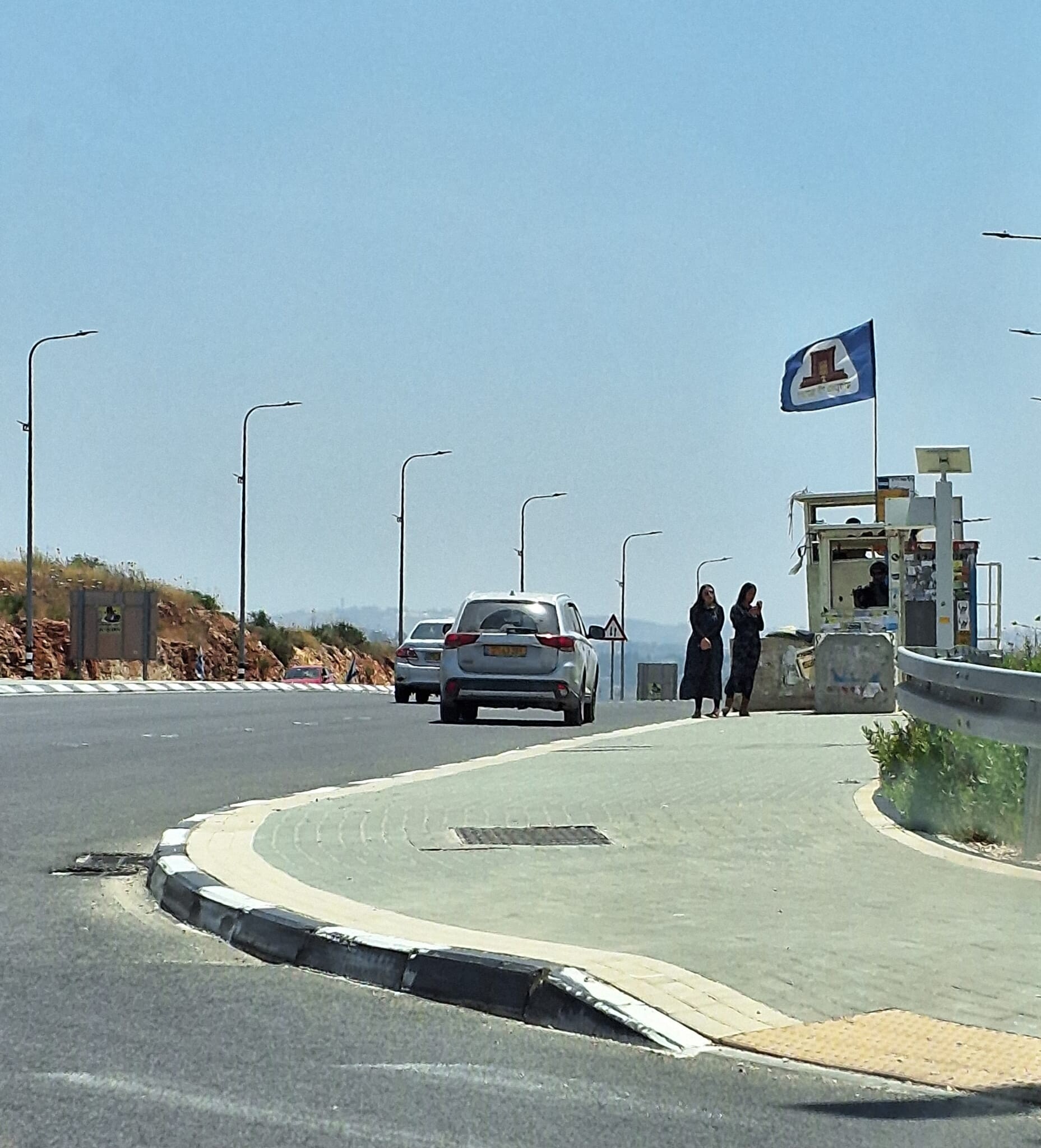 Ronit Dahan-RamatiJun-9-2026Za'atara (Tapuach Junction). The Temple Flag Above a Station
-
