
‘Azzun ‘Atma, Habla

There are Israeli Arabs who have made their home in Habla, some due to marital
relations and some just to pass a quiet weekend.
The town has about 8000 inhabitants. The livelihood of the Habla inhabitants is work in Israel, and about 70 percent of them work in agriculture.
Later at the baladiyah they told us that whoever gets engaged and is over 20 years old get a permit (except the persons who are prevented by the general security service and
the police) and about 60 percent of the Shabab hold permits.
At the baladiya, we actually met those who have difficulties in getting permits. A young man, a father of 5, who underwent a traffic accident and still uses crutches, says that he is debarred from getting a permit and doesn't understand why. He begs that the debarment be lifted to enable him to get a work permit. With a debarment how can I find an employer? Another man doesn't succeed in crossing over to water his orchard in the afternoon hours, although he has a permit. The soldiers at the CP decided that he cannot return until the time the gate is closed. Another says that he finds it impossible for him and his family and visit Jordan, because the debarment.
"We are accused of being collaborators. The truth is that we are a quiet village that causes no problems," says S.
The baladiyah tries to serve the citizens. There is a clerk who sees after the permits, another deals with electricity matters, and a third in water problems. There is an accountant. There is a woman municipal engineer (!!), a secretary to the major (who has five children and because she has a baby works one hours less, according to the law. The baby is taken care of by her friend against payment).
The town is not supported by the Palestinian Authority, according to one of the clerks. All the funds are obtained through taxes. We asked whether the new policy of the Israeli electric company harms them, and they said no, they pay what is required. The current town mayor wasn't present but we met the former one, who told us that they established a coalition of 3 families and decided on a rotation so that each one would serve 14 months as major.
We asked whether that is favorable to the town and he said that he would have preferred a longer term in order to be able to carry out projects in favor of the town, but from the political angle that was the best option.
On our way out we were informed that the army had closed the lower passage which leads to Habla from the direction of Kilkilya. We preferred to drive by way of Azun and thus we felt the traffic difficulties of the Palestinians.
Azun Atma
Last Saturday again we were informed, by means of a telephone conversation with an inhabitant of the village, that the army had closed the entrance to the village and did not allow the inhabitants to enter or exit. The closures last two-three hours, sometimes more, and seriously hamper the daily routine of the village.
'Azzun 'Atma
See all reports for this place-
'Azzun 'Atma
A Palestinian village of about 1,800 residents. The settlement of Sha'arei Tikva was established on its land adjacent to it, and the settlement of Oranit was established on its agricultural lands. By 2013, the separation fence had passed through the village and a checkpoint staffed by the army allowed the residents to cross from side to side. After building a massive wall surrounding the village and some of its agricultural lands, the residents went daily for five years to their lands that remained in the Seam Zone through the Oranit agricultural checkpoint (4). Since 2018 it has only opened during the olive harvest and the farmers have to pass daily at the Beit Amin / Abu Salman checkpoint (1447), about 3 kilometers north.From a report from March 24, 2021: "The farmers from Beit Amin and Azon Atma are happy that since February 21 the Oranit checkpoint .is going to be open 3 times a day, The farmers are really developing the place."
Report from July 14, 2024: "Ornit checkpoint is closed . The Beit Amin/Abu Salman agricultural checkpoint is closed (there is no contact with the military to check if it opens rarely), the Ezbat Jaloud checkpoint was opened once a day before the war.
Updated for July 2024
 Apr-11-2019Azoun: The main entrance to village blocked now for several weeks
-
Habla
See all reports for this place-
Habla CP (1393)
The Habla checkpoint (1393) was established on the lands of the residents of Qalqilya, on the short road that
connected it for centuries to the nearby town of Habla. The separation barrier intersects this road twice and cut off the residents of Qalqilya from their lands in the seam zone.(between the fence and the green line).
There is a passage under Road 55 that connects Qalqilya to the sabotage This agricultural barrier is used by the farmers and nursery owners established along Road 55 from the Green Line and on both sides of the kurkar road leading to the checkpoint.
This agricultural checkpoint serves the residents of Arab a-Ramadin al-Janoubi (detached from the West Bank), who pass through it to the West Bank and back to their homes. The opening hours (3 times a day) of this agricultural checkpoint are longer than usual, about an hour (recently shortened to 45 minutes), and are coordinated with the transportation hours of a-Ramadin children studying in the occupied in the West Bank.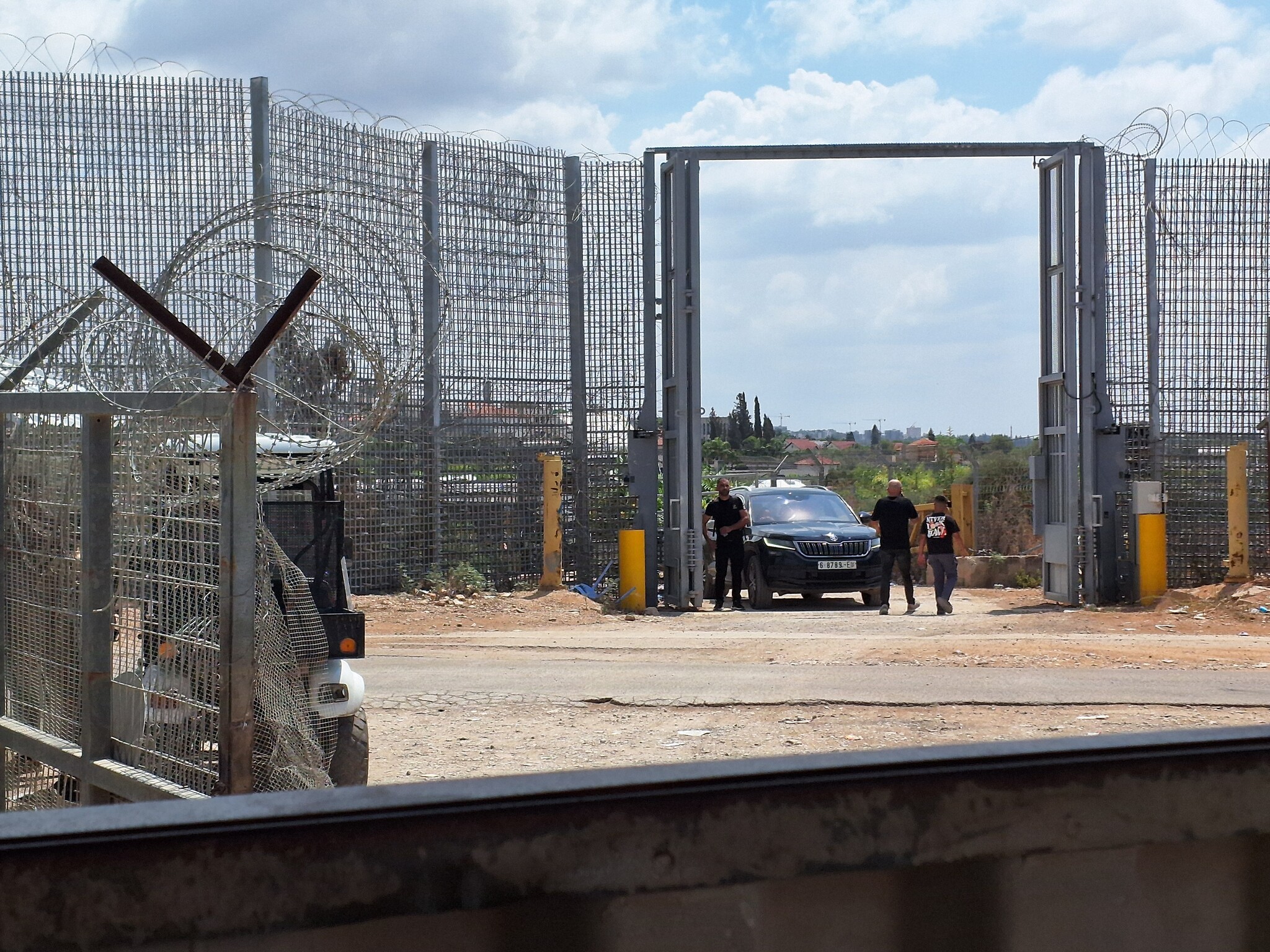 Ronit Dahan-RamatiAug-31-2026Habla. The gate is open
-
