
‘Azzun, ‘Azzun ‘Atma, Habla, Mon 21.6.10, Afternoon
15:20 Azzun Atma. A very hot day. Few people crossing at this hour. One of the soldiers asks us whether we care only about what happens to the Palestinians but not what happens to the soldiers. That was an invitation to a conversation, and we had one. We also drove through Elkana to show the guest what a settlement looks like, and the solitary house from Maskha.
16:15 Kafr Hares: A number of cars at the entrance to the village, most of them serving to provide rides to people. It’s impossible to ignore the huge observation tower casting its shadow over the entire village (and apparently over much more). The people we spoke with said that they can see all of us on the computer in the tower talking to each other. There’s a yellow gate, but it’s open, and we’re told it’s open 24 hours a day. On the other hand, the army and the Border Police enter the village whenever they feel like it at any hour of the day and night. We agreed to give a woman a ride to Azzun.
16:35 Kafr Seir. L., the young woman to whom we gave a ride, speaks English well, works for an international humanitarian organization that primarily assists farmers. She invited us to have something to drink at her home in Seir. We agreed to stop briefly. Seir is a small village (only 500 inhabitants) through which we passed on a trip with Daliah and Zvia. The woman is the daughter of the school principal the village head. It was an unusual break in our usual Machsom Watch routine. An unnaturally peaceful village, without settlements surrounding it – because all the inhabitants refused to sell land, our hostess explained as we drove to her house. They also seem to manage to preserve a reasonably comfortable standard of living. We sat outside under trees, met her family, and had an interesting and pleasant visit. L. established a group of women from the village who initiate agricultural projects, like producing organic olive oil, etc. They’ve obtained initial funding from overseas sources. They have a monthly working meeting. We thought we might come to one of the meetings. We exchanged phone numbers. Maybe we’ll learn something from them about empowering women.
17:30 Habla agricultural gate. The usual crossing routine. The people we met didn’t have any particular complaints. We asked the soldiers what they thought of the fact that an entire village is fenced in, its agricultural activity depending on the limited number of hours that the gate is open – they didn’t understand why that should be a problem.
'Azzun
See all reports for this place-
Azoun (updated February 2019)
A Palestinian town situated in Area B (under civil Palestinian control and Israeli security control),
on road 5 between Nablus and Qalqiliya, east of Nabi Elias village. The inhabitants are allowed to construct and improve infrastructures. The Separation Fence has confiscated lands belonging to the town's people. In 2018 olive tree groves owned by one of its inhabitants were confiscated for the sake of paving a road to bypass Nabi Elias. Azoun population numbers 13,000, its economic state dire. Its infrastructures are poor, neglect and poverty rampant. In the meantime, the town council has completed paving an internal road for the inhabitants' welfare.
Because of its proximity to the Jewish settler-colony of Karnei Shomron and its outposts, the town suffers the intense presence of the Israeli army, especially at nighttime: soldiers enter homes, arrest suspects, trash the house and sometimes ruin it, as they do in numerous places in the West Bank. At times a checkpoint closes the entrance to the town, so no one can come in or get out.
-
'Azzun 'Atma
See all reports for this place-
'Azzun 'Atma
A Palestinian village of about 1,800 residents. The settlement of Sha'arei Tikva was established on its land adjacent to it, and the settlement of Oranit was established on its agricultural lands. By 2013, the separation fence had passed through the village and a checkpoint staffed by the army allowed the residents to cross from side to side. After building a massive wall surrounding the village and some of its agricultural lands, the residents went daily for five years to their lands that remained in the Seam Zone through the Oranit agricultural checkpoint (4). Since 2018 it has only opened during the olive harvest and the farmers have to pass daily at the Beit Amin / Abu Salman checkpoint (1447), about 3 kilometers north.From a report from March 24, 2021: "The farmers from Beit Amin and Azon Atma are happy that since February 21 the Oranit checkpoint .is going to be open 3 times a day, The farmers are really developing the place."
Report from July 14, 2024: "Ornit checkpoint is closed . The Beit Amin/Abu Salman agricultural checkpoint is closed (there is no contact with the military to check if it opens rarely), the Ezbat Jaloud checkpoint was opened once a day before the war.
Updated for July 2024
 Apr-11-2019Azoun: The main entrance to village blocked now for several weeks
-
Habla
See all reports for this place-
Habla CP (1393)
The Habla checkpoint (1393) was established on the lands of the residents of Qalqilya, on the short road that
connected it for centuries to the nearby town of Habla. The separation barrier intersects this road twice and cut off the residents of Qalqilya from their lands in the seam zone.(between the fence and the green line).
There is a passage under Road 55 that connects Qalqilya to the sabotage This agricultural barrier is used by the farmers and nursery owners established along Road 55 from the Green Line and on both sides of the kurkar road leading to the checkpoint.
This agricultural checkpoint serves the residents of Arab a-Ramadin al-Janoubi (detached from the West Bank), who pass through it to the West Bank and back to their homes. The opening hours (3 times a day) of this agricultural checkpoint are longer than usual, about an hour (recently shortened to 45 minutes), and are coordinated with the transportation hours of a-Ramadin children studying in the occupied in the West Bank.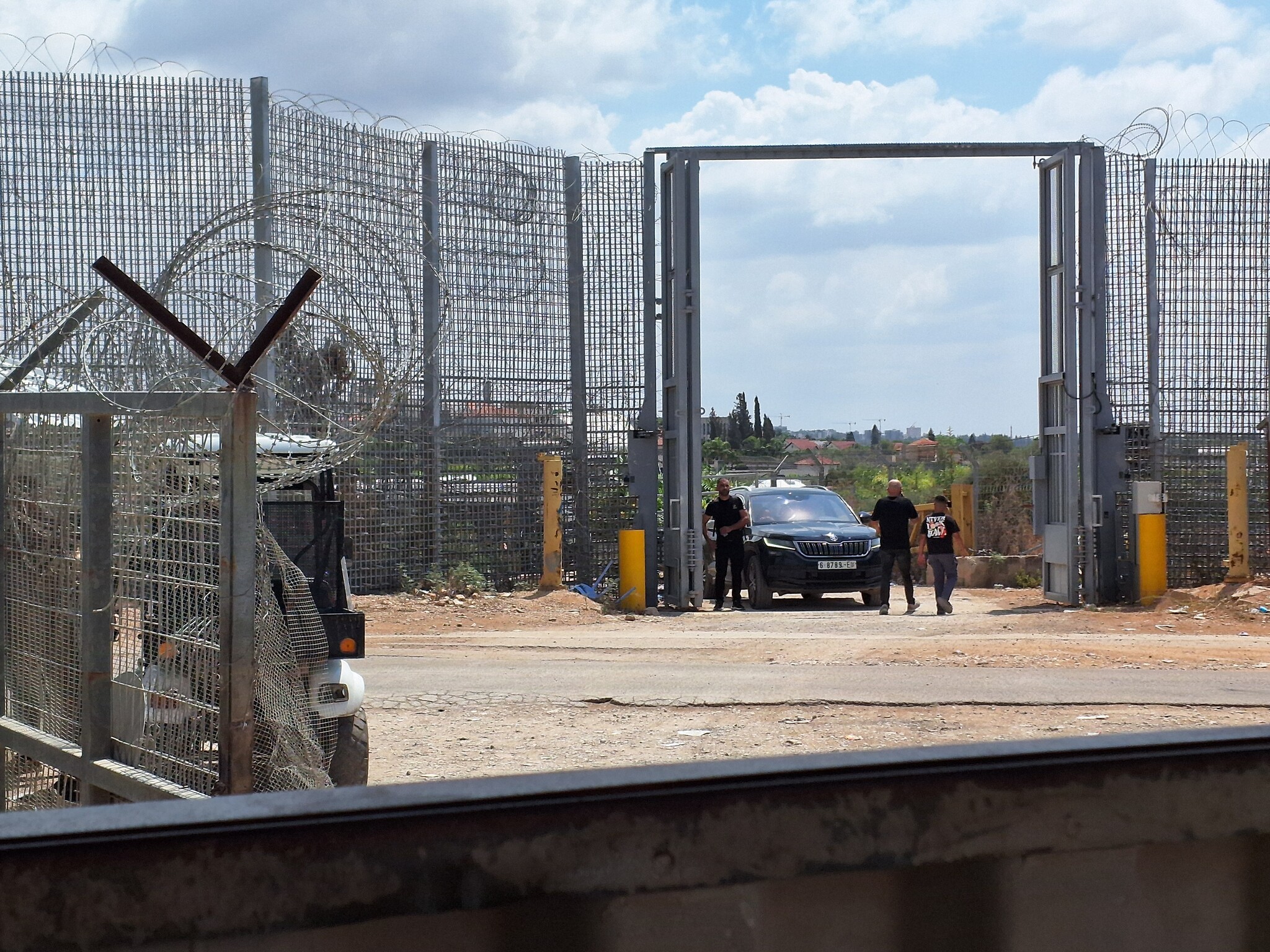 Ronit Dahan-RamatiAug-31-2026Habla. The gate is open
-
