
‘Azzun, ‘Einabus, Burin (Yitzhar), Huwwara
Following a report in the press about armed patrols on road 60 from Jit to Huwwara, initiated by the settlers in Yitzhar, and the harassment of Palestinian villages on the weekend, we drive into the area to find out how this new militia operates ( an "appropriate Zionist response" to the weakness of the army??), and whether the settlers in Yitzhar were involved in the weekend events.
9:15 Leaving the train station in Rosh HaAyin.
We drive along road 55. At this time of the year, The West Bank is extremely beautiful with its pastoral views, small plots of cultivated land intertwined with green stretches and blooming trees on both sides of the road.
The entrance to Azun is not blocked. But opposite us on the other side of the road, an armed army Jeep is parking. There is little traffic from the Jit junction towards Huwwara. A stuck van is parking on the side of the road. Some young tourists are waiting for another car in order to continue their trip. An army Jeep is driving towards the Jit junction.
We see the first sign of the settlers' new initiative on the driveway leading into Yitzhar from the main road: two armed settlers , a live road block, are posted by a private SUV.
Nadim initiates a meeting with M., our friend from Burin, and we drive to meet him near the school, which have turned into a target both for the army and the settlers from Yitzhar. M. informs us about the on-goings in the area.
300 children aged 8-18 are learning at the school, which is located at some distance from the houses in the village. Its windows are closed with iron shutters. We see the children playing quietly in a wide yard surrounded by a concrete fence with a netted fence on top. However, these children are the enemy, and the enemy has to be fought. Soldiers arrive and throw stun grenades into the school claiming that the children have been throwing stones at them. This has been going on since the beginning of the school year. Last week, the security coordinator in Yitzhar outdid himself when shooting tear gas at the children. Army representatives have even threatened to close the school.
Last Thursday the settlers from Yitzhar inaugurated their new militia. On Friday a TV team arrived at the settlement. In front of the cameras, the settlers explained why they have to perform their own patrols: The risk of death has risen, since the school children don't make do with stones. Now they are throwing Molotov cocktails at the settlers! No less.
This is how the settlers in Yitzhar spent their weekend:
Thursday: 13 acres (53 dunams) of cultivated land separate between the school and the settlement. The people from Yitzhar enter this area, hide among the trees and watch the road from there.
Friday: One step further – They go down the hill and attack a farmer working in his field. They break his leg and arm with an iron bar. Soldiers arriving at the spot are watching, but as usual, they don't intervene. Now the injured man is hospitalized.
Sabbath: On the morning of the holy Sabbath, after having prayed with great intent and having observed all the Sabbath commandments meticulously, they set out, dressed in white, to fulfill the most important commandment of all –the abuse of their Palestinian neighbors. For a change, since time is plentiful, they are going south towards Einabus.
A shepherd and his son leading their sheep are an easy prey. The attackers divide the tasks between them: Some steal a number of sheep and run away. As we know, stealing on a Sabbath means fulfilling a most holy commandment. Two others attack the boy, hit him and make him fall. One of them puts him on his back and starts to run towards Yitzhar. At the last moment, some young men from the village arrive. They release the terrified boy and return the stolen sheep to their owner.
While listening to the description of these events, we notice a private Jeep parking on the side of the driveway. Two settlers are standing nearby. After a moment they enter the car and drive towards the road. The patrol of the settlers' militia is on the way to its mission.
On our way back we pass through Huwwara. There is much traffic is on the road. The entrance to Beita is blocked, but two army vehicles are parking there. At the Tapuah junction Israeli policemen stop three cars with Palestinian numbers. The fines that the car owners will have to pay will be a welcome addition to the budget of the police force. Yes, Israel's police force is very efficient both inside and outside the Green Line.
11:30 Back to Rosh HaAyin
'Azzun
See all reports for this place-
Azoun (updated February 2019)
A Palestinian town situated in Area B (under civil Palestinian control and Israeli security control),
on road 5 between Nablus and Qalqiliya, east of Nabi Elias village. The inhabitants are allowed to construct and improve infrastructures. The Separation Fence has confiscated lands belonging to the town's people. In 2018 olive tree groves owned by one of its inhabitants were confiscated for the sake of paving a road to bypass Nabi Elias. Azoun population numbers 13,000, its economic state dire. Its infrastructures are poor, neglect and poverty rampant. In the meantime, the town council has completed paving an internal road for the inhabitants' welfare.
Because of its proximity to the Jewish settler-colony of Karnei Shomron and its outposts, the town suffers the intense presence of the Israeli army, especially at nighttime: soldiers enter homes, arrest suspects, trash the house and sometimes ruin it, as they do in numerous places in the West Bank. At times a checkpoint closes the entrance to the town, so no one can come in or get out.
-
'Einabus
See all reports for this place-
'Einabus
A village in the Nablus district, west of Hawara, numbering about 3,000 people. 85% of the village's land in Area B, 15% in Area C. 114 dunams of its land were expropriated to establish the violent settlement of Yitzhar and its outposts. Due to the proximity and violence of the settlers sitting on the top of the mountain to invade the village lands, the inhabitants of Einabus regularly suffer from harassment by settlers throwing stones, smashing windows, cutting down olive groves, as well as arson of vehicles and fields. All these were intensified in the second decade of the 21st century.
-
Burin (Yitzhar)
See all reports for this place-
Burin (Yitzhar)
This is a Palestinian village in the Nablus governorate, a little south of Nablus, on the main road passing through the West Bank. The settlements: Yitzhar and Har Bracha, settled in locations that surrounded the village, placed fences so it is cut off the main road.
There are around 4000 inhabitants. Most of them are engaged in agriculture and pasture, although many graduates of the two secondary schools continue to study at the university. Academic positions are hardly available, they find work as builderd, or leave for the Gulf countries.
The village lands were appropriated several times for the establishment of Israeli settlements and military bases, and as a result, Burin's land and water resources dwindled. lSince 1982, more than 2,000 dunams of village land have been declared "state land" and then transferred to Har Bracha settlement.
Over the past few years and more so since 2017, the villagers have been terrorized by the residents of Yitzhar and Har Bracha, the Givat Ronen outpost and others. Despite the close proximity of soldiers to an IDF base close to one of the village's schools, residents are suffering from numerous stone-throwing events, vehicle and fire arson, also reported in the press.
In 2023, the prevention of the olive harvest in the village plot was more violent than ever. Soldiers and settlers walked with drawn weapons between the houses of the village and demanded that people stop harvesting in the village itself and in the private plots outside the village. The settlers from Yitzhar and Giv'at Roned raided the olive groves and stole crops. 300 olive trees belonging to the residents of Burin, near Yitzhar, were uprooted. The loss of livelihood from the olives causes long-term economic damage to the farmers' families, bringing them to the point of starvation.
(updated for November 2023)
-
Huwwara
See all reports for this place-
The Huwwara checkpoint is an internal checkpoint south of the city of Nablus, at the intersection of Roads 60 and 5077 (between the settlements of Bracha and Itamar). This checkpoint was one of the four permanent checkpoints that closed on Nablus (Beit Furik and Awarta checkpoints to the east and the Beit Iba checkpoint to the west). It was a pedestrian-only barrier. As MachsomWatch volunteers, we watched therre since 2001 two shifts a day - morning and noon, the thousands of Palestinians leaving Nablus and waiting for hours in queues to reach anywhere else in the West Bank, from the other side of the checkpoint the destination could only be reached by public transport. In early June 2009, as part of the easing of Palestinian traffic in the West Bank, the checkpoint was opened to vehicular traffic. The passage was free, with occasional military presence in the guard tower. Also, there were vehicle inspections from time to time. Since the massacre on 7.10.2023, the checkpoint has been closed to Palestinians.
On February 26, 2023, about 400 settlers attacked the town's residents for 5 hours and set fire to property, such as houses and cars. Disturbances occurred in response to a shooting of two Jewish residents of Har Bracha by a Palestinian Terrorist. The soldiers stationed in the town did not prevent the arson and rescued Palestinian families from their homes only after they were set on fire. No one was punished and Finance Minister Smotrich stated that "the State of Israel should wipe out Hawara." Left and center organizations organized solidarity demonstrations and support actions for the residents of Hawara.Hawara continued to be in the headlines in all the months that followed: more pogroms by the settlers, attacks by Palestinians and a massive presence of the army in the town. It amounted to a de facto curfew of commerce and life in the center of the city. On October 5, 2023, MK Zvi established a Sukkah in the center of Hawara and hundreds of settlers backed the army blocked the main road and held prayers in the heart of the town all night and the next day. On Saturday, October 7, 23 The "Swords of Iron" war began with an attack by Hamas on settlements surrounding Gaza in the face of a poor presence of the IDF. Much criticism has been made of the withdrawal of military forces from the area surrounding Gaza and their placement in the West Bank, and in the Hawara and Samaria region in particular, as a shield for the settlers who were taking over and rioting.
On November 12, 2023, the first section of the Hawara bypass road intended for Israeli traffic only was opened. In this way, the settlers can bypass the road that goes through the center of Hawara, which is the main artery for traffic from the Nablus area to Ramallah and the south of the West Bank. For the construction of the road, the Civil Administration expropriated 406 dunams of private land belonging to Palestinians from the nearby villages. The settlers are not satisfied with this at the moment, and demand to also travel through Hawara itself in order to demonstrate presence and control.(updated November 2023)
.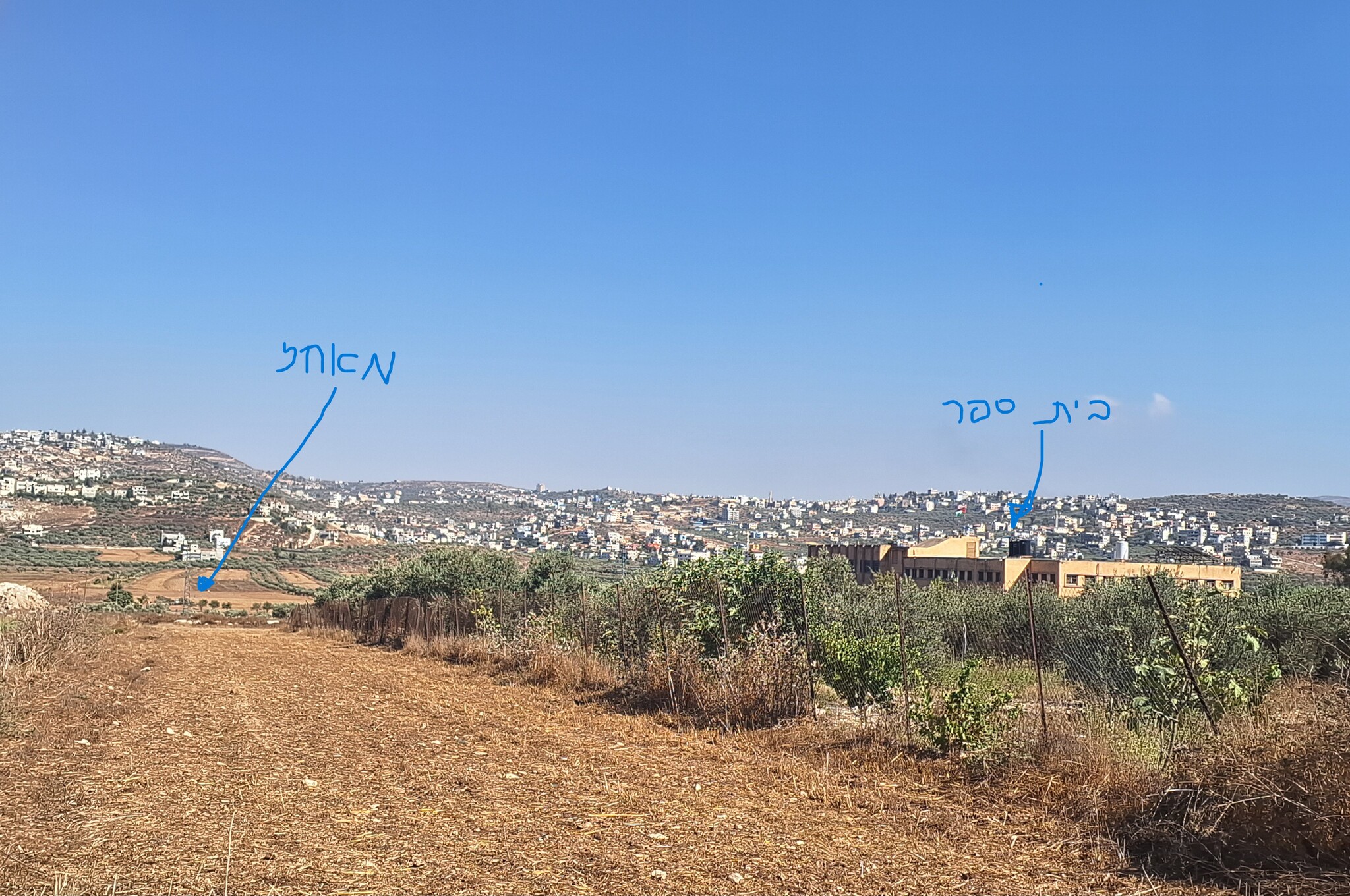 Ronit Dahan-RamatiAug-24-2026Huwara: The school on the outskirts of town and an outpost hidden among the trees
-
