
‘Azzun, Eliyahu Crossing, Habla, Jayyus, Mon 3.9.12, Morning
05:45 Eliyahu Gate
We see only a few workers waiting to cross. Two cars at the inspection
booth.
06:00
We move to 'Azzun. It is still dark, and it seems as though everyone is
asleep.
06:10 Jayuus Agricultural Gate
Here everyone is already up and the sun is rising. We meet Ecumenical
volunteers whom we had arranged to see. Tractors and large vans are going
through.
A car arrives with an elderly couple, whom we know greet us, and those going to open
the irrigation system for their avocado grove and lemon trees.
A farmer who owns a lot of land stops next to us and, at our request, gives
a report that the municipality will submit requests for an organized olive
harvest. We told him that there are new forms which will allow them to make
requests for both workers and family members, even if the land is not
registered in their name and that it is worthwhile checking if they have
received these forms. He told us with great joy that he had received, for
the first time. a permit to stay overnight in the field (he and his wife),
but did not receive permission to go in their new jeep. The Ecumenicals
told us that the schools opened this week and they are observing at the
checkpoints where the children pass through. On Sunday they waited for the
buses of children in the morning at Habla.
They reported that on Sunday, a young Palestinian who seemed to have gotten
through the fence at 'Azzun 'Atma escaped from the soldiers who were chasing
him, fell and apparently died of a heart attack. The village chief of Nebi
Elias reported the same event to us, but he said that the soldiers fired on
the youth who was escaping and killed him.
06:40
We leave the checkpoint which closed a bit late, because a tractor arrived
at the last minute.
06:55
A lot of workers waiting at the exit for their transportation.
07:00 Eliyahu Gate
7 cars and a small pink bus, which turned out to be the bus which arrives
from Qalqilyah daily and takes the children from the Ramadin tribe by way of
the Habla checkpoint to the school in Habla, wait for inspection.
07:05 Habla checkpoint
The elderly guard from the nursery, who returns to his home in Habla every
morning, has already been waiting for 20 minutes, so he says, until the
officer is kind enough to let him pass.
Also a driver arrives, who goes back and forth every day; however, he needs
to wait each time and go through inspection. He is less patient.
07:15
Two buses with children arrive. Their drivers get off and come up to the
Gate for inspection. There is a new driver, who doesn't know the procedures
yet, and asks to go right through. They call the officer
and finally everyone goes through. The buses are not inspected.
Groups of workers coming from the Habla side go through inspection
relatively quickly (5 workers in 3-4 minutes).
7:30
Another guard from the nursery arrives with a donkey and cart and waits
patiently until they notice him. He speaks good Hebrew and tells us that on
the previous evening there was a long article on the Lebanese Al Quds TV
station about MachsomWatch! Naturally, very supportive, and they said that
the MachsonWatch women are among the few people who help the Palestinians
and empathize with their suffering.
7:50
The line shortens but there is a steady flow of new people. We leave and go
to the village of Nebi Elias to meet the village head, G. in order to speak
about the coming olive harvest. The meeting takes place in his sewing
workshop.
Nebi Elias is on Highway 55, a little after the turnoff to Qalqilya and the
settlement of Tzofim. Highway 55 passes Eliyahu Gate like a sort of sleeve,
on one end of which is the settlement Alfei Menashe and, on the other end,
the settlement of Tzofim and Nebi Elias on either side of the road. A large
portion of its land was taken when they built Tzofim and the fence; a long
and exhaustive court case did, this time, succeed, and the fence was moved
nearer to the settlement and most of their land on this side of the fence
was returned to them.
On the side of Alfei Menashe, the fence passes close to the village and the
olive groves are situated right underneath Alfei Menashe; only people wth
special permits can go onto their land. They must go through the Eliyahu
Gate and along a path which comes to the side of the hill where the olive
trees are. They are allowed to enter only with a donkey and cart and it is
forbidden to bring any vehicle or tractors. From the time when the
checkpoint passed into private hands, their situation has worsened.
There is a well on the land and they are allowed to bring only 2 pails of
gasoline at a time which can only work the well for 2 hours! One can see
the lands very close to the village and all the paths which the farmers used
to use to go straight from their homes to their orchards. Today, the fence
and the security road prevent them from reaching their land.
Another serious problem is that most of the lands of the village are in Area
C and it is forbidden to build there even a shed for their sheep. They are
requesting permits for tractors to enter the area.
G. speaks fluent Hebrew, works with an Israeli textile workshop and knows a
lot of what is going on. In another month there will be elections to the
PNA, both in the villages and in the cities. He says that he is tired and
wants to retire. We all prayed for better times and went home.
'Azzun
See all reports for this place-
Azoun (updated February 2019)
A Palestinian town situated in Area B (under civil Palestinian control and Israeli security control),
on road 5 between Nablus and Qalqiliya, east of Nabi Elias village. The inhabitants are allowed to construct and improve infrastructures. The Separation Fence has confiscated lands belonging to the town's people. In 2018 olive tree groves owned by one of its inhabitants were confiscated for the sake of paving a road to bypass Nabi Elias. Azoun population numbers 13,000, its economic state dire. Its infrastructures are poor, neglect and poverty rampant. In the meantime, the town council has completed paving an internal road for the inhabitants' welfare.
Because of its proximity to the Jewish settler-colony of Karnei Shomron and its outposts, the town suffers the intense presence of the Israeli army, especially at nighttime: soldiers enter homes, arrest suspects, trash the house and sometimes ruin it, as they do in numerous places in the West Bank. At times a checkpoint closes the entrance to the town, so no one can come in or get out.
-
Eliyahu CP (109) / Crossing
See all reports for this place-
Eliyahu CP (109) / Crossing This checkpoint, also known as the Fruit Crossing, is one of the main checkpoints between Israel and the West Bank. It is located on Route 55 between Alfei Menashe and the turn to Qalqilya and Zufin, more than 4 km east of the Green Line, in the separation fence, which separates Qalqilya from its lands to the south, thus leaving Alfei Menashe West of the fence - the Seam Zone. This checkpoint, a few kilometers across the Green Line, is intended for "Israeli settlement in the West Bank and the population of the Seam Zone." It is managed by a civil company. Palestinians with a special permit for their lands in the seam area are also allowed to pass through it, on foot, and sometimes by car.
-
Habla
See all reports for this place-
Habla CP (1393)
The Habla checkpoint (1393) was established on the lands of the residents of Qalqilya, on the short road that
connected it for centuries to the nearby town of Habla. The separation barrier intersects this road twice and cut off the residents of Qalqilya from their lands in the seam zone.(between the fence and the green line).
There is a passage under Road 55 that connects Qalqilya to the sabotage This agricultural barrier is used by the farmers and nursery owners established along Road 55 from the Green Line and on both sides of the kurkar road leading to the checkpoint.
This agricultural checkpoint serves the residents of Arab a-Ramadin al-Janoubi (detached from the West Bank), who pass through it to the West Bank and back to their homes. The opening hours (3 times a day) of this agricultural checkpoint are longer than usual, about an hour (recently shortened to 45 minutes), and are coordinated with the transportation hours of a-Ramadin children studying in the occupied in the West Bank.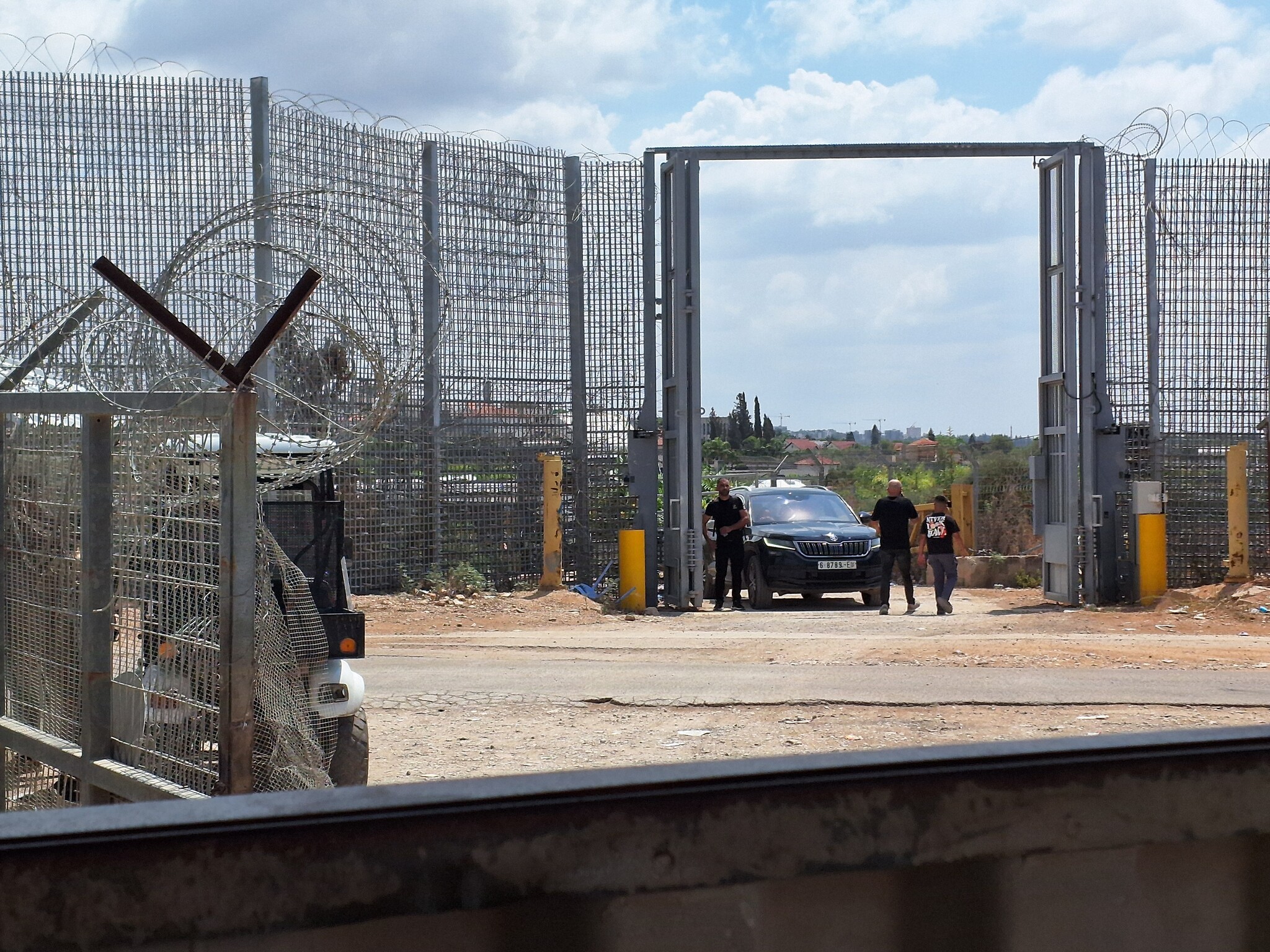 Ronit Dahan-RamatiAug-31-2026Habla. The gate is open
-
Jayyus North (935)
See all reports for this place
