
‘Azzun, Falamiya, Habla, Jayyus, Mon 18.6.12, Afternoon
Jayyus, Falamya and Habla are seam zone checkpoints whose purpose is to maintain the “fabric of life” of Palestinian farmers who are cut off from their lands by the separation barrier. They’re known as “gates.” Other than Falamya, which is open all day, the others are open for about an hour in the morning, afternoon and evening. Traffic through Jayyus and Falamya is light, restricted to the few Palestinians barely making a living from agriculture. More people go through Habla, which is near Qalqilya and Jilijliya.
The Occupation routine at the agricultural checkpoints:
12:00 Jayyus
The soldiers arrive a few minutes after we do. No one crossed in the half hour we stood there.
12:40 Falamya
An elderly woman waits on a donkey cart. Her husband shows their documents to the soldiers seated under a canopy. They’re coming from their field on the Israeli side of the barrier. Five minutes after we arrive he returns to the cart and they cross to the Palestinian side. Their cart is small, just a few boards nailed together. A pile of khubeiza leaves they probably picked in the fields for lunch. Twenty minutes later, driving back to the road to Jayyus on the track leading to the checkpoint, we pass them. They’d proceeded only a few hundred meters.
A man riding a bicycle comes from Falamya toward the Israeli side of the barrier. We watch and learn how complicated is the procedure for crossing. He leaves the bicycle in the middle of the checkpoint, walks to a small yellow gate. He rings the bell, a female soldier seated in a building (called a “blocker”) opens the gate. Then he must go through the revolving gate which is also operated by that soldier. He goes into the building for about four minutes. He exits the other end, returns to the yellow gate for his bicycle. His field is the one closest to the gate; we see him stop a little way past the checkpoint. Another farmer joins him, also riding a bicycle. He arrives from the security road (which is supposed to be restricted to military vehicles) and doesn’t have to go through inspection.
[Photo: The “blocker” at the Falamya checkpoint]
At the exit from 'Azzun, on our way to Habla, we gave a ride to a woman going to Qalqilya. She stood at the junction of Highway 55 and the road to 'Azzun, wearing a hijab. I mention this to indicate that her ethnicity was clear. Nora turned left toward the Elias checkpoint. I don’t think she’d broken any laws, though I was still turned around talking to the woman who sat in the back. But Nora might have made the turn without giving the right of way to cars coming from the right. I saw a car with yellow license plates coming toward us fast, the driver blew the horn and when the car reached us remained dangerously close. Nora moved to the shoulder to avoid it and stopped. We sat paralyzed in the car. The other car stopped ahead of us, two people got out, apparently a woman and her son. The woman approached us threateningly. She was heavy-set, waving her hands at us. When she reached us she leaned in through the driver’s window, her face next to Nora’s. She wasn’t irate because of Nora’s driving. She began yelling, “Stinking leftist, stupid bitch, murderers, you Peace Now always photographing” she spat, “What are you thinking, driving like an idiot, irresponsibly.” She kept repeating herself for a few minutes, then her son joined her (he’d waited a while in the car – to jot down our license number?), banging angrily on the hood of the car in which we sat. When they finally moved away the mother turned toward us again and made a motion as if she were photographing. We sat paralyzed in the car the entire time. I didn’t even do the minimum, write down their license number.
13:20 Habla
Twenty Palestinians wait on the Israeli side, including a man with a horse cart (photo attached), 9 on the Palestinian side.
[Photo: Habla, laborers waiting on the Israeli side]
They enter the building in two groups of five, one group from each side of the checkpoint. One member of the group collects the IDs from the other four. He’ll give them to the officer seated inside. It takes 7-12 minutes for a group of five to go through. We understand how much they’re in a hurry and how annoying is this pointless wait under the burning sun when the group on the Palestinian side numbers only four people, instead of five. The laborers next to us adopt the checkpoint’s strange rules that have been imposed on them, and yell to those on the other side that it’s their turn to go in. At 13:45 everyone on our side had crossed.
Vehicle/agricultural-vehicle crossing – the driver leaves the vehicle at the side of the checkpoint, goes through the building like a pedestrian, his ID remains with the soldier at the other side of the checkpoint, the driver returns to the vehicle and gets his ID back after he drives through.
Much of the interaction at the Habla checkpoint involves the adjacent plant nurseries, all of which have warehouses on the Palestinian side of the barrier. The owners must bring tools through the checkpoint (drills, vehicles with seedlings) or agricultural vehicles (tractor). The procedure: a worker arrives with the tool, a second gives his ID to the soldier, goes through the checkpoint, gets the tool and retrieves his ID on his way back.
A young man crosses carrying a bag with new jeans. He’s not allowed to bring them through. The MP responded to our question that the jeans might have been bought in Tel Aviv, which means that he entered Israel illegally (it’s easy to get to Israel once you’re on the Israeli side of the checkpoint). The man says he bought the jeans in Qalqilya (maybe the laborers should be required to save their receipts?). The MP says that those are the officer’s orders, and “that’s that.” We guess the man will have to wait until the checkpoint closes (in 15 minutes), and then go through with the jeans. But the problem is solved when a woman he knows goes through the checkpoint to Israel. He gives her the bag and goes through the checkpoint (our guess – tomorrow he’ll come wearing shorts, will meet the woman in Qalqilya, put on the new jeans and the pants made of lightweight fabric won’t take up much room in his backpack).
14:00 We left.
'Azzun
See all reports for this place-
Azoun (updated February 2019)
A Palestinian town situated in Area B (under civil Palestinian control and Israeli security control),
on road 5 between Nablus and Qalqiliya, east of Nabi Elias village. The inhabitants are allowed to construct and improve infrastructures. The Separation Fence has confiscated lands belonging to the town's people. In 2018 olive tree groves owned by one of its inhabitants were confiscated for the sake of paving a road to bypass Nabi Elias. Azoun population numbers 13,000, its economic state dire. Its infrastructures are poor, neglect and poverty rampant. In the meantime, the town council has completed paving an internal road for the inhabitants' welfare.
Because of its proximity to the Jewish settler-colony of Karnei Shomron and its outposts, the town suffers the intense presence of the Israeli army, especially at nighttime: soldiers enter homes, arrest suspects, trash the house and sometimes ruin it, as they do in numerous places in the West Bank. At times a checkpoint closes the entrance to the town, so no one can come in or get out.
-
Falamiya
See all reports for this placeHabla
See all reports for this place-
Habla CP (1393)
The Habla checkpoint (1393) was established on the lands of the residents of Qalqilya, on the short road that
connected it for centuries to the nearby town of Habla. The separation barrier intersects this road twice and cut off the residents of Qalqilya from their lands in the seam zone.(between the fence and the green line).
There is a passage under Road 55 that connects Qalqilya to the sabotage This agricultural barrier is used by the farmers and nursery owners established along Road 55 from the Green Line and on both sides of the kurkar road leading to the checkpoint.
This agricultural checkpoint serves the residents of Arab a-Ramadin al-Janoubi (detached from the West Bank), who pass through it to the West Bank and back to their homes. The opening hours (3 times a day) of this agricultural checkpoint are longer than usual, about an hour (recently shortened to 45 minutes), and are coordinated with the transportation hours of a-Ramadin children studying in the occupied in the West Bank.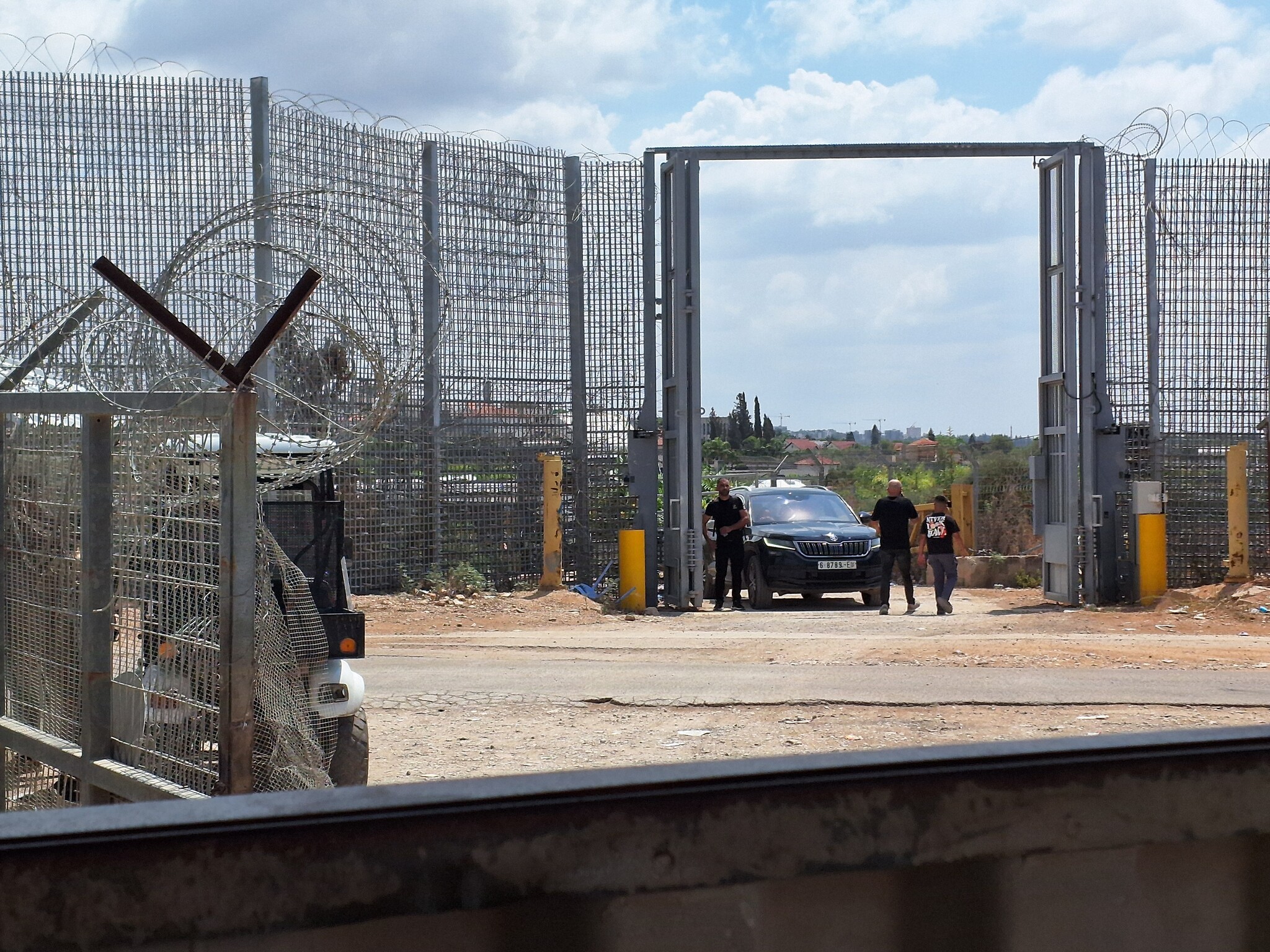 Ronit Dahan-RamatiAug-31-2026Habla. The gate is open
-
Jayyus North (935)
See all reports for this place
