
Barta’a-Reihan, Tayba-Rummana, Tura-Shaked, Ya’bed-Dotan
06:20-07:00 A’anin checkpoint
About 70 people crossed. Two weeks ago dozens of A’anin residents had their crossing permits confiscated because the computer indicated that although they’d exited here to the seam zone in the morning they hadn’t come back through here in the afternoon – in other words, they were in Israel illegally. In fact, many do prefer to return through the Barta’a-Reihan checkpoint, which is farther away, because it’s open later than A’anin. A’anin is open twice a week for holders of agricultural or employment crossing permits. They’re unable to use that permit to go through Barta’a-Reihan in the morning; otherwise they could access their lands every day. But it’s always possible to return through Barta’a. And that creates a mess for the computers. If the Barta’a-Reihan computer was linked to the one at A’anin it would be possible to see when those “in Israel illegally” returned to the West Bank. But the Israeli hi-tech empire can’t do that, so soldiers at the agricultural checkpoints make decisions according to their gut feelings, while the staff at the Reihan terminal only follow the “rules.”
There’s a short school vacation; we see many children accompanying their fathers to the olive groves. They’re pruning trees in preparation for the next harvest season.
After the crossing ended the commander, Lt. S., approached us and amicably explained things we’ve known and seen since he was in kindergarten. He also gave us his phone number and told us to call him whenever we had a concern about the soldiers. He doesn’t have anything to do with crossing 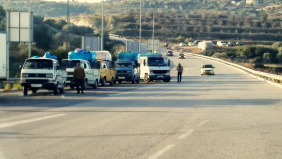 permits or other civilian issues; they’re handled by the Civil Administration or the DCO.
07:10-07:30 Tura-Shaked checkpoint
The checkpoint, notwithstanding its profusion of unnecessary electrified installations, fenced corridors, sheds and buildings operates without any apparent problems. Who goes through? Someone with a permit. Can everyone wishing to cross here obtain a permit, or go through in their car? No. But that’s their own, non-apparent, problem.
07:40 Barta’a-Reihan checkpoint
It’s operating, efficient, crowded with people and cars. A line of vehicles laden with agricultural produce waits on the road from Jenin, on their way from the West Bank to the seam zone. The merchandise is completely wrapped in plastic which will be removed at the inspection station. I recall the period when only five cartons per vehicle were allowed through, and our desperate efforts to annul that evil decree.
07:45-07:55 Yabed-Dothan checkpoint
No soldiers. People cross freely.
The metal gate on the side road to Yabed is closed. Earthen berms along the road prevent people from taking shortcuts to the village over dirt roads.
08:10-08:40 Taiybe-Rummaneh checkpoint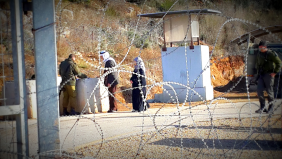
About 25 people crossed this morning. Border Police soldiers operate this crossing. People come from the villages of Taiybe and Rummaneh, east of the fence, cross the security road, approach the concrete barrier, are interrogated, show their documents, empty their pockets and are then frisked manually because there’s no magnemometer.
Where are you going? To my land. Where’s the land? There. What’s the phone charger for? My uncle charges my phone while I’m working.
Two young men were sent back because they weren’t able to say where their land was. We asked people coming through what’s happening. OK, OK, they say and hurry away. One says – things are OK when you’re here. Another says there are problems but is afraid to say more. Here, too, after people have gone through the senior Border Police soldier approaches us and politely explains what we’ve known since he’s been in kindergarten – about the problems with people in Israel illegally and the efforts of the security forces to disrupt their plans.
Barta’a-Reihan Checkpoint
See all reports for this place-
This checkpoint is located on the Separation Fence route, east of the Palestinian town of East Barta’a. The latter is the largest Palestinian community inside the seam-line zone (Barta’a Enclave) in the northern West Bank. Western Barta’a, inside Israel, is adjacent to it. The Checkpoint is open all week from 5 a.m. to 9 p.m. Since mid-May 2007, the checkpoint has been managed by a civilian security company subordinate to the Ministry of Defense. People permitted to cross through this checkpoint into and from the West Bank are residents of Palestinian communities inside the Barta’a Enclave as well as West Bank Palestinian residents holding transit permit. Jewish settlers from Hermesh and Mevo Dotan cross here without inspection. A large, modern terminal is active here with 8 windows for document inspection and biometric tests (eyes and fingerprints). Usually only one or two of the 8 windows are in operation. Goods, up to medium commercial size, may pass here from the West Bank into the Barta’a Enclave. A permanent registered group of drives who have been approved by the may pass with farm produce. When the administration of the checkpoint was turned over to a civilian security firm, the Ya’abad-Mevo Dotan Junction became a permanent checkpoint. . It is manned by soldiers who sit in the watchtower and come down at random to inspect vehicles and passengers (February 2020).
-
Tayba-Rummana
See all reports for this place-
Tayba-Rummana is an agricultural checkpoint. It is located in the separation fence in front of the eastern slopes of the Israeli city of Umm al-Fahm. The Palestinian villages next to the checkpoint are Khirbet Tayba and Rummana. Dozens of dunams of olive groves were removed from their owners, the residents of these villages on the western side of the separation fence. The Palestinian villages next to the checkpoint are Khirbet Tayba and Rumna. Dozens of olives dunams were removed from these villages' residents and swallowed up in a narrow strip of space, on the western side of the separation fence. The checkpoint allows the plantation owners who have permits to pass. Twice a week, the checkpoint opens for fifteen minutes in the morning and evening. During the harvest season, it opens every day for fifteen minutes in the morning (around 0630) and fifteen minutes in the afternoon (around 1530). (February 2020).
-
Tura-Shaked
See all reports for this place-
Tura-Shaked
This is a fabric of life* checkpoint through which pedestrians, cabs and private cars (since 2008) pass to and from the West Bank and the Seam-line Zone to and from the industrical zone near the settler-colony Shaked, schools and kindergartens, and Jenin university campuses. The checkpoint is located between Tura village inside the West Bank and the village of Dahar Al Malah inside the enclave of the Seam-line Zone. It is opened twice a day, between 7 a.m. and 10 a.m., and from 12 noon to 7 p.m. People crossing it (at times even kindergarten children) are inspected in a bungalow with a magnometer. Names of those allowed to cross it appear in a list held by the soldiers. Usually traffic here is scant.
- fabric of life roads and checkpoints, as defined by the Terminals Authority in the Ministry of Defense (fabric of life is a laundered name that does not actually describe any kind of humanitarian purpose) are intended for Palestinians only. These roads and checkpoints have been built on lands appropriated from their Palestinian owners, including tunnels, bypass roads, and tracks passing under bridges. Thus traffic can flow between the West Bank and its separated parts that are not in any kind of territorial contiguity with it. Mostly there are no permanent checkpoint on these roads but rather ‘flying’ checkpoints, check-posts or surprise barriers. At Toura, a small (less than one dunam) and sleepy checkpoint has been established, which has filled up with the years with nearly .every means of supervision and surveillance that the Israeli military occupation has produced. (February 2020)
 Mar-21-2022Anin Checkpoint: A magnificent breach in the center of the checkpoint
-
Ya'bed-Dotan
See all reports for this place-
Ya’bed-Dotan
This checkpoint is located on road 585, at the crossroads of Mevo Dotan settler-colony / Jenin/ Ya’abad. It has an army watchtower (‘pillbox’ post) and concrete blocs that slow down vehicular traffic. It was erected when Barta’a Checkpoint, lying to the west on the Separation Fence, was privatized and its operation was passed over to civilian security personnel. Since December 2009 this checkpoint enables flow of Palestinian vehicular traffic towards the Barta’a Checkpoint. Seldom is it manned by soldiers sitting in the watchtower, who conduct random inspections of vehicles and passengers. (february 2020)
-
