
Beit Furik, Huwwara PM
BEIT FURIK,HUWWARA, Monday 19 July 2004 PMObservers: Meki S., Anat S., Maya K. (reporting)A tough shift, but without any exceptional events.14:00 — Beit Furik On our way to the checkpoint, we were informed that a group from B’tselem (The Israeli Information Centre for Human Rights in the Occupied Territories) was already there. We met them near the car park , after they’d been refused permission to stand by the checkpoint itself. They asked us to investigate rumors that detainees had been beaten up, and that they still bore the signs on their faces.There were 40 to 50 Palestinians on the western side (at the exit from Nablus) and two on the eastern side, one of them claiming he’d been waiting for half an hour. Since the soldiers called people alternately from each of the two sides, those coming from Nablus went through the checkpoint quickly, while those entering the city crossed only about half an hour after our arrival.The detainees: There were 10 of them waiting in the sun, and two more inside the concrete cabin. We couldn’t get any nearer, but we couldn’t see any obvious signs of them having been beaten up (no blood, no swollen faces). We got a soldier to take them cold water from us and we reported on the situation to the B’tselem group. According to the soldiers, all the detainees had been “caught” up in the hills around trying to by-pass the checkpoint; the ones in the cabin, said the soldiers, were the drivers who’d transported them. They’d all stay here until the evening, we were told . While we were there another three detainees joined the group.The soldiers weren’t well-disposed towards us , but we managed to get along with them. One woman soldier was pleased we were there and kept telling us so. As usually happens here, the soldiers told us there was a security alert about terrorists on their way here from Balata, and they asked us to move away. We did, but gradually we moved back closer. Suddenly we heard shooting. The soldiers ran off in pursuit of more people trying to evade the checkpoint. We watched until they disappeared from sight. 15:00 — HuwwaraThere was construction work underway at the northern side of the checkpoint. Slabs of concrete swayed in the air above our heads, dangling from a crane on a truck. Nearby a machine raised clouds of dust as it levelled the ground. There were 25 detainees, but it was difficult to know how long they’d been waiting (one told me he’d been there two hours. Later, when I spoke to him again through an interpreter, the interpreter told him: “Tell them you’ve been here since 07:00!” and that was just what he did. The checkpoint commander claimed that they had not been able to carry out the checks of the ID card details because of the noise from the construction machinery! On the southern side of the checkpoint, we were told that “communication problems” had prevented the checking of the detainees’ IDs [the checkpoint soldiers phone through the ID card details to the General Security Services (GSS — also known, from the Hebrew acronym, as the Shabak, or the Shin Bet), which cross-checks against its central list of security suspects and then contacts the checkpoints with the answers. Sometimes, the soldiers wait until they have accumulated several ID cards before they contact the GSS: this further prolongs an in any case often lengthy process. During this time, the detainees are virtually prisoners at the checkpoints since the soldiers hold their ID cards until clearance is received].Many of the detainees were on their way to the university and had produced pink university registration documents; but these do not have the same validity as proper student cards. They said they wanted to get to the university to collect their cards. But, according to the checkpoint commander at Huwwara South, the students get their cards after they’ve registered either through the mail or via relatives who pick them up for them , either way, he insisted, “They know how to get them!” All the detainees here were released at 16:00 , and there were three new detainees when we left. People generally speaking went through the checkpoint at reasonable speed. At 15:30, there were 13 detainees on the southern side of the checkpoint; some said they’d been there since 07:00, but according to the commander they’d only been there an hour or two. Their ID details hadn’t yet been sent for checking because of “communication problems”. We nagged a bit, and nagged again realizing that the detainees on the northern side had already released. But there were none released on the southern side before we left. Suddenly, aand for no apparent reason, a soldier shouted at the detainees: “Why are you looking at us? Turn around, all of you!”People with all the necessary permits went through quite quickly here, too. . Some young men, and others without permits, were refused permission to go through and it proved quite impossible to persuade the soldiers to change their minds.A minibus crowded with passengers from Saudi Arabia arrived. Their elegant suitcases were thoroughly checked, at first on a table, and then on the dirty ground (the carter transporting them was in a hurry), and from time to time their contents overflowed onto the ground.
Huwwara
See all reports for this place-
The Huwwara checkpoint is an internal checkpoint south of the city of Nablus, at the intersection of Roads 60 and 5077 (between the settlements of Bracha and Itamar). This checkpoint was one of the four permanent checkpoints that closed on Nablus (Beit Furik and Awarta checkpoints to the east and the Beit Iba checkpoint to the west). It was a pedestrian-only barrier. As MachsomWatch volunteers, we watched therre since 2001 two shifts a day - morning and noon, the thousands of Palestinians leaving Nablus and waiting for hours in queues to reach anywhere else in the West Bank, from the other side of the checkpoint the destination could only be reached by public transport. In early June 2009, as part of the easing of Palestinian traffic in the West Bank, the checkpoint was opened to vehicular traffic. The passage was free, with occasional military presence in the guard tower. Also, there were vehicle inspections from time to time. Since the massacre on 7.10.2023, the checkpoint has been closed to Palestinians.
On February 26, 2023, about 400 settlers attacked the town's residents for 5 hours and set fire to property, such as houses and cars. Disturbances occurred in response to a shooting of two Jewish residents of Har Bracha by a Palestinian Terrorist. The soldiers stationed in the town did not prevent the arson and rescued Palestinian families from their homes only after they were set on fire. No one was punished and Finance Minister Smotrich stated that "the State of Israel should wipe out Hawara." Left and center organizations organized solidarity demonstrations and support actions for the residents of Hawara.Hawara continued to be in the headlines in all the months that followed: more pogroms by the settlers, attacks by Palestinians and a massive presence of the army in the town. It amounted to a de facto curfew of commerce and life in the center of the city. On October 5, 2023, MK Zvi established a Sukkah in the center of Hawara and hundreds of settlers backed the army blocked the main road and held prayers in the heart of the town all night and the next day. On Saturday, October 7, 23 The "Swords of Iron" war began with an attack by Hamas on settlements surrounding Gaza in the face of a poor presence of the IDF. Much criticism has been made of the withdrawal of military forces from the area surrounding Gaza and their placement in the West Bank, and in the Hawara and Samaria region in particular, as a shield for the settlers who were taking over and rioting.
On November 12, 2023, the first section of the Hawara bypass road intended for Israeli traffic only was opened. In this way, the settlers can bypass the road that goes through the center of Hawara, which is the main artery for traffic from the Nablus area to Ramallah and the south of the West Bank. For the construction of the road, the Civil Administration expropriated 406 dunams of private land belonging to Palestinians from the nearby villages. The settlers are not satisfied with this at the moment, and demand to also travel through Hawara itself in order to demonstrate presence and control.(updated November 2023)
.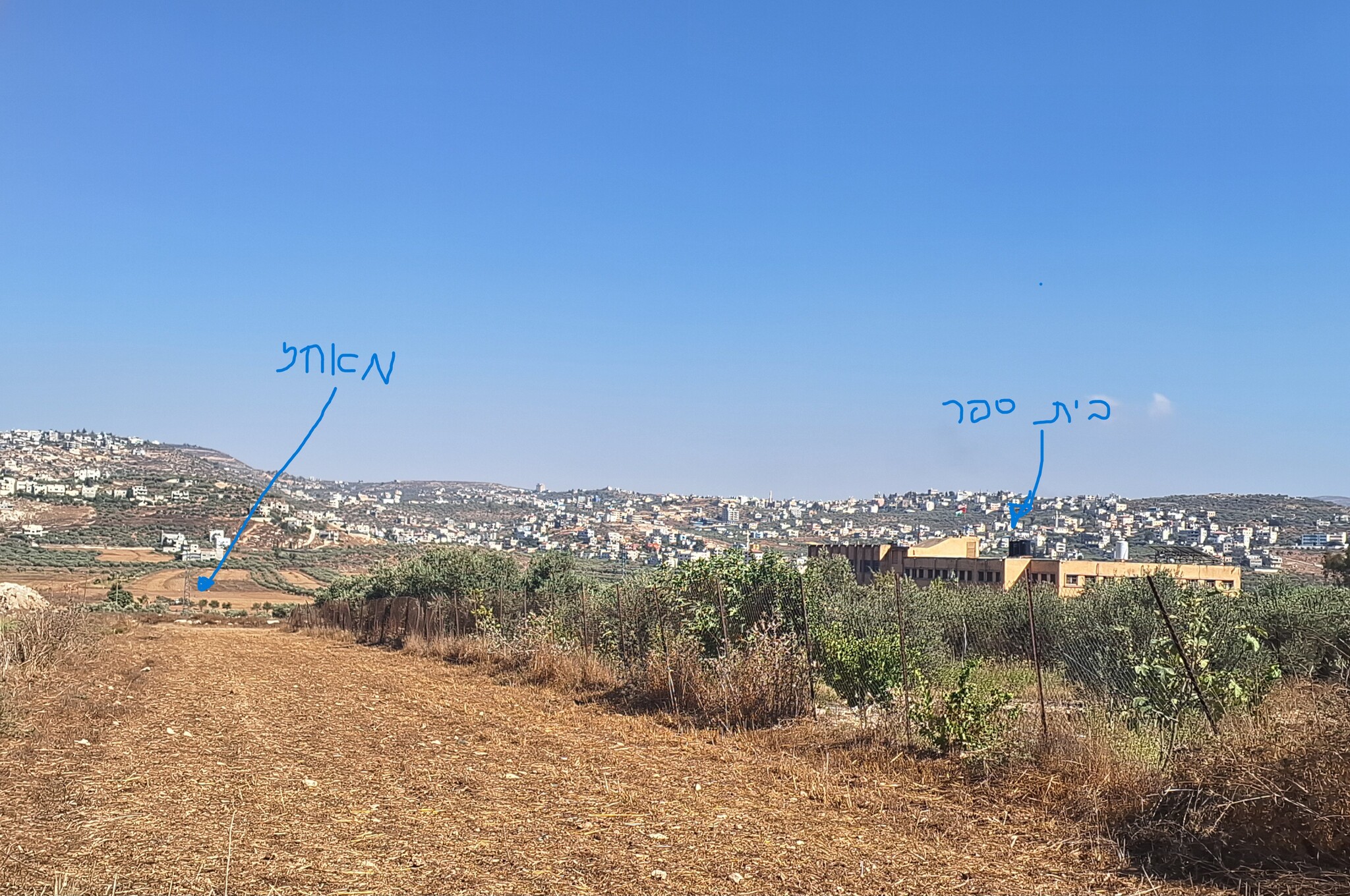 Ronit Dahan-RamatiAug-24-2026Huwara: The school on the outskirts of town and an outpost hidden among the trees
-
