
Beit Furik, Huwwara, Sat 2.2.08, Morning
Translation: Hanna B.
We left Jerusalem at 10:00. The road northwards from Jerusalem and beyond Ofra is all covered with snow and the landscape is so beautiful that it hurts. But the CPs are ugly and bad as usual!
Beit Furik:
We decided to begin the observation this time at Beit Furik. The CP is nearly empty, and there was no car queue either. Some of the people crossing over observed to us that "today is a good day but this week was terrible" – a fact that was also clear from the last reports. While we were standing at the CP we saw a military Hammer driving in the fields opposite the CP on its southern side. We decided to wait so as to clarify to ourselves the meaning of this. And indeed, some time later the Hammer returned with a Palestinian in it.
The man was made to stand with his face toward the concrete blocks and he was searched. But when we approached the spot he must have already been released and returned in the direction of Nablus.
We intended leaving when suddenly two cars with Israeli number plates burst forth on the Madison road. What does that mean? On a Shabbat? But our amazement didn't last for more than two minutes. The cars stopped at the CP and some men and women opened the car trunk of the car and out of it they took food and drink for the CP soldiers. We understood what the meaning of that was and moved away. When these people left – before we did, of course, they couldn't restrain themselves and remarked that "you certainly bring goodies to the Palestinians, you are Palestinian lovers". We refrained from reacting – what does all that have to do with us!
We "met" a stork on the field near the CP and thought, full of envy, how free it was to wander, and how restrained the movement of the people having to pass the CP is.
Huwwara:
When we arrived the movement was sparse, but later the flow of people returning from shopping and errands at Nablus, increased considerably. At the beginning of our stay it took about 20 minutes to pass, but until the end of the shift (16:15) the passage of the young men took two hours. The car passage took at least 50 minutes for a car which was positioned at the beginning of the queue – and we were unable to find out how long it had taken for the cars which had passed before. As the two x-ray cars which belong to the Shomron battalion are out of order, the checking of the people's belongings had to be made by hand – another delay, added to the usual delay. Again we say women of all ages waiting for the men, and chased away, time and again, and made to stand at the end of the CP.
Students study now on Mondays, Tuesdays and Wednesdays, which may account for the fact that the CP was empty at the beginning of our stay there.
The behavior of the women soldiers of the Military Police was disgraceful, and that of the military-policewoman Esti was even more shameful than that of the others. Their commander a young man with the rank of sergeant, strolled around with hands in his pocket and didn't do a things to alleviate the pressure at the queues nor to restrain the military-policewomen.
We talked to one of the young man who passed at the CP. The man told us that he was working at Ramallah and earned $650 per month. He shares a flat with a few friends and they pay $500 rent. After financing food and travel he remains with a monthly deficit – but the possibility of sitting at home without work seems much worse.
In the solitary confinement shed there was a detainee in whose belongings was found a picture of a shahid – and unforgivable "crime". It took very man phone calls to have the man released.
The DCO man was there when we arrived but he left immediately for lunch. After we called a few times the humanitarian center to complain about the especially slow passage of vehicles, the head of the DCO arrived. When we stressed that the DCO representative had left and that a long time had passed since, and that the situation at the vehicle passage queue was difficult – the "miracle" happened. The DCO representative arrived with the speed of lightening, the Military Police commander took his hands out of his pockets and began helping with the passage of vehicles – and we were convinced that it was possible to act when there is somebody who demands it.
It has to be stressed that the CP commander, the officer D. came up to us twice out of his own initiative to find out whether we had any complaints and asked us not to hesitate to approach him in every and any matter. His positive influence was felt in the operation of the CP.
On the way back at the BurinYitzhar CP there was a long queue of cars. We couldn't stay any longer, but did complain.
It wouldn't be right to finish the report without stressing the humiliation caused by the very passage at the CP, efficient as it may be. It is a real violation of human dignity and freedom – and many of the people passing at the CPs express this feeling with words that don't leave any reason for doubt.
_.
Beit Furik checkpoint
See all reports for this place-
One of the three internal checkpoints that closed on the city of Nablus - Beit Furik to the east, Hawara to the south, Beit Iba to the west. The checkpoint is located at the junction of Roads 557 (an apartheid road that was forbidden for Palestinians), leading to the Itamar and Alon Morea settlements and Road 5487. The checkpoint was established in 2001 for pedestrians and vehicles; The opening hours were short and the transition was slow and very problematic.Allegedly, the checkpoint is intended to monitor the movement to and from Nablus of the residents of Beit Furik and Beit Dajan, being the only opening outside their villages. Since May 2009 the checkpoint is open 24 hours a day, the military presence is limited, vehicles can pass through it without inspections, except for random inspections. (Updated April 2010)
-
Huwwara
See all reports for this place-
The Huwwara checkpoint is an internal checkpoint south of the city of Nablus, at the intersection of Roads 60 and 5077 (between the settlements of Bracha and Itamar). This checkpoint was one of the four permanent checkpoints that closed on Nablus (Beit Furik and Awarta checkpoints to the east and the Beit Iba checkpoint to the west). It was a pedestrian-only barrier. As MachsomWatch volunteers, we watched therre since 2001 two shifts a day - morning and noon, the thousands of Palestinians leaving Nablus and waiting for hours in queues to reach anywhere else in the West Bank, from the other side of the checkpoint the destination could only be reached by public transport. In early June 2009, as part of the easing of Palestinian traffic in the West Bank, the checkpoint was opened to vehicular traffic. The passage was free, with occasional military presence in the guard tower. Also, there were vehicle inspections from time to time. Since the massacre on 7.10.2023, the checkpoint has been closed to Palestinians.
On February 26, 2023, about 400 settlers attacked the town's residents for 5 hours and set fire to property, such as houses and cars. Disturbances occurred in response to a shooting of two Jewish residents of Har Bracha by a Palestinian Terrorist. The soldiers stationed in the town did not prevent the arson and rescued Palestinian families from their homes only after they were set on fire. No one was punished and Finance Minister Smotrich stated that "the State of Israel should wipe out Hawara." Left and center organizations organized solidarity demonstrations and support actions for the residents of Hawara.Hawara continued to be in the headlines in all the months that followed: more pogroms by the settlers, attacks by Palestinians and a massive presence of the army in the town. It amounted to a de facto curfew of commerce and life in the center of the city. On October 5, 2023, MK Zvi established a Sukkah in the center of Hawara and hundreds of settlers backed the army blocked the main road and held prayers in the heart of the town all night and the next day. On Saturday, October 7, 23 The "Swords of Iron" war began with an attack by Hamas on settlements surrounding Gaza in the face of a poor presence of the IDF. Much criticism has been made of the withdrawal of military forces from the area surrounding Gaza and their placement in the West Bank, and in the Hawara and Samaria region in particular, as a shield for the settlers who were taking over and rioting.
On November 12, 2023, the first section of the Hawara bypass road intended for Israeli traffic only was opened. In this way, the settlers can bypass the road that goes through the center of Hawara, which is the main artery for traffic from the Nablus area to Ramallah and the south of the West Bank. For the construction of the road, the Civil Administration expropriated 406 dunams of private land belonging to Palestinians from the nearby villages. The settlers are not satisfied with this at the moment, and demand to also travel through Hawara itself in order to demonstrate presence and control.(updated November 2023)
.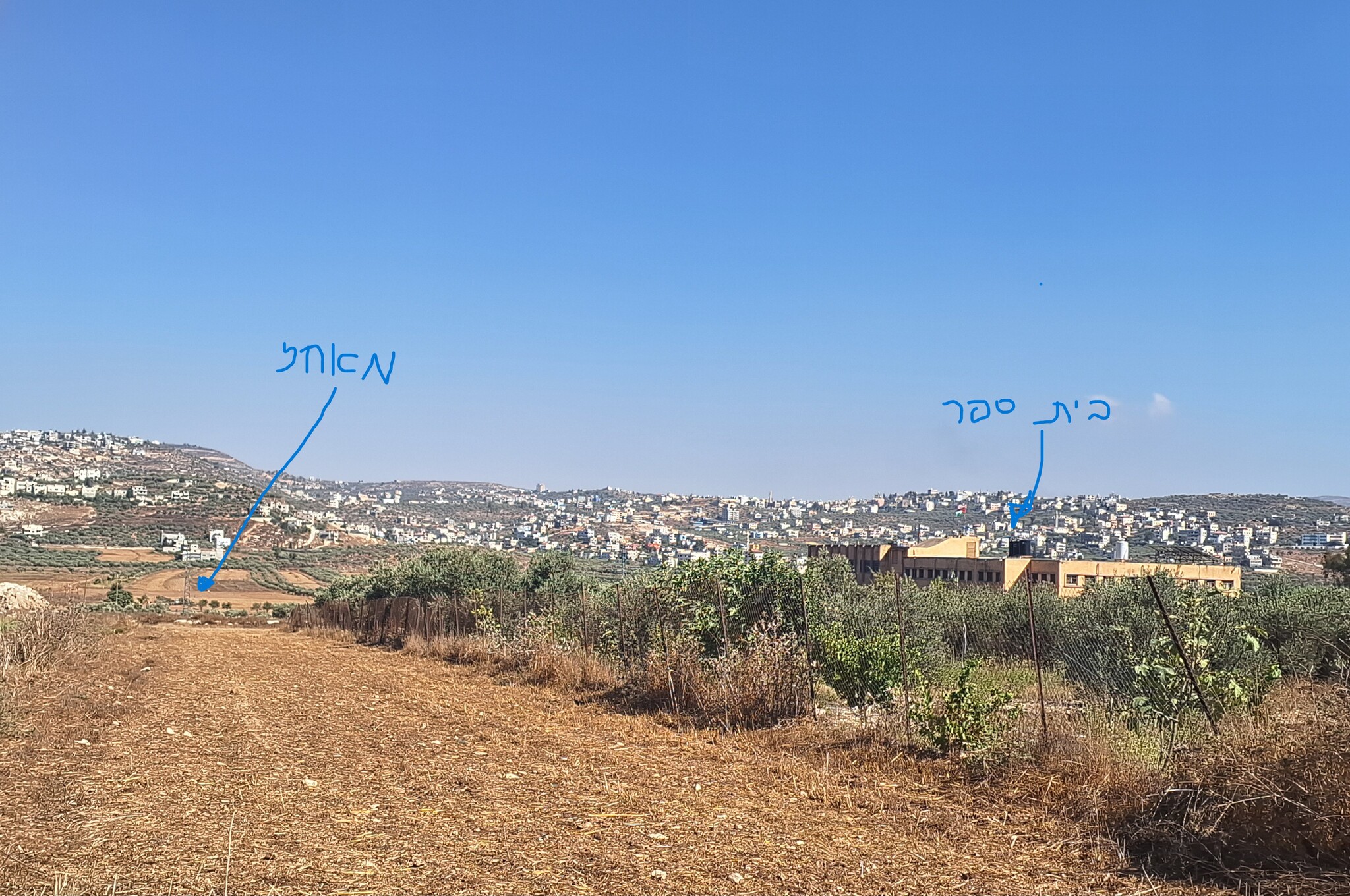 Ronit Dahan-RamatiAug-24-2026Huwara: The school on the outskirts of town and an outpost hidden among the trees
-
