
Beit Furik, Huwwara, Sun 3.2.08, Afternoon
Translation: Tal H.
The day the public heard about Israeli soldiers baring their bottoms in full view of Palestinians in the South Hebron Hills and army spokesperson's response – still in the aftermath of the vapid Winograd committee report – was that "the deed was done contrary to the spirit of the IDF", we looked and looked and found not a trace of the "spirit of the IDF" in the closure checkpoints of Nablus.
"The spirit of the IDF" certainly was not present amidst the concrete slabs and iron bars and metal fences enclosing thousands of human beings forced to wait for hours and pass through them day-in-day-out at the hands of young male and female soldiers who cannot differentiate between horsing and goofing around and having fun with the guys, and unadulterated vulgarity. "Come on, you fucker, you're not here to play around!" (to one of the soldiers); "Where did she go? I'll fuck them both!" (about a MPwoman and a soldier who went over to smoke a cigarette in the vehicle checking booth) and the like, while screaming and screeching various ID numbers towards the single checking post with the wanted lists. Luckily for them, those listed did not arrive at the checkpoint today, so during our shift at least, the detention cubicle remained empty.
We figured out the following: a Palestinian waits every day an average of two hours, times six days a week (12) times four weeks a month (48) times twelve months a year (576) – we get 576 hours a year, namely 24 day-and-night-cycles a year of lost time waiting at Huwwara Checkpoint alone.
16:00 HUwwara-
Long waiting lines of male pedestrians filling and spilling out of the shed. Three checking posts, where two or more soldiers scream ID numbers of everyone throughout the shift, asking and answering everything about checking, as well as personal conversation, in loud, low, racist language that is highly embarrassing (including comments about skin-color of some of the soldiers). The time robbed of Palestinians waiting in line stretches between one hour and two and a half hours.
"This is what it's like every day", say the young men coming out of the checks, their eyes lowered, hands holding their belt, watch, pocket contents and cigarettes, looking for a spot to place all of these as they fix their clothing again. Some of them hiss a quiet curse, others lock it inside. We see their look, their expression, lowered, angry, refusing to acquiesce. The procedure: the young man goes through the metal detector with his coat. Then without the coat. Now the belt. Now off with the watch. Then the change in his pockets. Sometimes the soldier feels him up back and front. When the young man is finally out and trying to get himself back together again in the exit area, a soldier chases him away from there for this is his job, according to the 'spirit of the IDF", to keep the place sterile (=no Palestinians allowed).
At the waiting vehicle line, a sniffer-dog and its lady soldier operator instead of the X-ray truck that's missing today. That is why all vehicles exiting Nablus – the rare fortunates who have withstood the tough criteria of the GSS and the Civil Administration and the Nablus Brigade and the DCO and actually possess the State of Israel's permission to exit Nablus in their own car, the minority thus deemed worthy – stand still waiting for two-three hours until their moment for checking arrives. Today the sniffer-dog-lady conducts the works. Passengers are required to disembark a few meters away, and wait. The car approaches the checking post, the driver presents his and the passengers' IDs, and is ordered to open all the doors, through which the dog will enter to find the prize which its mistress will have hidden for it. The X-ray truck being absent, a rickety table has been placed at the spot and packages are opened so that the dog can stick its snout in and sniff. Nylon wrappings of a huge package are torn open for the dog's snout.
At 17:00, the sniffer-dog ladies packed up and went. We wondered – at the absence of this unclean animal whose touching observant Moslems people and their belongings makes them unclean as well – how come security is now suddenly abandoned? Why is the dog a security must until 5 p.m., and afterwards, we are fine without it??
17:00 – crowding in the shed gets worse, and a soldier yells at the crowd: "You be quiet now!!" The cold bites to the bone. A MPman holding the single list of ID numbers around is busy yelling his answers to his mates' queries, and is not available to perform the inspection at the line under his charge. The Palestinian has to pass to and fro through the metal-detector. The searching soldier "upgrades" the inspection by rummaging all the smallest compartments of the slender wallet holding someone's ID, to make sure he has not missed some hidden explosive device, all the while debriefing his victim: Where do you live? Where are you coming from right now? Where are you going? Where do you study? The fellow is coming from Nablus, from school/work, going home to his village. "It's like this every single day", some of them tell us, angrily.
18:30 – the lines are less crowded now. We think aloud that unlike the past, Palestinians no longer arrive requesting to be allowed into Nablus without special permits. They already know. And we leave.
On second thought, this was a normal shift. Everything flowed, there were no special events, no flagrantly sadistic harassment, no bottom-baring khaki flashers. Everything was done in the spirit of the IDF and its spokespersons.
Beit Furiq Checkpoint, 17:00-18:00
Tal H. and guest:
Thin trickle of pedestrians, very long waiting line of vehicles exiting Nablus, but checks themselves are brief. No detainees. No sniffer dog.
A single checking lane for vehicles, incoming and outgoing both.
An inbound truck has been waiting for over half an hour. Another truck driver complains of waiting over an hour already.
As soon as our guest takes out her camera and wishes to photograph (from the CP compound outwards, at the landscape around, not even the checkpoint itself), the checkpoint commander rushes at us – a miniscule sergeant, looking both startled and frightening, wearing an army-issue protective vest with a huge 4 painted in yellow on his back – and asks her threateningly in Hebrew, "Think this is a museum here?? You are not allowed to take pictures!!!"
I told him she does not speak Hebrew and he repeated the same pearl of wisdom in hissed English. He sounded frightening and so I told him. He announced this was indeed his job and left to return to the checking post.
The truck has already waited for over 45 minutes. I called the army hotline and asked to do something to speed things up.
One of the drivers approached us to complain of the prolonged waiting. No sooner had we begun talking, and – what else? – Commander 4 was with us again ordering the Palestinian not to dare talk to us and split, on the double. I asked Commander 4 why he was so angry. He answered very calmly: "Because I don't really like you folks", and gave us his back.
At 17:50, after helpful calls from DCO officer R. the soldiers finally restarted the cars still waiting to enter Nablus, still on the single lane, and eventually the remaining outbound vehicles, and we left.
Beit Furik checkpoint
See all reports for this place-
One of the three internal checkpoints that closed on the city of Nablus - Beit Furik to the east, Hawara to the south, Beit Iba to the west. The checkpoint is located at the junction of Roads 557 (an apartheid road that was forbidden for Palestinians), leading to the Itamar and Alon Morea settlements and Road 5487. The checkpoint was established in 2001 for pedestrians and vehicles; The opening hours were short and the transition was slow and very problematic.Allegedly, the checkpoint is intended to monitor the movement to and from Nablus of the residents of Beit Furik and Beit Dajan, being the only opening outside their villages. Since May 2009 the checkpoint is open 24 hours a day, the military presence is limited, vehicles can pass through it without inspections, except for random inspections. (Updated April 2010)
-
Huwwara
See all reports for this place-
The Huwwara checkpoint is an internal checkpoint south of the city of Nablus, at the intersection of Roads 60 and 5077 (between the settlements of Bracha and Itamar). This checkpoint was one of the four permanent checkpoints that closed on Nablus (Beit Furik and Awarta checkpoints to the east and the Beit Iba checkpoint to the west). It was a pedestrian-only barrier. As MachsomWatch volunteers, we watched therre since 2001 two shifts a day - morning and noon, the thousands of Palestinians leaving Nablus and waiting for hours in queues to reach anywhere else in the West Bank, from the other side of the checkpoint the destination could only be reached by public transport. In early June 2009, as part of the easing of Palestinian traffic in the West Bank, the checkpoint was opened to vehicular traffic. The passage was free, with occasional military presence in the guard tower. Also, there were vehicle inspections from time to time. Since the massacre on 7.10.2023, the checkpoint has been closed to Palestinians.
On February 26, 2023, about 400 settlers attacked the town's residents for 5 hours and set fire to property, such as houses and cars. Disturbances occurred in response to a shooting of two Jewish residents of Har Bracha by a Palestinian Terrorist. The soldiers stationed in the town did not prevent the arson and rescued Palestinian families from their homes only after they were set on fire. No one was punished and Finance Minister Smotrich stated that "the State of Israel should wipe out Hawara." Left and center organizations organized solidarity demonstrations and support actions for the residents of Hawara.Hawara continued to be in the headlines in all the months that followed: more pogroms by the settlers, attacks by Palestinians and a massive presence of the army in the town. It amounted to a de facto curfew of commerce and life in the center of the city. On October 5, 2023, MK Zvi established a Sukkah in the center of Hawara and hundreds of settlers backed the army blocked the main road and held prayers in the heart of the town all night and the next day. On Saturday, October 7, 23 The "Swords of Iron" war began with an attack by Hamas on settlements surrounding Gaza in the face of a poor presence of the IDF. Much criticism has been made of the withdrawal of military forces from the area surrounding Gaza and their placement in the West Bank, and in the Hawara and Samaria region in particular, as a shield for the settlers who were taking over and rioting.
On November 12, 2023, the first section of the Hawara bypass road intended for Israeli traffic only was opened. In this way, the settlers can bypass the road that goes through the center of Hawara, which is the main artery for traffic from the Nablus area to Ramallah and the south of the West Bank. For the construction of the road, the Civil Administration expropriated 406 dunams of private land belonging to Palestinians from the nearby villages. The settlers are not satisfied with this at the moment, and demand to also travel through Hawara itself in order to demonstrate presence and control.(updated November 2023)
.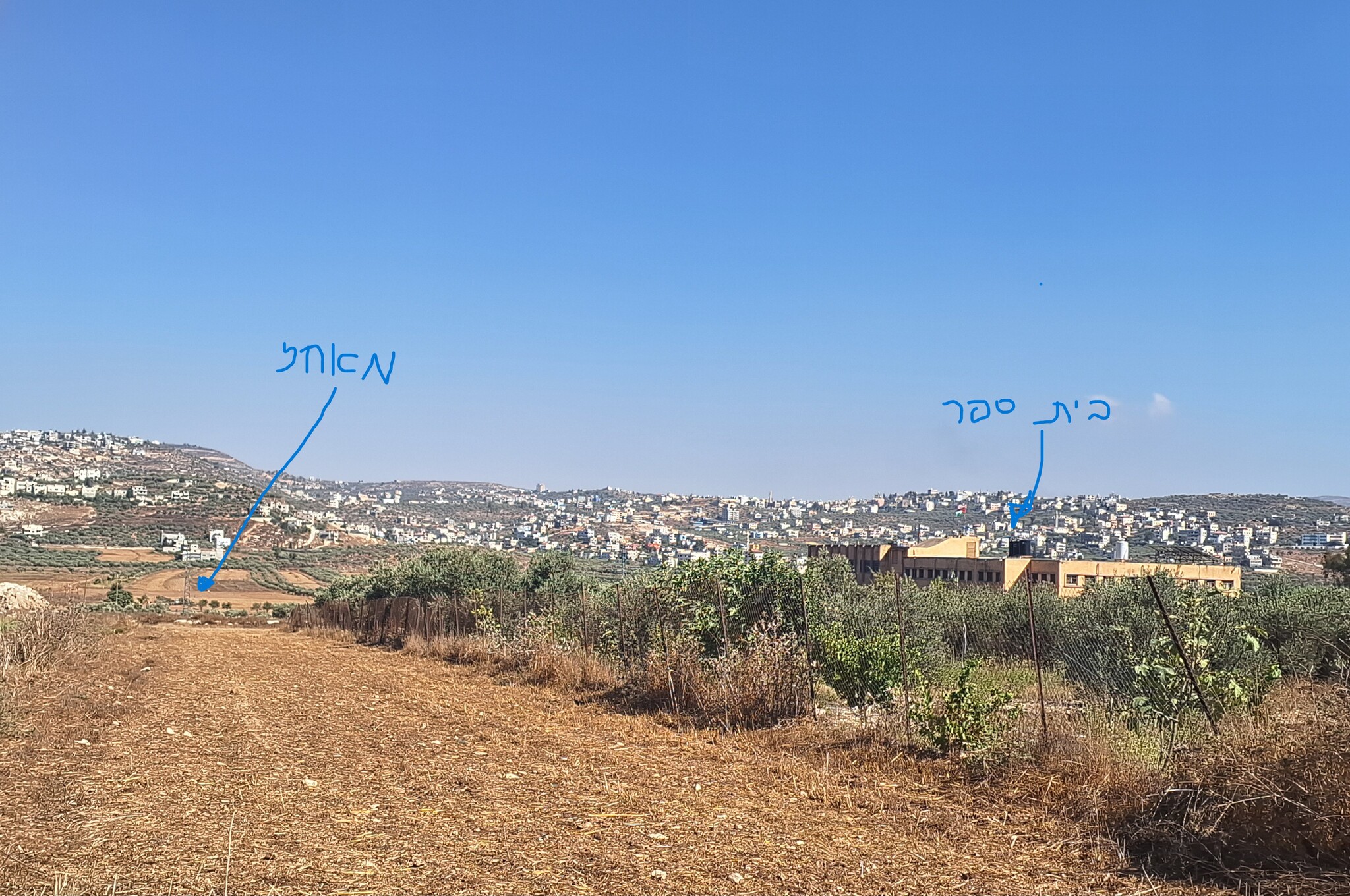 Ronit Dahan-RamatiAug-24-2026Huwara: The school on the outskirts of town and an outpost hidden among the trees
-
