
Beit Furik, Huwwara, Za’tara (Tapuah), Mon 19.11.07, Morning
Translation: Rachel B.
The taxi drivers at Huwwara always respond to the question "kif alhal (what's happening?)" with "Crappy!" Then comes the question whether at this moment the situation at the checkpoint in "crappy crappy" or "semi-crappy" – or something like that, which means the soldiers are not harassing them excessively.
According to this barometer of the situation, the report is that today the Huwwara checkpoint is "semi-crappy" – no acute problems, but, of course, the Occupation continues, the checkpoints continue and the soldiers process the Palestinians through like they were objects (if I had the skills I would write a film script based on "Modern Times" but set at the checkpoints) and, of course none of the Palestinians know what the next moment will bring.
Za'tra Junction – Tapu'ach Settlement; 7: 20 AM
This time we drove directly to Beit Fureik. There are 8 cars in the line approaching from the west and a bus that was directed to go into the parking lot. Coming from the north there were only 5 cars. The bus was parked in the lot and was being checked while the passengers waited below.
Beit Fureik; 7:40 AM
When we arrived there were no cars in the parking lot. From the parking lot we saw that cars going to Nablus were checked through quickly. We waited a while and then came down to the checkpoint.
We stood close to the new white line – the line that demonstrates more vividly than anything else the demonization of the women of MachsomWatch in the eyes of the soldiers. At that very instant, with a Pavlovian conditioned response, the soldier arrived and announced to us, politely and without anger, that we are not to cross the white line. He checked to make sure we know the rules and agreed upon terms {regarding our presence}. We nodded "yes" and started to mumble that these rules are not really acceptable to us, but we gave up on developing this line of conversation. Moriah commented that the very approach towards us {trying to limit us} indicates our power. There was no point in a confrontation with the soldiers despite our feeling of frustration at the limitations on our movement in the checkpoint area, which is completely arbitrary and unfounded in any law, not to mention justice. It was an opportunity for another taste of what the Palestinians go through every day, every hour, and in every place.
Even though we were not placed right at the center of things, we were pleasantly surprised to see that cars were checked through very quickly today (no more that half a minute per car) and pedestrians also passed through in both directions without confrontations or delays.
In the parking lot we met a young man who had forgotten his ID card at home and was waiting for someone to bring it to him. Meanwhile, he told us anecdotes about another aspect of Palestinian life – about the wealthy men of Nablus for whom he worked as a contractor. There are 10 families there {in Nablus} whose property is estimated to run into the billions, among them are families well known from the media, such as the Al-Matzri and Shaqu'a families. He told us about a palace of one of these billionaires for whom he works, who had building materials flown in on two chartered flights from Italy and France. All of this happened before the {present} Intifada. Surrounding the house are 150 dunams (nearly 40 acres) of lawns and trees. This young man earns 300 shekel per day and the workers he employs get paid 70 shekel /day. It turns out that class disparities afflict oppressed societies too…
Awarta; 8:30 AM
In the parking lot we saw a long line. We went to the edge of the lot and immediately the soldier informed us that we are not allowed to park there, only at the entrance to the parking lot. He threatened to hold up the trucks {if we don't comply}. We decided not to ask why or argue with him, because we had more important things to do there. Plus -had we asked, the answer is totally predictable:{because he has the} power… This is how it is when you need to show who is in control.
At the checkpoint we observed the soldiers detaining an ambulance. We went over to see what was going in and it turned out the ambulance had already been held since 7:00 AM. The ambulance was carrying a patient who had had a stroke a while back and was being transferred by ambulance to Beit Jala. But the patient is on the list of people barred from travel for security reasons and evidently is on the "black lists" as a member of one of the "Wolf Gangs." (Please indicate the proper translation for this new term: Myb)z twqhl)
The patient, in critical condition, was taken out of the ambulance and was standing to the side. His head is shaved. When we asked the commander of the checkpoint why he is not letting him through, seeing that he is in danger of having a stroke, the soldier answered us: "Does he look to you like someone having a stroke?" From now on we should say that the IDF soldiers are experts in everything – doctors and educators. Maybe it's really not necessary to end the teachers' strike and demand smaller classrooms in our schools if the results {of our educational system} are so perfect!
But the problem is, {the soldiers} may be great experts but have a very limited repertoire. It's beyond them to call the District Coordination Office or Dalia Bassa {in order to resolve this crisis}.
We called Rudi from the District Coordination Office and he immediately sent an officer to the checkpoint o investigate the situation and within 10 minutes the ambulance was released and on its way. As to opening the soldiers' eyes regarding contacting the District Coordination Office – we asked Rudi why the soldiers did not call the District Coordination Office themselves. It turns out that the normal procedures do not allow them to do that. They have to call the Company Commander first, he contacts the Brigade Advanced Command Post Officer who has to locate the Battalion Commander. The latter "remembers" that there is a District Coordination Office and again the chain starts from the District Coordination Office Commander to the District Coordination Office Field Commander and after at least two hours, if the patient is not dead, there is a chance that he will be allowed to go through the checkpoint. So – this is why it is so important that we exist and are present to intervene and save {a life, save the soldiers too, from being {responsible for the loss of life} by our "cooperation" with the Palestinians. We can only console ourselves with the saying of the Rabbis that whoever saves the life of one person in the world is as if he has saved the whole world, even if that person is a Palestinian.
Huwwara 9:30 AM
There are very few people at the checkpoint and they go through fast, including the usual ritual of taking off their belts. Cars are going through in both directions fairly quickly. At the entrance – about 2 minutes per car. At the exit – a maximum of 5 minutes per car. The scanner is operating. We should note that there is now a passage cleared through the cement blocks, so it's no longer necessary to jump around to get through them. The soldiers exchange anecdotes and stories from home and about their uncles from El'ad and Brukhin (2 settlements} while the Palestinians go through as if they were objects who only warrant any kind of human ineraction if it's to "educate them" or to detain or harass them.
The checkpoint commander has nothing to do at the moment, so he does not forget his role as "an educator" and makes sure that at any given point the 2-4 Palestinian who are behind the turnstiles go back at least 10 meters lest it should, God forbid, get crowded at the turnstile. Were he to talk to us about it, he would probably excuse this with the magic word "security," good for whatever the circumstances.
At a certain moment when there were no people seeking to exit the checkpoint, one of the soldiers calls out in joy: "How great to have an empty checkpoint!" There is, however, no chance of getting him to admit that it would be even better not to have a checkpoint at all. His preference, were he to admit his feelings, would probably be that there should be no Palestinians.
10:30 AM
Bingo – someone from the "Wolf Gangs" has been caught by the Military Police. The Military Police was commended for this by the MP Commander (Great, Racheli!), but after a short interrogation by the Security Services it turns out {the suspect} was just "small fry" and he was released after 5 minutes. Good – so there won't be any abuse or even just detention. Only the little details of the revolting Occupation – and, as the taxi drivers said, a "semi-crappy" day!
Za'tra 11:00 AM
There are only 2 cars at the checkpoint from the direction of Nablus and 12 from the west. They are checked through fairly quickly. We took pictures of a new Café – relatively fancy with 4 tables and a plastic roof. It's empty. I wonder how many customers – probably settlers- it has per day… The name of the café is Tapu'ach BiDvash (Apple Dipped in Honey). If there is ever peace, it can be called Tapu'ach BeZa'atar (Apple Dipped in Zaatar – a local spice and the name of the checkpoint) . But till then, we still have an Occupation and those from the Jewish state, even if they live in Palestine, are permitted to set up a "portable" cafe even if they have no customers, while the Palestinians are forbidden to serve coffee in the parking lot, where hundreds of people pass every day. Once in a while the improvised coffee stand that they {the Palestinians} dare to set up in order to make a meager living and meet the needs of the large number of people passing through, are turned upside down {by the IDF soldiers}; for this is the law of the Occupation: Jews – yes; yes, yes; Palestinians- no!
Beit Furik checkpoint
See all reports for this place-
One of the three internal checkpoints that closed on the city of Nablus - Beit Furik to the east, Hawara to the south, Beit Iba to the west. The checkpoint is located at the junction of Roads 557 (an apartheid road that was forbidden for Palestinians), leading to the Itamar and Alon Morea settlements and Road 5487. The checkpoint was established in 2001 for pedestrians and vehicles; The opening hours were short and the transition was slow and very problematic.Allegedly, the checkpoint is intended to monitor the movement to and from Nablus of the residents of Beit Furik and Beit Dajan, being the only opening outside their villages. Since May 2009 the checkpoint is open 24 hours a day, the military presence is limited, vehicles can pass through it without inspections, except for random inspections. (Updated April 2010)
-
Huwwara
See all reports for this place-
The Huwwara checkpoint is an internal checkpoint south of the city of Nablus, at the intersection of Roads 60 and 5077 (between the settlements of Bracha and Itamar). This checkpoint was one of the four permanent checkpoints that closed on Nablus (Beit Furik and Awarta checkpoints to the east and the Beit Iba checkpoint to the west). It was a pedestrian-only barrier. As MachsomWatch volunteers, we watched therre since 2001 two shifts a day - morning and noon, the thousands of Palestinians leaving Nablus and waiting for hours in queues to reach anywhere else in the West Bank, from the other side of the checkpoint the destination could only be reached by public transport. In early June 2009, as part of the easing of Palestinian traffic in the West Bank, the checkpoint was opened to vehicular traffic. The passage was free, with occasional military presence in the guard tower. Also, there were vehicle inspections from time to time. Since the massacre on 7.10.2023, the checkpoint has been closed to Palestinians.
On February 26, 2023, about 400 settlers attacked the town's residents for 5 hours and set fire to property, such as houses and cars. Disturbances occurred in response to a shooting of two Jewish residents of Har Bracha by a Palestinian Terrorist. The soldiers stationed in the town did not prevent the arson and rescued Palestinian families from their homes only after they were set on fire. No one was punished and Finance Minister Smotrich stated that "the State of Israel should wipe out Hawara." Left and center organizations organized solidarity demonstrations and support actions for the residents of Hawara.Hawara continued to be in the headlines in all the months that followed: more pogroms by the settlers, attacks by Palestinians and a massive presence of the army in the town. It amounted to a de facto curfew of commerce and life in the center of the city. On October 5, 2023, MK Zvi established a Sukkah in the center of Hawara and hundreds of settlers backed the army blocked the main road and held prayers in the heart of the town all night and the next day. On Saturday, October 7, 23 The "Swords of Iron" war began with an attack by Hamas on settlements surrounding Gaza in the face of a poor presence of the IDF. Much criticism has been made of the withdrawal of military forces from the area surrounding Gaza and their placement in the West Bank, and in the Hawara and Samaria region in particular, as a shield for the settlers who were taking over and rioting.
On November 12, 2023, the first section of the Hawara bypass road intended for Israeli traffic only was opened. In this way, the settlers can bypass the road that goes through the center of Hawara, which is the main artery for traffic from the Nablus area to Ramallah and the south of the West Bank. For the construction of the road, the Civil Administration expropriated 406 dunams of private land belonging to Palestinians from the nearby villages. The settlers are not satisfied with this at the moment, and demand to also travel through Hawara itself in order to demonstrate presence and control.(updated November 2023)
.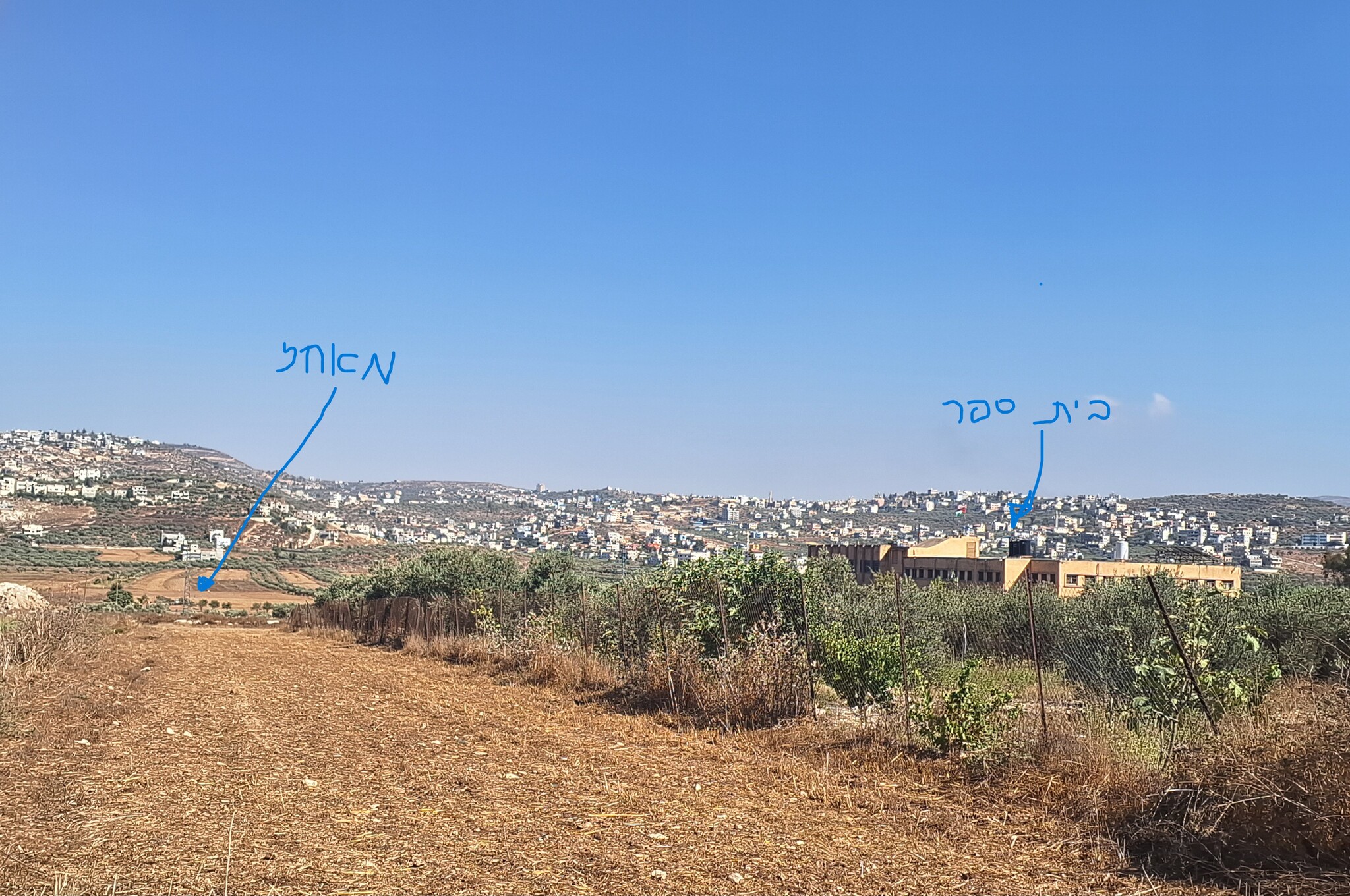 Ronit Dahan-RamatiAug-24-2026Huwara: The school on the outskirts of town and an outpost hidden among the trees
-
Za'tara (Tapuah)
See all reports for this place-
Za'tara (Tapuah) Za'tara is an internal checkpoint in the heart of the West Bank, at the intersection of Road 60 and Road 505 (Trans-Samaria), east of the Tapuah settlement. This checkpoint is the "border" marked by the IDF between the north and south of the West Bank, in accordance with the policy of separation between the two parts of the West Bank that has been in place since December 2005. At the Za'tara checkpoint, there are separate routes for Israelis and Palestinians. In the route for Israelis, there are no inspections and the route for Palestinians inspects. The queue lengthens and shortens suits. The checkpoint is open 24 hours a day. The checkpoint is partially staffed and the people who pass through it are checked at random.
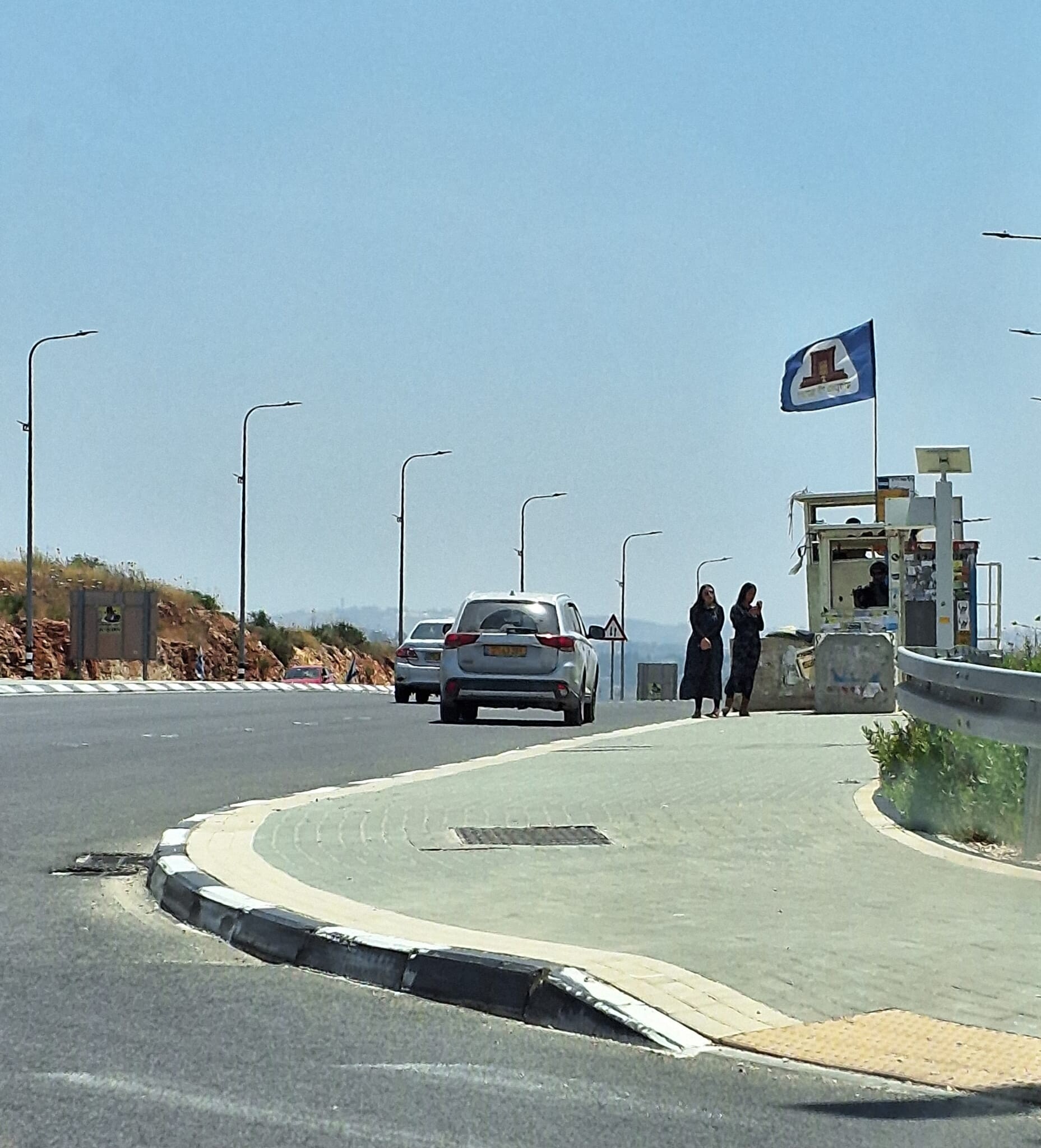 Ronit Dahan-RamatiJun-9-2026Za'atara (Tapuach Junction). The Temple Flag Above a Station
-
