
Beit Iba, Huwwara AM
Huwwara, Beit Iba, Monday 28 June AMObservers: Mickie S., Hagar K., Sivan T., Anat D. (reporting) colour = red> Beit Iba There was only very sparse traffic through the checkpoint (possibly because of mourning for the casualties caused by the latest Israeli army incursion into Nablus). Trucks proceeded slowly. There were 15 detainees who’d been waiting some four hours. The soldiers had changed shifts shortly before our arrival and the officer in charge said kindly that he’d deal with the matter. We took down the phone number of one of the detainees to verify the time of their release. There was no representative of the District Co-ordinating Office (DCO) [the army section that deals with civilian matters and usually has representatives at the checkpoints , ostensibly to alleviate the lot of the Palestinians] present when we were there, and R.. (the commander of the DCO in Nablus) was not available. We phoned seven different numbers to contact the office and finally managed to speak to the woman operations officer who claimed that she’d try to sort out the situation, but she didn’t sound very convincing. An hour after we left Beit Iba, the detainees were still there.Jit junctionA commando unit jeep was parked at the side of the road, and the soldiers were eating watermelon. There was no-one else there.Huwwara SouthWaiting time at the checkpoint was short and traffic flowed. There was no pressure of people seeking entry. During our stay there the number of detainees began to rise (to about 10). The detainees waited [for security clearance from the General Security Services (GSS)] around two-and-a-half hours. The soldiers and their superior, the commander of the checkpoint, ran things far more effectively than did the GSS – the commander phoned four times to the operations room in order to try to get answers about the detainees and even told them off for their inefficiency. The checkpoint soldiers took care to bring water for the detainees, although there was no water container at the site. They also behaved politely towards us.In contrast, the actual checking of those going through the checkpoint was carried out using two completely infuriating methods: The commander insisted on being spoken to in Hebrew only and did everything possible to make life difficult for those crossing through ; and then he subjected the Palestinians to a truly evil form of cross-questioning. Thus a music teacher, who holds a teacher’s diploma, was forced to pass an impromptu “test” on the history of classical music (who was Mozart and what are his important works?!). He let his ‘examinees’ pass in the end (he had no choice – they had the right papers), but only after abusing them shamefully. An ambulance was detained after it was discovered that one of its passengers (a 47-year-old heart surgeon, being brought to Nablus) was an Arab, and a German citizen, who only had his German passport with him. The ambulance continued on its way with the other members of the crew, but the doctor was released only after the intervention of A., from the DCO, who was at the northern checkpoint.There were two cases in which our pleas didn’t help: a Nablus resident and his son, a student at university in the Ukraine now home for the vacation, approached the checkpoint in order to enter Nablus. But in the son’s ID card, he was listed as living elsewhere (in Beituniya) and therefore was not allowed to pass. After discussions with the soldiers, the father entered Nablus, but the son had to retrace his footsteps to wherever he’d come from. An Israeli Arab woman, accompanied by her sister’s children (the sister had died only yesterday), asked permission to enter Nablus with the children so that she could bid farewell to their mother for the last time. They were all profoundly upset and the two girls, aged 15 and 16, wept without let-up. They were also carrying a lot of luggage which only added to their problems. Here again we had a vivid and awful example of the soldiers’ total lack of compassion and any sense of humanity – army orders came first and foremost, above all els . The woman returned to her home and the poor girls went back to Nablus without her.Huwwara NorthA short while after the soldier’s changed shifts, the woman soldier checking the women said she wanted to stop for a while. She sat down under one of the concrete blocks and did not look at all well. We offered her some water, she said that she was anaemic. When I got back to her after getting some sweetened drink for her she had fainted and didn’t respond when I tried to get her to drink or when we poured a bottle of cold water over her. The soldiers paid no attention to any of this, and ,when we asked that she be moved somewhere more shaded ,they were in no hurry to help, apparently believing she was simply putting on an act. Only after Mickie raised her voice, did the commander call a jeep to evacuate her. What would have happened had we not been there?Apart from this episode , which reduced the number of soldiers checking and slowed the pace at which the Palestinians went through, the soldiers were efficient and courteous. The detainees were released after two hours, and the polite DCO representative helped out in special cases (like that of the ambulance) or detainees at the checkpoint.A [ Jewish Israeli] settler who stopped at the checkpoint unloaded two bottles of ice-cold water for the soldiers and spat out in our direction: “They smell like Arab women”. We didn’t react.
Beit Iba
See all reports for this place-
A perimeter checkpoint west of the city of Nablus. Operated from 2001 to 2009 as one of the four permanent checkpoints closing on Nablus: Beit Furik and Awarta to the east and Hawara to the south. A pedestrian-only checkpoint, where MachsomWatch volunteers were present daily for several hours in the morning and afternoon to document the thousands of Palestinians waiting for hours in long queues with no shelter in the heat or rain, to leave the district city for anywhere else in the West Bank. From March 2009, as part of the easing of the Palestinian movement in the West Bank, it was abolished, without a trace, and without any adverse change in the security situation.
 Jun-4-2014Beit-Iba checkpoint 22.04.04
-
Huwwara
See all reports for this place-
The Huwwara checkpoint is an internal checkpoint south of the city of Nablus, at the intersection of Roads 60 and 5077 (between the settlements of Bracha and Itamar). This checkpoint was one of the four permanent checkpoints that closed on Nablus (Beit Furik and Awarta checkpoints to the east and the Beit Iba checkpoint to the west). It was a pedestrian-only barrier. As MachsomWatch volunteers, we watched therre since 2001 two shifts a day - morning and noon, the thousands of Palestinians leaving Nablus and waiting for hours in queues to reach anywhere else in the West Bank, from the other side of the checkpoint the destination could only be reached by public transport. In early June 2009, as part of the easing of Palestinian traffic in the West Bank, the checkpoint was opened to vehicular traffic. The passage was free, with occasional military presence in the guard tower. Also, there were vehicle inspections from time to time. Since the massacre on 7.10.2023, the checkpoint has been closed to Palestinians.
On February 26, 2023, about 400 settlers attacked the town's residents for 5 hours and set fire to property, such as houses and cars. Disturbances occurred in response to a shooting of two Jewish residents of Har Bracha by a Palestinian Terrorist. The soldiers stationed in the town did not prevent the arson and rescued Palestinian families from their homes only after they were set on fire. No one was punished and Finance Minister Smotrich stated that "the State of Israel should wipe out Hawara." Left and center organizations organized solidarity demonstrations and support actions for the residents of Hawara.Hawara continued to be in the headlines in all the months that followed: more pogroms by the settlers, attacks by Palestinians and a massive presence of the army in the town. It amounted to a de facto curfew of commerce and life in the center of the city. On October 5, 2023, MK Zvi established a Sukkah in the center of Hawara and hundreds of settlers backed the army blocked the main road and held prayers in the heart of the town all night and the next day. On Saturday, October 7, 23 The "Swords of Iron" war began with an attack by Hamas on settlements surrounding Gaza in the face of a poor presence of the IDF. Much criticism has been made of the withdrawal of military forces from the area surrounding Gaza and their placement in the West Bank, and in the Hawara and Samaria region in particular, as a shield for the settlers who were taking over and rioting.
On November 12, 2023, the first section of the Hawara bypass road intended for Israeli traffic only was opened. In this way, the settlers can bypass the road that goes through the center of Hawara, which is the main artery for traffic from the Nablus area to Ramallah and the south of the West Bank. For the construction of the road, the Civil Administration expropriated 406 dunams of private land belonging to Palestinians from the nearby villages. The settlers are not satisfied with this at the moment, and demand to also travel through Hawara itself in order to demonstrate presence and control.(updated November 2023)
.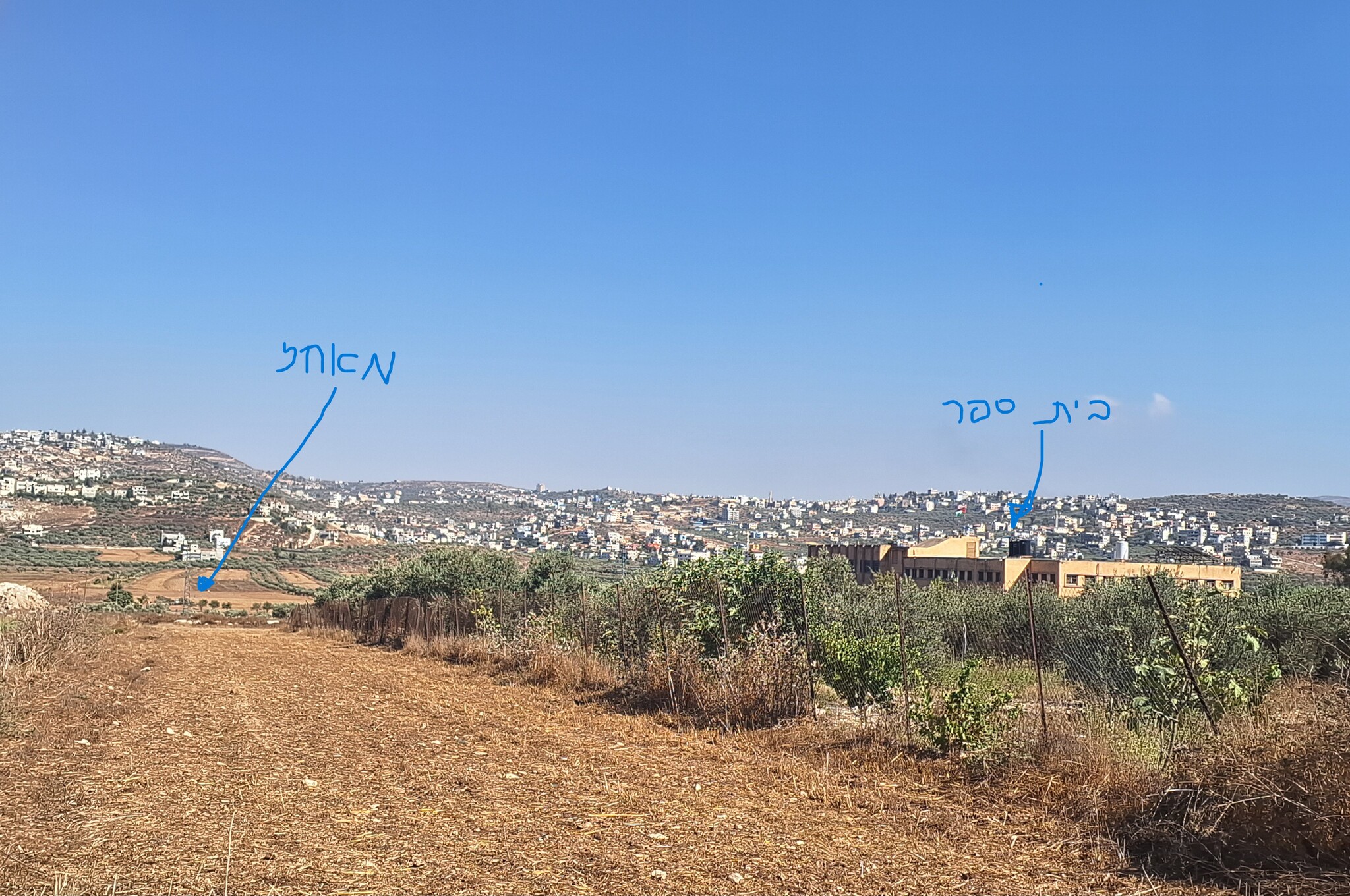 Ronit Dahan-RamatiAug-24-2026Huwara: The school on the outskirts of town and an outpost hidden among the trees
-
